As almost three-quarters of the Earth’s surface, the oceans are home to millions of species, from which only one in every ten have been scientifically recognized. Here is our top ten list of the most fascinating marine animals.
10- Sea Turtles
Sea Turtles, Credit; Wikimedia/Ashley Lee
Where they live: Sea turtles are found in almost every ocean worldwide, nesting on tropical and subtropical beaches.
Unique Marine Characteristics: Sea turtles are known for their long lifespans, estimated to be 50–100 years. These fascinating marine animals can migrate long distances to feed, able to cross entire oceans using unique navigational skills. They are one of the Earth’s most ancient creatures and have remained unchanged for 110 million years. These animals are essential for marine ecosystems, helping to maintain healthy seagrass beds and coral reefs.
Scientific Facts: Over the years, scientists have studied these fascinating marine animals , providing insights into their migration patterns and showing that they use the Earth’s magnetic fields to navigate the oceans. This magnetic imprinting guides them back to their nesting sites. Conservation efforts have also highlighted the critical impact of human activities on sea turtle populations, including habitat destruction and accidental capture in fishing gear. Scientists also state that climate change affects the sex ratio of hatchlings due to temperature-dependent sex determination.
9- Coral Reefs (as ecosystems, but home to countless fascinating species)
Unique Marine Characteristics: Coral reefs are complex and diverse marine ecosystems, being home to thousands of species. Although they cover less than 1% of the ocean floor, they support over 25% of all marine life. They live in warm, shallow, clear waters where sunlight can penetrate to support photosynthesis. Interestingly, corals are colonies of tiny living animals that secrete calcium carbonate to form a hard skeleton, a vital reef-building process.
Scientific Facts: Research on coral reefs has significantly contributed to understanding human activities’ impact on marine ecosystems. For example, coral reefs are susceptible to water temperature changes, leading to coral bleaching that threatens their survival. Furthermore, increases in carbon dioxide in the atmosphere cause threats to coral reefs. The absorption of this gas leads to an acidic ocean. Coral reefs need to produce calcium carbonate to grow, and ocean acidification can cause this compound to form slowly, thus slowing the growth of coral skeletons.
8- Blue Whales
Blue Whales, Credit; Wikimedia/National Marine Sanctuaries
Where they live: Blue whales are found in all oceans worldwide, predominantly in the North Atlantic, North Pacific, and Antarctic.
Unique Marine Characteristics: Blue whales are considered the largest animal alive, reaching lengths of up to 30 meters and weighing approximately 200 tons. Despite the size, blue whales feed almost exclusively on tiny krill, consuming up to 4 tons of krill a day. Their heart can weigh as much as a car, and scientists believe that their vocalizations are used to communicate and to sonar-navigate the lightless ocean depths. These marine animals travel to warmer tropical waters during winter to mate and give birth. Then, they swim to the colder waters of the Arctic or Antarctic in the summer, where food is abundant.
Scientific Facts:Advanced tagging technology has allowed scientists to track blue whales over thousands of miles, revealing their migration routes, breeding, and feeding areas. Studies have also focused on the impact of human activities on blue whales. For example, commercial whaling and noise pollution are two of the biggest threats to these fascinating marine animals.
Unique Marine Characteristics: These fascinating marine animals are known for their distinctive method of predation. Females of these creatures have a dorsal spine resembling a fishing pole above their mouths, attracting prey with a luminous lure. Their large mouths and flexible bodies enable them to swallow prey up to twice their size. Also, the female anglerfish is unique for its bizarre mating ritual, where the much smaller male permanently attaches itself to the female, eventually fusing to her body and sharing a circulatory system.
Scientific Facts: Some genetic studies are trying to understand the phenomenon of sexual parasitism. They found that joining genetically disparate male and female anglerfishes does not induce a strong immune rejection response, often observed in vertebrates if tissues from two individuals are grafted or connected. Recent studies showed that the evolutionary processes that led to this mating strategy coevolved with genetic changes that resulted in the loss of functional genes encoding immune system components. These genetic alterations enabled anglerfishes to tolerate their mate’s incompatible tissue antigens and prevent reciprocal graft rejection responses.
6- Manta Rays
Manta Rays, Credit; Wikimedia/Ken FUNAKOSHI
Where they live: Manta rays live in tropical, subtropical, and temperate waters worldwide, including the Pacific, Atlantic, and Indian Oceans. They are commonly found in open waters, near coral reefs, and along continental shelves.
Unique Marine Characteristics: Manta rays are known for their large size, with wingspans reaching up to 7 meters. They are filter feeders, consuming large quantities of plankton and small fish by swimming with their mouths open. Manta rays are also known for their acrobatic leaps out of the water, a behavior whose reason remains unclear.
Scientific Facts:Studies have shown that manta rays have a large brain relative to their body size. They may recognize themselves in the mirror, which supports the conclusion that they have high cognitive function. Additionally, scientists have shown that these marine animals can create mental maps of their environment using smell and visual cues, demonstrating highly developed long-term memory. Unfortunately, the International Union for Conservation of Nature classifies manta rays as vulnerable. Since they are long-living creatures with slow reproduction, localized populations have difficulty bouncing back when fished.
5- Dolphins
Dolphins, Credit; Wikimedia/Arnaud 25
Where they live: Dolphins are widely distributed in seas and oceans worldwide, from polar to tropical waters, including the Pacific, Atlantic, Indian Oceans, and the Mediterranean and Black Seas.
Unique Marine Characteristics: Dolphins are considered fascinating marine animals because of their intelligence, social structure, and complex behaviors, such as using tools, cooperative hunting techniques, and sophisticated communication methods. Dolphins also demonstrate playful behavior, often leaping out of the water and riding waves.
Scientific Facts: Studies have shown that dolphins have a high level of self-awareness, as demonstrated by mirror recognition tests. Interestingly, these marine animals also have a complex language-like communication system containing an extensive repertoire of acoustic signals. Conservation efforts focus on understanding human activities’ impact on dolphin populations, including pollution, fishing practices, and habitat destruction.
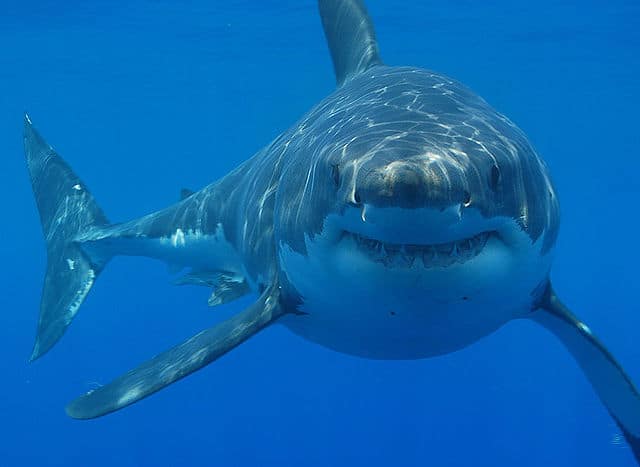
4- Great White Sharks
Great White Sharks, Credit; Wikimedia/Hermanus Backpackers
Where they live: Great white sharks are found in coastal waters worldwide, particularly near the United States, South Africa, Japan, Oceania, Chile, and in the Mediterranean Sea.
Unique Marine Characteristics: Great white sharks are known for their size, with mature individuals measuring up to 21 feet in length. They are apex predators, playing an essential role in marine ecosystems by helping regulate other marine animal populations. They can help remove weak and sick individuals and keep balance with competitors, helping to ensure species diversity. Great whites are capable of impressive bursts of speed and can leap out of the water when attacking prey from below.
Scientific Facts: Tagging and tracking research has revealed their long-distance migratory patterns, depth preferences, and hunting strategies. These marine animals can detect electrical fields produced by their prey and usually can react to charges of one-millionth of a volt in water. Conservation research has highlighted the vulnerability of great white sharks because of hunting for fins and teeth and as a trophy for sport fishing.
3- Seahorses
Seahorses, Credit; Wikimedia/Bae Jiwon (뽀그르)
Where they live: Seahorses are found in shallow tropical and temperate waters worldwide, particularly in seagrass beds, coral reefs, and mangroves. They are prevalent in the Atlantic, Pacific, and Indian Oceans.
Unique Marine Characteristics: Seahorses are fascinating marine animals mainly because of their upright posture, horse-like head, and prehensile tail. They are poor swimmers, relying on their dorsal fins for propulsion and their tails for anchoring to vegetation. These animals have a unique reproduction system with male pregnancy, since females deposit eggs into the male brood pouch where he then fertilizes the eggs. They form monogamous pairs and engage in elaborate courtship displays. Males open and fill their pouch with water by bending forward and contracting their bodies to force water into the pouch, before “dancing” with the female.
Scientific Insights: Studies have shown that climate change also affects this marine population. They are sensitive to habitat degradation, pollution, and overfishing, particularly for use in traditional medicine and the aquarium trade.
2- Jellyfish
Jellyfish, Credit; Wikimedia/Mtheletter
Where they live: Jellyfish are found in every ocean, from the surface to the deep sea. They are common in coastal zones worldwide.
Scientific Facts: Jellyfish have been studied for their unique cellular structures and processes, such as their efficient propulsion system and the neurotoxins produced by some species. For example, the Box Jellyfish is considered the world’s most venomous marine animal. Its tentacles can inject venom capable of causing heart failure, severe pain, and death within minutes.
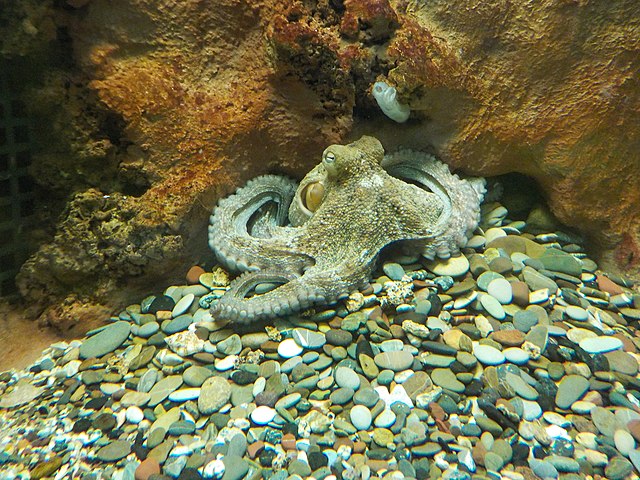
1- Octopuses
Octopuses, Credit; Wikimedia/Albarubescens
Where they live: Octopuses inhabit a wide range of marine environments, from tropical coral reefs to the deep sea, and are found in all the world’s oceans.
Unique Marine Characteristics: Octopuses are known for their high intelligence and ability to solve complex problems, use tools, and escape from enclosures. They have a remarkable capacity for camouflage, changing color and texture to match their surroundings, becoming virtually invisible. These marine animals exhibit fascinating behaviors, such as jet propulsion for fast movement and the use of ink to deter predators.
Scientific Facts: Studies have shown that octopuses can regenerate limbs and other body parts, including the central and peripheral nervous system. Researchers have also described octopuses adapting to seasonal temperature shifts by producing neural proteins under warm versus cool conditions. That is, they can modify their RNA sequence to protect their brains from drastic temperature changes.
Copyright @smorescience. All rights reserved. Do not copy, cite, publish, or distribute this content without permission.
Join 20,000+ parents and educators
To get the FREE science newsletter in your inbox!
SUBSCRIBE TO OUR NEWSLETTER
.......... ..........
Subscribe to our mailing list to get updates to your email inbox.