You have probably been warned by your parents to not be mean. For a human who can get most things needed to live our daily life with relative ease, being mean does make you look bad. However, you cannot judge mean animals in the wild. Good luck catching prey after a wild chase, only to find another animal lurking around to snatch your food. Or, you can be the food someday. Maybe you need to fight like crazy to set up your territory. The roots of meanness are embedded in the very motto of living in the wild– survival.
Survival: The root of 'meanness'
A key to deciphering the notion of ‘meanness’ in animals lies in understanding its root – survival. It encompasses several distinct but related traits, namely aggressiveness, predation, and territorial defense.
Aggressiveness
The offense is the best defense, and life in jungles echoes this virtue. Have you ever seen a wild buffalo give in to a lion attack? Or a honey badger being picked on by larger animals like leopards or a pack of lions. Or even in the urban setting– a cat attacked by a group of dogs. They never give in. They meet their attackers with counters, to fight back and take control over the hostile situation, something we refer to as aggressiveness. This behavioral trait plays an integral role in safeguarding an animal’s kin and food resources.
Predation
Predation, another facet of ‘meanness’, represents an animal’s relentless pursuit and capture of its prey. Certain animals exhibit ruthless hunting tactics, often demonstrating ‘meanness’ in their approach. Not a reflection of their moral compass, but an act born out of the primal necessity for sustenance .
Territorial defense
Lastly, territorial defense sheds light on an animal’s tendency to guard its space no matter what. Animals assert their dominance and protect their homes from invaders, another form of ‘meanness’ that is essential for their survival.
Spotlight on notoriously 'mean' animals
Venturing beyond the abstract, let’s illuminate some notoriously ‘mean’ representatives of the animal kingdom.
Tasmanian Devil
Firstly, the Tasmanian Devil, is an animal synonymous with fierceness. This marsupial , though small, is known for its mean nature and powerful jaw, which it doesn’t hesitate to employ when threatened or during communal feeding .
Tasmanian Devil, Credit: Wikimedia/Wayne McLean
Africanized Honey Bee
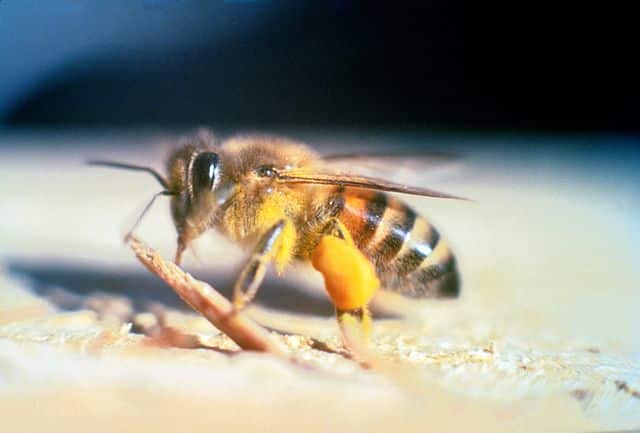
The Africanized Honey Bee, colloquially known as the ‘Killer Bee’, earns its mean reputation through its highly defensive nature. Triggered with ease, these bees swarm and sting their perceived threats, a trait that unfortunately often puts humans at risk.
Africanized Honey Bee, Credit: Wikimedia/Jeffrey W. Lotz, Florida Department of Agriculture and Consumer Services, Bugwood.org
Cape Buffalo
Lastly, we have the Cape Buffalo, often considered the most dangerous animal in Africa. They are infamous for their unpredictability and will not hesitate to charge if they perceive a threat, showcasing their ‘mean’ side.
Cape Buffalo, Credit: Wikimedia/Ikiwaner
'Meanness': An evolutionary advantage
The portrayal of ‘meanness’ isn’t proof of the brute nature of these creatures. Rather, it’s a testament to their survival strategies, which have been honed over millions of years of evolution. This ‘meanness’ often contributes to these species’ success, assisting them in combating threats, securing food, and safeguarding their habitats.
Concluding thoughts: Interpreting 'meanness'
In the grand theatre of the animal kingdom, ‘meanness’ plays an indispensable part. It’s a survival tactic, a means to ensure the continuation of a species. Remember, when you hear tales of the ‘meanest’ animal, it’s not a villain arc, but the plot of a tragic hero’s story of survival, born out of the will to live on. Wouldn’t we fight back when we are cornered? Imagine wild animals facing the question of “Will I live to see the next day?”, every day. It’s a testament to the intricate and complex web of relationships that constitutes the world of animals, contributing to the delicate balance that maintains life on Earth.
Glossary
Marsupial: A class of mammals that carry their young in a pouch. Kangaroos and koalas are well-known marsupials.
Communal feeding: A term referring to the act of multiple animals feeding together.
Colloquially: About informal speech or casual conversation.
Swarming: The act of moving somewhere in large numbers, typically used to refer to insects like bees.
Hone: To refine or perfect something over some time. In this context, it refers to the process of evolution improving a species’ survival strategies.
Sustenance: Food and drink regarded as a source of strength; nourishment.