Time is the currency of the universe. The time we spend seldom comes back to us. All our lives, we try to save time, or gain time on something— be it a due assignment, or some other deadline-based work. Just like every currency has coins of different values, there are countless terms and phrases we use to describe a certain amount of time. One of the most interesting, and perhaps most playful, is ‘jiffy.’ This term has woven itself into our everyday language, but do you know what it really means? How long is a ‘jiffy’? Let’s explore together.
The origin of 'jiffy'
The term ‘jiffy’ may sound cool and casual to some, but its origins are deeply rooted in history. Theories suggest that it was derived from an old term ‘jiff,’ signifying a ‘lightning flash.’
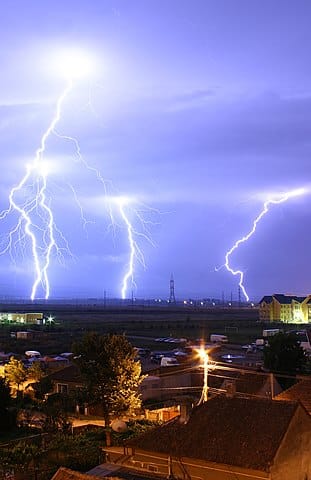
Lightning, Credit: Wikimedia/Mircea Madau
'Jiffy' in different fields
Since the word comes from comparison with the flash of lightning, let’s consider how quick a lightning flash is. As the clouds form, they develop static charges between themselves and with the ground. The air acts as an insulator, which prevents electric discharge immediately. However, when sufficient charges build up, the air can no longer insulate well enough. The result is a bright flash of electric discharge, that we call lightning.
A lightning strike in itself is 0.52 seconds long, with smaller strokes lasting for 60 to 70 microseconds also present. As you would see, a jiffy in the technical world is quite different.
In the realm of computing and electronics, a ‘jiffy’ is not just a fun term, but a defined unit of time. Here, it signifies the duration of one tick of the system timer interrupt , typically around 10 milliseconds. It may seem like a minuscule amount of time to us, but in the fast-paced world of electronics, it’s ample time for a computer to execute multiple operations.
In physics and chemistry, the term ‘jiffy’ is elevated to an even more precise level. In these fields, a ‘jiffy’ is defined as the time it takes for light to travel one fermi , approximately the size of a nucleon , in a vacuum. This translates to a duration incredibly brief even by scientific standards – approximately 3 x 10^-23 seconds.
How long is a 'jiffy'?
So, to the question at hand, how long is a ‘jiffy’? As we’ve explored, the answer depends on the context. In everyday conversation, a ‘jiffy’ may be a couple of seconds or even less. It’s often used when referring to a very short, quick amount of time. For instance, if a friend tells you they’ll be ready in a ‘jiffy,’ they’re implying they won’t take long.
However, in scientific contexts, a ‘jiffy’ can be significantly shorter than a second. Whether it signifies the brief moment of an eye blink or the time it takes for light to traverse a fermi, the essence of a ‘jiffy’ is all about rapidity and swiftness.
Conclusion
The fancy terms of science might not make much sense in a normal person’s language. Terms like ‘jiffy’ enable us to express and grapple the smallest fractions of time, without being fancy. Regardless of whether you’re a scientist calculating the speed of light or a child waiting for a friend, a ‘jiffy’ our perception of time is diverse.
Glossary
Tick: In the context of computing, a tick is a recognized and regular interval at which a computer’s timer interrupt occurs.
System Timer Interrupt: This is a kind of interrupt in computer architecture that deals with timing activities. It can be a countdown, an elapsed time counter, or a time-of-day clock.
Fermi: A fermi is a unit of length used in nuclear physics, named after Enrico Fermi. It is equivalent to 1 femtometer (1 x 10^-15 meters) and is approximately the size of a nucleon.
Nucleon: A nucleon is a collective term for two types of particles found in an atomic nucleus, namely protons and neutrons.