In the early 1900s, as Western colonizers were exploring the region of Komodo, they thought they had found real dragons! This is part of the reason they’re most commonly called “Komodo dragons”, even today.
Komodo dragons are the largest living species of lizard, growing up to mammoth sizes of 110 feet (3.3 meters long) and up to 300 pounds (136 kgs). To put that into perspective, two people stacked together would be between 10 and 12 feet long, and about that weight.
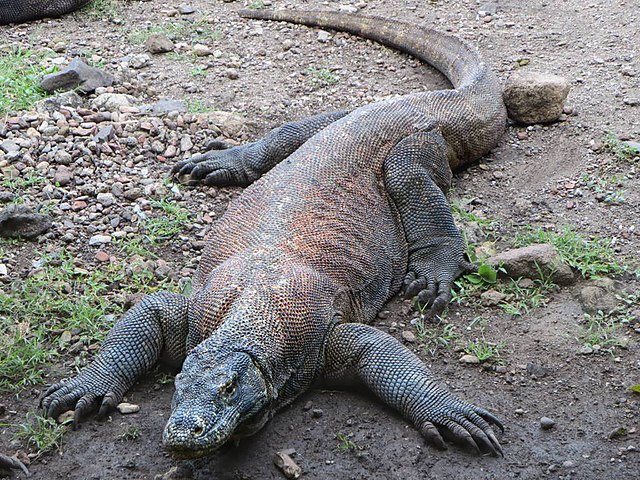
The Komodo dragon in its natural habitat on Komodo island, Credit: Wikimedia/David Stanley
Komodos live on only a handful of Indonesian islands, including Komodo, Rinca, Flores, and Gili Motang. Hunting and poaching, and this tiny range, means that Komodos are endangered.
Komodo dragons are truly deadly predators. They use a combination of stealth, speed, brute strength, and even venom to take down prey as large as water buffalo and deer. On land, they can briefly attain speeds of 12 miles per hour (20 kilometers per hour), which is truly incredible for a 300 pound animal. When they can’t find fresh meat, Komodos will consume carrion. Their keen sense of smell can help them find carcasses miles away. Another attribute that makes them such fearsome predators are their special teeth.
How do their teeth work?
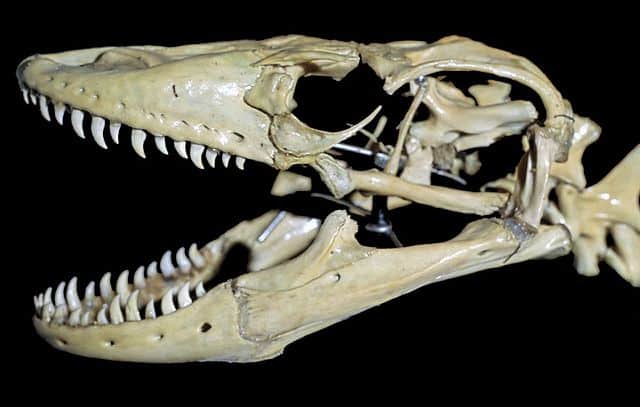
Komodo dragon teeth possess some unique features. The teeth are curved and blade like, which allow them to “puncture” prey more effectively. In other words, they’re able to bite hard and deep, which makes it less likely for their prey to escape. In addition to this, the teeth are also serrated. The serrations, or small tooth-like notches along the edges of the teeth, act like a series of tiny knives that slice through tough tissues, such as skin, muscle, and tendons, with greater ease than smooth-edged teeth. This makes their teeth more efficient at cutting. Serrations also help create multiple points of contact, increasing their grip by creating more friction. This is especially important for large predators, like Komodo dragons, which need to quickly and efficiently overpower large and potentially dangerous prey.
The teeth of the Komodo dragon are blade like and curved, Credit: Wikimedia/Danadi Sutjianto
Scientists have now discovered that iron helps Komodos maintain their special teeth. They noted that the teeth tips and serrations were orange tinged. Rust colored orange is usually an indicator that there may be iron deposits. When comparing komodo teeth with other closely related lizards, they found that almost all monitor lizards have these special, iron capped teeth.
What’s even more incredible is that these lizards are sequestering iron into their teeth themselves. It’s similar to how humans can eat iron compounds and make hemoglobin for red blood cells. Iron from the food that komodos are eating is being metabolized, and converted into enamel friendly pigments. Sequestering iron seems to be unique to monitor lizards – no other reptile, bird or mammal is able to create the iron for their capped teeth.
Researchers found that the iron tipped regions seemed to be harder than the other parts of the teeth. This may allow the serrations and teeth tips to be even more effective at biting and cutting than previously thought. Regions with iron on them also showed less wear and tear than other parts of the tooth, suggesting that the iron coating may help protect against degradation. The iron layer is also acid resistant – unlike human teeth, which form cavities over time. Replacing teeth is an expensive and difficult process that most animals can’t do. Komodos may be taking a “prevention is better than a cure” approach, trying to minimize the number of teeth they lose over the years. It’s particularly vital as komodos are long lived, often reaching ages of thirty years!
Although scientists are still trying to pinpoint exactly why this feature is so important, it’s clear that they help komodos cement their place as fearsome predators.
How can this help us understand dinosaurs?
Lizards and dinosaurs descended from the same evolutionary lineage of reptiles. Although crocodiles and birds are closer to dinosaurs then reptiles, they still shared a common ancestor. They both retain certain primitive qualities from these ancestors.
In addition to genetics, Komodos and dinosaurs share behavioral and physical characteristics. Both groups are territorial and carnivorous, and teeth play a huge role in carnivory. Komodos are also the largest extant lizards, and likely take down prey similar to ones dinosaurs used to.
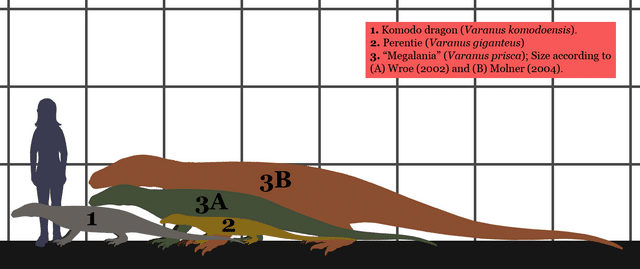
The size of a human, komodo dragon (1), another monitor lizard (2), and different extinct reptiles (3A, 3B), Credit: Wikimedia/Conty
Komodos and dinosaurs also seem to share the same type of serrated, curved and blade shaped teeth. It’s difficult for researchers to identify the chemical makeup of fossil teeth – compounds like iron oxides don’t stick around for millions of years. Nonetheless, commonalities in structure and function means that understanding komodos can help us understand their ancient, extinct cousins.
FAQ
Can female komodos reproduce independently?
Female komodos take part in an extraordinary process known as parthenogenesis. Zoo females in captivity for many years can still produce viable eggs, which are genetically similar to the mother lizards.
Do komodo dragons kill humans?
Human fatalities are rare. Humans are not the preferred prey of Komodo dragons. However, there are occasional conflicts.