Table of Contents
What is Venus like?
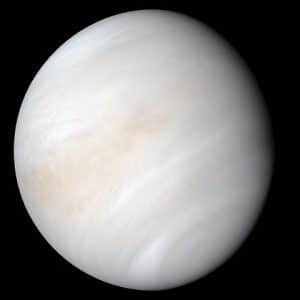
Venus is the second closest planet to the Sun. It is also known as “Earth’s twin” because it is relatively similar. Even though Venus is a bit smaller than Earth, the atmosphere there is complete with clouds too, and has a similar structure to our planet.
However, despite its similarities, unlike Earth, Venus is uninhabitable for humans. Venus is an extremely hot planet, even hotter than an oven or a bonfire. The surface temperatures on Venus is 470oC (880oF) which is hot enough to melt lead or cook a pizza in seconds. And it has an atmospheric pressure that is 90 times greater than on Earth. This would be like us walking around half a mile underwater. Venus also has very strong winds, reaching 450 mph. By comparison on Earth, the strongest tornado winds are around 300 mph.
Its clouds are comprised of toxic sulphuric acid, and it has a high concentration of carbon dioxide. Because Venus is so hot and is one of the closest planets to us, it can often be seen in the night sky. Its layer of clouds reflects more light than other planets so, with the exception of the Sun and the Moon, the brightest thing in the sky is often Venus.
Venus is the slowest rotating planet. A single rotation, or day, on Venus takes the equivalent of 243 days on Earth. Interestingly, however, a year on Venus is shorter than its day. It takes Venus just 224 Earth days to complete its orbit of the Sun.

How far away is Venus from Earth?
Because Earth and Venus follow elliptical orbits of the Sun, their distance from each other changes regularly. At their farthest apart, they are about 162 million miles away from each other. But every 584 days, they move closer together and are approximately 24 million miles apart. Venus is also 67 million miles away from the Sun.
How long would it take to travel to Venus?
If we were to take a trip to Venus, it would take us roughly four months to travel from Earth to Venus.
In the 1960s, NASA and the Soviet Union both sent spacecraft to Venus to analyze and study the planet. None of them landed on the surface of Venus, but instead recorded data as they flew by. They managed to measure the temperature, atmospheric gases, and density.
It wasn’t until 1970 that the first spacecraft landed on Venus. This was the Soviet Union’s Venera 7 and, despite a difficult landing, it managed to take measurements and transmit a signal for 23 minutes before it was destroyed the inhospitable environment.
Since then, there have been over 40 missions to Venus. Some have landed and some have just flown by. Each mission has provided valuable information about one of our closest planetary neighbors.

Could Venus support life?
Scientists believe that microbial life might be found in Venus’ clouds. These clouds are still hot, but bearable at 60oC (140oF), and have an atmospheric pressure similar to Earth.
It is thought that hundreds of millions of years ago Venus may have contained water and harbored life. It wasn’t until 700 million years ago that carbon dioxide took over the planet and led to a substantial greenhouse effect which increased its temperature dramatically.
Check out this video summarizing Venus
Flesch Kincaid Grade Level: 6.9
Flesch Kincaid Reading Ease: 67.5
Glossary
atmospheric pressure: the pressure created by the weight of the atmosphere.
elliptical orbits: oval-shaped pathways that planets follow when circling around the sun.
greenhouse effect: the trapping of heat from the sun on a planet’s surface.
References
CBBC (2011) https://www.bbc.co.uk/newsround/14143063 Accessed on April 6th 2023
Space.com (2012) How far away is Venus https://www.space.com/18529-distance-to-venus.html Accessed on April 6th 2023
Tornado Extreme https://www.tornadoxtreme.com/how-far-do-tornadoes-travel/ Accessed on April 6th 2023
NASA (2023) Venus Fact Sheet. https://nssdc.gsfc.nasa.gov/planetary/factsheet/venusfact.html Accessed on April 6th 2023
Space.com (2022) Planet Venus: 20 interesting facts about the scorching world. https://www.space.com/15988-venus-planet-weird-facts.html Accessed on April 7th 2023
Contributors
Copyright @smorescience. All rights reserved. Do not copy, cite, publish, or distribute this content without permission.
SUBSCRIBE TO OUR NEWSLETTER
.......... ..........Subscribe to our mailing list to get updates to your email inbox.
Monthly Newsletter