How Long Does It Take To Get To Jupiter?

Table of Contents

What is Jupiter like?

Jupiter is known as a “gas giant” as it is made up largely of hydrogen and helium. It is the largest planet in our solar system and would be able to fit 1,300 Earths inside it.


Like its neighbor Saturn, Jupiter also has a ring system. However, these rings are not as visible as the rings of Saturn.


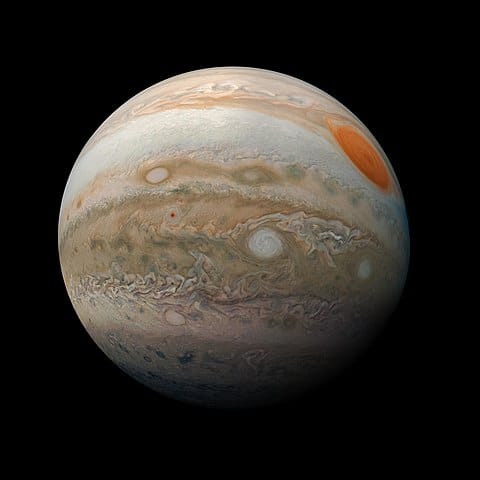
When we look at Jupiter, we can see different colors on its surface. These form bands or stripes which are created from the strong, swirling winds that can reach up to 400 miles per hour. Jupiter is known for its giant red spot. This mark on its surface is actually a storm that has been raging in Jupiter’s southern hemisphere for more than 300 years. The massive storm, which has winds of 250 mph, is bigger than the width of Earth.

The colorful planet, Jupiter, with its red spot clearly visible. Photo from
The colorful planet, Jupiter, with its red spot clearly visible, Credit: Wikimedia/NASA

Jupiter has many moons with 4 main ones and up to 60 others. Its largest moon is called Ganymede and is bigger than the planet Mercury.


One day on Jupiter lasts 10 hours, as it is the fastest rotating planet in our solar system. But it takes 12 Earth years for Jupiter to orbit the Sun. So, one year on Jupiter is the equivalent of 12 here on Earth.

How far away is Jupiter from Earth?

Like Earth, Jupiter travels in an elliptical orbit  around the Sun. This means that its distance from Earth varies depending on its location along its orbital path. At its furthest point from Earth, Jupiter is 601 million miles away. At its closest, it is 365 million miles away. 

saturn

How long would it take to travel to Jupiter?

Various spacecraft have flown to Jupiter. The routes they have taken vary enormously and therefore, so too does the time taken to reach Jupiter.


Our first visit to the gas giant was in 1973. A NASA-launched space probe named Pioneer 10 took the first close-up pictures of the planet. Since then, there have been several flyby missions as well as others which have entered Jupiter’s orbit.


New Horizons space probe, which was launched to investigate Pluto, flew by Jupiter on its journey, reaching the gas giant in 13 months. Other space missions, whose destination has been solely Jupiter, have made it to the planet’s orbit in just under 2 years or as long as 6 years.


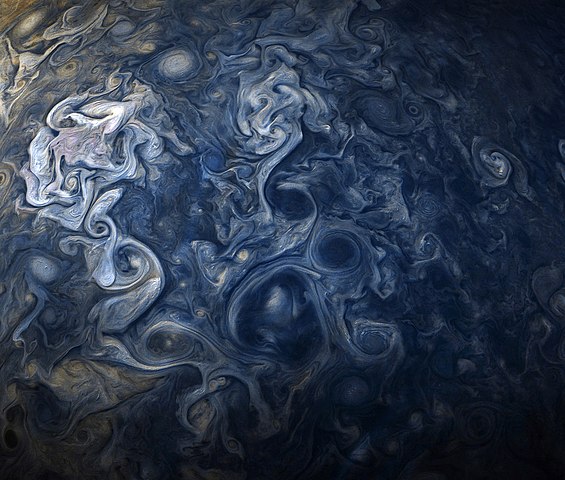
A space probe called Juno was launched in 2011 and has been orbiting the planet since 2016. It feeds back valuable information about the planet. It has been able to measure the formation and composition of Jupiter

A color-enhanced photo of Jupiter’s cloud system taken by spacecraft Juno, Credit: Wikimedia/NASA

Could Jupiter support life?

With its atmosphere mostly made up of hydrogen and helium, it is unlikely Jupiter could support life. There is no solid structure on the planet and the temperatures are extreme, reaching lows of −110oC (−166.6oF). Some of Jupiter’s moons may be more conducive to life with suspected oceans of ice or water hidden below their surface.


Check out this video showing what you would see if you fell into Jupiter.

Flesch Kincaid Grade Level: 7.5


Flesch Kincaid Reading Ease: 66

Glossary

elliptical orbit: an oval-shaped pathway planets follow when circling around the Sun.

CBBC (2011) Jupiter – facts about planets in the solar system https://www.bbc.co.uk/newsround/14143066  Accessed on April 7th 2023


NASA (1997) Jupiter’s Great Red Spot https://www.jpl.nasa.gov/images/pia00296-jupiters-great-red-spot Accessed on April 7th 2023


Journal of Cosmology (2022) How Far Is Jupiter? And How Long To Travel There https://journalofcosmology.com/how-far-is-jupiter/#google_vignette Accessed on April 7th 2023


NASA (2023) Juno Mission https://www.space.com/topics/juno-mission Accessed on April 7th 2023


Universe Today (2023) Is there water on Jupiter https://www.universetoday.com/15148/is-there-water-on-jupiter/ Accessed on April 7th 2023
Contributors

Copyright @smorescience. All rights reserved. Do not copy, cite, publish, or distribute this content without permission.


Join 20,000+ parents and educators
To get the FREE science newsletter in your inbox!