Nuclear energy sounds mysterious, doesn’t it? Learn how a common reaction powers our daily lives
The very first fuel source was firewood, keeping humans warm in the winter and helping us cook. From firewood, we began to use coal and other fossil fuels. Although nuclear energy is many centuries younger, having been used in the U.S. for only about 60 years, it is no less important! Around 20% of the electricity produced in the United States is nuclear energy, which means it comes from a nuclear reactor.
What is an atom?
Atomsare the fundamental units that make up everything that we see in the world! If you could break the world down an infinite number of times, you would end up with smaller and smaller pieces. Eventually, the piece would develop a negative or positive charge if you tried to divide it anymore. The smallest piece you can make without a charge is known as the atom.
Atoms are key to making nuclear reactions work. They’re not quite the hero of the story—more like the landlord to the hero. Within the atom, there are two main spaces. Concentrated in the middle of the atom, and highly dense, is the nucleus. Arranged in rings around the nucleus are orbits or shells where electrons reside. Imagine something similar to our solar system, with the Sun representing the nucleus and electrons playing the part of the planets. Electrons are negatively charged and have minimal mass.
The nucleus is made up of two different types of particles: the proton and the neutron. Protons are positively charged and have a significant mass, almost like the opposite of an electron. Neutrons do have mass, but they have no charge. They are neutral. Neutron, neutral, nucleus, nuclear! All these words are similar since they describe processes, particles, and phenomena which are dependent on each other.
The structure of the atom Credit: Wikimedia/CNX OpenStax
What is fission?
The atom is a delicate structure. In order for the charge to be neutral, it needs to have exactly as many protons as electrons. Protons and neutrons have enough mass to maintain an orbit of electrons around the nucleus. If the balance of either protons, neutrons, or electrons is skewed, the atom falls apart. The number of protons that an elementhas is a defining property. If two atoms have a different number of protons, they have to be different elements. By contrast, the rules around neutrons aren’t so strict. Two atoms with the same number of protons but a different number of neutrons are still the same element, and are known as isotopes.
One common isotope is Carbon-14. The number 14 here represents the total number of protons and neutrons in the nucleus of the atom, which is called the mass number. Most carbon is Carbon-12, but Carbon-14 is very useful for Both forms of carbon have 6 protons, but Carbon-14 has two extra neutrons. In nuclear reactors, Uranium-235 and Uranium-238 are most commonly used. Both forms of Uranium have 92 protons, but Uranium-238 has three extra neutrons. Atoms with a very unequal number of protons and neutrons tend to be unstable, making them more likely to break down.
A piece of uranium ore, known as pitchblende. This is the most common Uranium ore Credit: Wikimedia
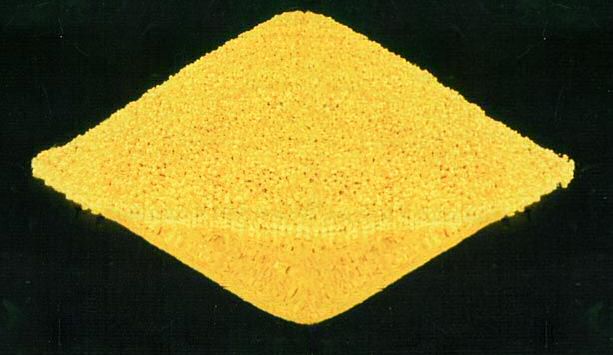
Uranium oxide, commonly known as “Yellowcake.” Credit: Wikimedia
Fissiondescribes the process by which a nucleus breaks down. When an atom is unstable, it tries to reach stability by ejecting protons or neutrons. Since protons and neutrons are held very tightly together in the dense nucleus, suddenly removing one releases a huge burst of energy!
When a nucleus breaks down, all the protons, neutrons, and electrons have to go somewhere. The protons and neutrons regroup to form nuclei of smaller atoms, forming two or more elements. Extra nuclei are released. Fission is a balanced process, so the total number of particles before and after fission have to be the same. The smaller atoms will add up to have the same number of protons as the atom which broke down.
What is a nuclear reactor?
A nuclear reactor is meant to synchronize the breakdown of many nuclei to produce even more energy. Although fission occurs naturally, it is a much slower process than induced fission. Fission can be induced by bombarding already unstable nuclei with neutrons. As the atoms absorb new neutrons, the imbalance in protons and neutrons grows greater and greater, speeding up the breakdown.
The most common nuclear reactors use Uranium-235. Rods of boron produce a surplus of neutrons which bombard the uranium atoms. As the imbalance grows, uranium breaks down to form smaller atoms of different elements. It is a cascade reaction: neutrons released when one atom of uranium breaks down will hit other uranium atoms, causing them to break down in turn, thus continuing the cycle.
Fission of Uranium-235, forming the smaller atoms of Krypton (Kr) and Barium (Ba), along with three neutrons. Credit: Wikimedia/MikeRun
Nuclear reactors are just a place where fission happens!
How does a nuclear power plant work?
When you picture a nuclear power plant, you probably imagine tall, billowing chimneys. These chimneys release nothing but steam, and deep within the chimney lies the nuclear reactor. When fission happens, the energy dissipates unless it is put to use. The easiest way to generate electricity from energy is a turbine, used in thermal power plants.
A turbine from a thermal power plant. Credit: Wikimedia/Qurren (talk)
Energy from fission is used to heat water, which turns to steam. The steam rises above the reactor, spinning a turbine. The spinning of the turbine is then converted to electricity.
Although nuclear reactors seem complicated, there is only one reaction at the heart of it. Fission is the key to nuclear power, and everything around the reaction is just there to make fission useful!
Glossary
Atom: The smallest unit which can be divided without the release of electrically charged particles Boron: A chemical element with 5 protons Electron: A negatively charged component of an atom with negligible mass Element: A primary constituent of matter Fission: The breakdown of nucleus Isotope: A form of an element with an identical number of protons but a different number of electrons Mass number: the total of protons and neutrons in the nucleus of an atom; it denotes the atomic weight Neutron: A component of an atom, present in the nucleus, with no charge Proton: A component of an atom, present in the nucleus, with a positive charge Turbine: A machine that transforms energy from rotation into energy that can be used for other purposes
Yamini's (he/they) interests lie in environmental education, science communication and trying to build a better world. When not languishing in front of his laptop, they can be found outside, poking at any insect, bird or plant. They love making science accessible, especially to those who aren't encouraged to pursue it. Yamini hopes that the young women who read Smore love learning from their articles and get just a little bit more excited about science!