We have evolved to eat food that contains salt. Ironically, salt enhances the sweetness of some foods and keeps a check on bitterness. However, many myths have stemmed out due to the regular use of salt in cooking. A common notion is that salt water boils faster. Although practiced by chefs worldwide, does salt water boil faster?
Salt water heats up faster than regular water for the same volume of water. Still, it hardly makes any difference because adding palatable amounts of salt increases the boiling point of water.
The boiling point of salt water
The boiling point of a liquid is the temperature at which a liquid starts to convert into a gas. The boiling point of water is 100°C or 212°F. When we add salt to the water, the boiling point increases, while another factor, the specific heat capacity, decreases. Specific heat capacity is the amount of heat energy required to raise the temperature of water (or any other substance) by 1°C. In easier terms, the temperature of a liquid with a lower specific heat capacity rises faster. Hence, salt water heats up faster than regular water.
That should put an end to the debate, right? No, there’s another factor we need to consider: the increased boiling point. Salt water boils at 102°C or 215.6°F. The higher boiling point counters the ease of heating salt water.
Why does salt increase the boiling point?
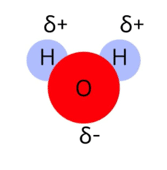
Chemically, salt is sodium chloride (NaCl). It has a positive sodium ion (Na+) and a negative chloride ion (Cl–). On the other hand, water has a small positive charge on the hydrogen (H) atoms and a small negative charge on the oxygen (O) atom.
Structure of water. Note how the individual atoms have charges of their own
Once the salt is added to water, the negative and positive charges on the water molecule start to pull the ionic bond (bond formed between oppositely charged ions) between the sodium and chloride ions apart. Then, the water molecules surround the salt ions. Sodium ions orient themselves with negative oxygen atoms, while chloride ions orient themselves with positive hydrogen atoms through ion-dipole interactions. These interactions hold the water molecules tightly in the liquid state, so more energy is needed to free the water molecules into the vapor phase, thereby increasing the boiling point. Adding baking soda or sugar will also result in the same rise in boiling point.
Water molecules surround the individual sodium and chloride ions
However, these factors hold only when the volume of water is the same. If the volumes are different — that is, one pot has more salt and less water, the story changes altogether. For example, let’s take two pots, pot A with 100g (3.5 oz) of water and pot B with 80g (2.8 oz) of water and 20 g (0.7 oz) of salt. Pot B will heat up 25 times faster than pot A, as written online by Mike Dammann, the manager of the Inorganics Section at The Southwest Research Institute in San Antonio, Texas. However, such high amounts of salt are not palatable.
Does salt water cook pasta faster?
Many chefs recommend salting pasta water like the sea. Salt gives a basic flavor and prevents the swelling of starch granules in pasta when brought into contact with hot water. As a result, the pasta cooked is al dente (cooked in a way that makes it firmer).
Salt is added to boiling pasta water to add a base of salty taste to it, Credit: depositphotos.com/resnick_joshua1
However, the common belief that salt water cooks pasta faster is more fiction than fact. As salt increases the boiling point of water, it helps cook pasta faster. How fast? A few seconds at most. The reason why salt is added to boiling water is simply that salt dissolves faster in it. Since pasta dough traditionally has no salt added, the only way to add salt as a base is while cooking it in a pot of boiling water.
Conclusion
To boil it down (no pun intended), salt doesn’t do enough to boil water faster. The difference in speed is not practical enough. However, salt adds a basic flavor, leading to better dishes.
Copyright @smorescience. All rights reserved. Do not copy, cite, publish, or distribute this content without permission.
Join 20,000+ parents and educators
To get the FREE science newsletter in your inbox!
SUBSCRIBE TO OUR NEWSLETTER
.......... ..........
Subscribe to our mailing list to get updates to your email inbox.