We use three-dimensional structures every day, and even simple ones, like ballpoint pens, have dozens of parts. Metal and plastic parts are often made using molds . Metal or plastic is heated until it melts, and poured into a mold. As it cools and hardens, it takes the shape of the mold. Other parts are carved out. Large blocks of material are cut into smaller parts using lasers or knives. Molded or carved, these small parts each need to be made individually before they’re put together into the three-dimensional structures we use. It’s not the simplest process.
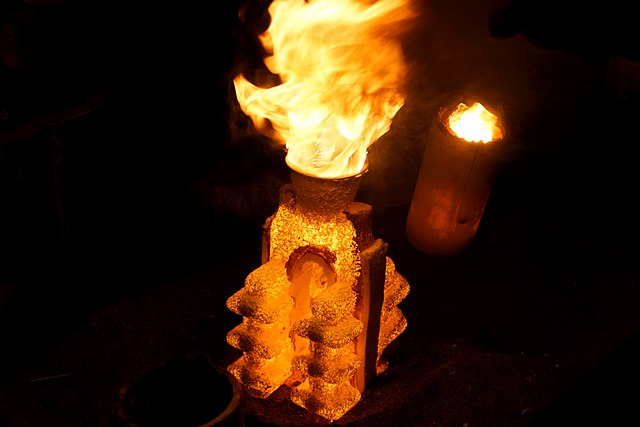
Molten metal being poured into a mold to create an instrument, Credit: Wikimedia/5oclockhustle
In 1971, Johannes F. Gottwald thought there had to be a better way. Inkjet printers, similar to the ones we use in our homes, already existed. Gottwald repurposed the inkjets which printed on paper, and adapted them to use molten metal!
The first 3D printer that used plastics was manufactured in Japan in 1980, but this prototype model did not experience much popularity. In 1988, the first plastic extruder printer came into being. This was the blueprint for the modern 3D printers we use today. Owning a 3D printer in the 1980s cost more than $300,000!
How does 3D printing work?
Printing in two dimensions is relatively simple. If you printed out this article, each word and letter would appear at a specific place on the page. This “I” is a specific distance from the left edge, right edge, top and bottom. Imagine if the “I” had to hover in space! There would be 360 degrees of options, and every angle is a possibility. This is one of the reasons why 3D printing is so challenging. Teaching a computer to recognize every possibility and choose the right one in order to create the right shape isn’t easy.
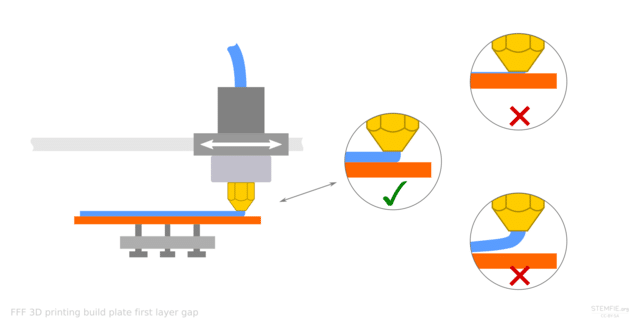
Printing also needs a design, similar to the way we lay out words on this page. We need to create a 3D model, with all the ridges, bumps, and hollows we want in our final product. The model is then “sliced” into thin wedges. The printing process usually happens by stacking thin layers on top of each other. After the model is made, it sometimes needs to be left to cool. Any minor errors can be corrected by sanding off extra material.
A 3D printer printing a model layer by layer, Credit: Wikimedia/Stemfie3D
Once these vital steps are achieved, it’s a matter of choosing the right “ink.” Plastics are one of the ingredients that make 3D printing ordinary objects possible. They’re flexible or rigid when they need to be, and lightweight, too. Plastics also have a wide variety of color options, including the ability to become entirely transparent. This spectrum of possibilities is what allows 3D printing to make any kind of object, from a careful prototype, to beautiful artistic forms and sculptures, to functional objects. Affordability is also key, and plastics are cheaper than almost any other material. The ease of working with plastics also means 3D printing can happen faster. Certain plastics also don’t react or biodegrade easily, which allowed them to be used in healthcare applications.
How is 3D printing being used in medicine?
The first application of 3D printing in medicine took place as early as the mid-1990s. People who experienced injuries to the bones in their faces needed reconstructive surgery. Implants were custom 3D printed to the patients’ faces to restore the damage that had been done. A similar process was used to treat newborns with breathing problems. Their airways were reconstructed using 3D printed parts.
3D printing is also a useful aid for normal medical treatments. Similar to how an X-ray or CT scan is used to help surgeons navigate during surgery, a 3D printed model can give surgeons an even more comprehensive picture.
During the height of the COVID-19 pandemic, normal citizens with 3D printers helped supply PPE to healthcare workers when it wasn’t available.
One of the most exciting applications of 3D printing in medicine comes from redefining the materials we use to print. What if, instead of plastic or metal, we could use cells and tissues?
The process of using living materials to 3D print is known as bioprinting . It sounds like science fiction. What if people needing organ transplants could print them? What if broken bones could be repaired not by screws or plates, but by bone tissue made from our own cells?
A 3D bioprinter that uses cells, Credit: Wikimedia/Андрей Ильин
Scientists have already invented spray-on skin. Inkjet bioprinters spray the liquid components of human skin to form thin layers of tissue. These can be personalized to each patient so that the body recognizes it as the “self.” Tissue can be laid on wounds to help burn patients and wounded victims recover faster, and with little chance of rejection . Researchers have even been able to reconstruct cartilage .
Although parts can be replaced when they malfunction in our bodies, some types of tissues can regenerate on their own—they just need a little help. Structures can be 3D printed to act as a layer for cells to live on, and eventually regrow into tissues. This process is known as scaffolding .
Medical technologies have advanced in leaps and bounds because of 3D printing, but we’re still quite a few steps away from science fiction becoming science reality. In order for technology to be accessible to everyone, it has to be inexpensive. It also has to work consistently. Right now, bioprinting is still very expensive, and performed in only a few places around the world. It is also a tricky process, and often fails.
But a process of failure and expense are how technologies grow and change. Gottwald, the inventor of the first 3D printer, experienced this too, and now we’ve even 3D printed entire buildings! Now, 3D printers are also present in companies, research institutes, and “maker’s spaces.” In twenty to thirty years, medicine might look entirely different.
If you had access to a 3D printer, what would you make? Crafting the future is in your hands.
Flesch Kincaid Grade Level: 7.8
Flesch Kincaid Reading Ease: 66.3
Glossary
Bioprinting: The process of using biological materials to 3D print
Cartilage: A strong, flexible connective tissue that protects your joints and bones
Rejection: An immune response of the body when introduced materials are recognized as foreign
Scaffolding: A framework to support further construction
Yamini's (he/they) interests lie in environmental education, science communication and trying to build a better world. When not languishing in front of his laptop, they can be found outside, poking at any insect, bird or plant. They love making science accessible, especially to those who aren't encouraged to pursue it. Yamini hopes that the young women who read Smore love learning from their articles and get just a little bit more excited about science!