Our teeth have important jobs. They help crush and break down foods, which is the first step in digestion. Teeth also play an important role in forming words when we speak. Having good dental hygiene by brushing, flossing, and using mouthwash is key to keeping our teeth healthy.
Dental cavities also known as dental caries are holes that form in the teeth. They are one of the most common dental problems and if left untreated can cause lots of pain, and even loss of the tooth. Read on to understand how cavities form and what role does bacteria, and candy play in forming cavities. And yes, it is possible to never get cavities ! We share tips on avoiding cavities and keeping your pearly whites in top working condition.
Table of Contents
How does a cavity begin?
Many people get cavities, and the cavities can range in shape and size. So how do these damaged spots form on our teeth? All people have bacteria living in their bodies. Bacteria are simply very small organisms that can be good or bad. Too much bacteria can cause sickness and infections. However, they can be helpful to our bodies, and they live everywhere from our stomachs to our mouths.
But bacteria can cause problems too. On our teeth, a sticky substance called plaque can form, and it can trap too much bacteria. Just like us, bacteria like to consume sugar. When we eat too much sugar, bacteria in our mouths produce more acid. That acid can then cause cavities by wearing down the outer layer of our teeth, the enamel, and forming holes.
Candy and sugar, Credit: Wikimedia/Elisa Azzali
Are some teeth more likely to get cavities than others?
Think about how you chew tough food. If your food is especially chewy, you use your back teeth more than your front teeth. Our back teeth also have more cusps, or small dents, for food and sugar to sit in. Brushing our back teeth can be more difficult than brushing our front teeth, as well. These things make our back teeth more likely to get cavities than our front teeth.
Parts of the tooth, Credit: BioRender.com
Do cavities cause bigger problems in our teeth?
What happens once there is a hole in the tooth? Our teeth have a few important layers. First, the enamel is the hard outer shell of the tooth. Underneath the enamel is a pressure-absorbing layer called the dentin. It is much softer than enamel, but it helps us to chew our food. Finally, under the dentin is a layer called the pulp. Pulp contains nerves and blood vessels and helps to provide support to the dentin.
Even though cavities form in the enamel, they can get deeper in our teeth if we do not notice them right away. Cavities can pass through the enamel and go into the dentin, becoming larger and more problematic. If cavities get too deep, they can cause pain and even serve as a doorway for infections in the mouth.
What can we do to fix cavities?
The larger a cavity becomes, the more difficult it is to deal with. This is why it is important to see a dentist at least once a year. Dentists are trained to notice cavities and stop them from getting any larger. They do this by giving your teeth fillings. Fillings are mixtures that fill in the cavities to protect the lower layers of your teeth from exposure. Fillings can be made of metals, plastics, and other materials. Some fillings last for over 15 years, but most will need to be replaced eventually.
When teeth become especially diseased and damaged, another option for treatment is a root canal. A root canal is when a dentist removes the pulp from the center of a tooth and seals the tooth. This helps to reduce pain and stops the tooth from getting more damaged.
Can a cavity heal on its own or go away with brushing?
Unfortunately, cavities are permanent holes in our teeth. This means they will not heal on their own. Before a cavity forms, enamel can be repaired if the damage is not too deep. Small enamel damage can be fixed with minerals from toothpaste or even saliva. However, cavities are too deep to self-repair. Even if you brush your teeth perfectly after getting a cavity, it will not fill itself back in. It may even continue to worsen if it is not filled by a dentist.
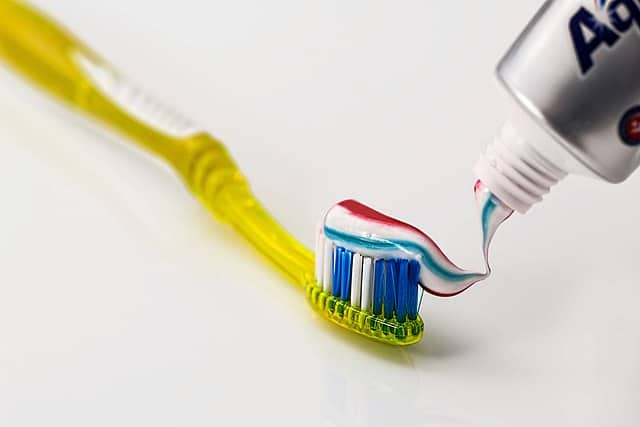
Toothbrush and toothpaste, Credit: Wikimedia/Steve Buissinne
How do you stop a cavity from forming?
Once cavities form, they are there to stay. Fillings help to keep the lower layers of our teeth safe, and we can work with our dentists to keep our mouths healthy after getting cavities. However, the best thing to do is to prevent cavities from forming in the first place. Since we know that cavities can form from too much sugar intake, reducing the amount of sugar we eat is a helpful step toward having fewer cavities.
Another thing we can do to protect our teeth is to brush them well. Brushing your teeth is recommended at least twice a day, for two minutes each time you brush. Many people brush their teeth in the morning and at night. This helps to clean up food and bacteria that accumulate throughout the day and night.
But is there a correct way to brush your teeth? It may be tempting to scrub your teeth with your toothbrush, but it can be better to brush gently. It is also important to brush difficult places on your teeth. Be sure to brush near your gums and on the inside of your teeth, and pay extra attention to those tricky back teeth. It can also be helpful to brush your tongue gently to get rid of extra bacteria in the mouth.
In addition to brushing our teeth, flossing and using mouthwash can keep both our teeth and gums healthier. Finally, drinking plenty of water helps to keep our mouths fresh and clean.
Glossary
Cavity – a hole in a tooth
Bacteria – very small organisms that live everywhere on earth, even inside people and animals
Plaque – sticky material on the teeth that may trap bacteria
Enamel – the hard outer shell of the teeth
Cusp – a dented area of your teeth
Dentin – the soft material below enamel that helps to absorb pressure from chewing
Pulp – the innermost material in the teeth that contains nerves and blood vessels
Fillings – material that a dentist uses to fill in cavities
Root canal – when a dentist takes the pulp out of a tooth and seals it to protect it from more damage and infection.
Tess Taggart Bub has a bachelor’s degree in biochemistry and a minor in data science from Houghton College. During her undergraduate studies, she conducted research in the areas of climate science, ecology, and muscle biology. She is currently a PhD candidate at the University of Tennessee Health Science Center studying host cellular response to viral infection. She is a strong believer that science can change the world, especially when it’s shared. In her free time, she loves communicating science, playing guitar and piano, and running. Writing for smore gives Tess the opportunity to help inspire a new generation of women in STEM.