Table of Contents
What is the Mariana Trench?
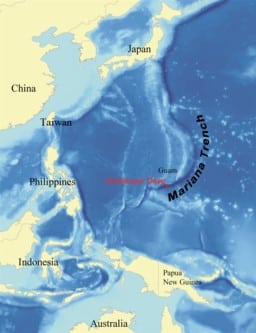
The Mariana Trench is the deepest place in the world’s oceans. It is located in the Pacific Ocean. It is a crescent-shaped trench and is the lowest measured point on Earth. But how deep is the Mariana Trench? Most recent measurements estimate it to be about 11 kilometers or 6.8 miles deep.
The trench is named after the nearby Mariana Islands and is part of the larger Mariana Trench system. This includes several other deep subduction zones and trenches.

How was the trench formed?
The Earth’s surface is covered in tectonic plates . Mountains are formed when these plates push together. Earthquakes occur when two tectonic plates rub together. Deep sea trenches can be formed when one plate moves under another. This is a process called subduction .
The Mariana Trench was formed in this way. The Pacific Plate and the Philippine Plate are pushing together. The Pacific Plate is being forced beneath the Philippine Plate. This is creating a deep subduction zone, forming the trench.
The Mariana Trench is still growing. As subduction continues the trench will continue to evolve over time.
Other geological processes can also alter the shape and structure of the trench. Underwater landslides and earthquakes change the seafloor. This changes the trench’s depth, shape, and location.
However, this process is slow and may take millions of years before significant changes occur.
Does anything live there?
The pressure at the bottom of the Mariana Trench is incredibly high because of the immense weight of the water above it. At the deepest point of the trench, the pressure is about 1,086 bar or 15,750 psi. This is over 1,000 times the atmospheric pressure at sea level. This is like having the weight of 50 jumbo jets pressing down on a table.
This makes the trench one of the most inhospitable places on Earth. However, some organisms have managed to survive there.
The Mariana Trench is home to a variety of unique and fascinating deep-sea creatures that have adapted to survive in the extreme conditions of the deep ocean.
Some of these animals include the:
- Mariana snailfish, a small, translucent fish that is found at the deepest depths of the trench
- Deep sea jellyfish
- Cusk eel, a deep-sea fish commonly found in the trench, with a long, slender body and large, prominent eyes
- Dumbo octopus, a small, deep-sea octopus that has ear-like fins
- Frilled shark and goblin shark

These animals have adaptations to cope with deep-sea conditions. They have flexible bodies that withstand high pressure. They have slow metabolisms , helping them to conserve energy. They can survive a long time without eating. Some produce bioluminescence. This is light which helps them communicate in the dark. Finding a mate in the depths can be difficult. Therefore, some have long lifespans as reproduction is so slow.
It is difficult for scientists to study the Mariana Trench. Creating technology that will survive high pressure and low temperature can be challenging. Although some incredible species have been discovered, there is likely to be much more that we don’t know about.
Check out this video of a frilled shark – a weird and wonderful creature of the deep!
Glossary
Subduction: when the edge of one tectonic plate descends below another
subduction zone: the area where subduction takes place
metabolism: chemical reactions inside our bodies which keep us alive. The breakdown of food and water to be used by the body
bioluminescence: the production and emission of light from living organisms through chemical reactions
tectonic plates: giant pieces of the Earth’s crust and mantle
Flesch Kincaid Grade Level: 7.3
Flesch Kincaid Reading Ease: 61
References
Wikipedia (2023) https://en.wikipedia.org/wiki/Bioluminescence Accessed 24th February 2023
Britannica (2023) Mariana Trench https://www.britannica.com/place/Mariana-Trench Accessed 24th February 2023
Fact City (2020) 25 Mega Facts about the Mariana Trench https://factcity.com/facts-about-the-mariana-trench/ Accessed 24th February 2023
Ocean Info (2023) 10 Strange Animals in the Mariana Trench. https://oceaninfo.com/list/mariana-trench-animals/ Accessed 24th February 2023
Contributors
-
Kate Lewis, Ph.D.: AuthorView all posts
I studied for my BSc Zoology degree in Swansea University, UK in 2009 and competed my PhD in Agriculture in 2014 at Aberystwyth University, UK. I'm passionate about science, in particular zoology. I've worked in research for over 10 years. This work is usually broad and extensive. It has involved finding solutions to problems associated with farming, antibiotic resistance, animal and human nutrition, and reducing the impact of agriculture on climate change. I have had the pleasure of working both in the UK and overseas. My most enjoyable project to date, has been working along the African Rift Valley. I love talking about these topics and trying to convey my enthusiasm for them through scientific writing. Writing for Smore Magazine allows me to do that.
Copyright @smorescience. All rights reserved. Do not copy, cite, publish, or distribute this content without permission.
SUBSCRIBE TO OUR NEWSLETTER
.......... ..........Subscribe to our mailing list to get updates to your email inbox.
Monthly Newsletter