Take a look outside your window, or go for a walk. What do you see? Even if you live in the middle of New York City, there’s something living: a tree in a pot, or an ant hiding under a leaf. Have you ever wondered how it got there, or why it’s in New York?
The answer lies in geography. The total geographic area a species occupies is known as its distribution.
Places around the Equator are warmer, with tropical climates of humidity and rain. Places at latitudes near the Antarctic and Arctic are colder, with a distinct summer, winter, spring, and fall. Climate, water, and soil shape the evolution of every species in every place. The species develop special traits for those conditions. Polar bears have thick layers of fat to survive Arctic winters. Sugar gliders have winglike arms to glide in rainforest canopies.
After climate influences what species can be found where, it’s important to remember that species also influence each other. Although black bears and grizzly bears coexist, they compete for a lot of similar resources. Due to their differences in size, a grizzly will almost always win a fight against a black bear. The fact that they both eat the same food and use the same habitats means that the number of black bears is influenced by the number of grizzlies and vice versa.
Species which rely on each other for survival also influence each others’ distributions. The Yucca plant and Yucca moth have a unique partnership where each depends on the other to survive. Yucca plants can’t be pollinated by anything other than the Yucca moth. The Yucca moth, in turn, lays its eggs in the plant’s flowers. Although the moth’s larvae eat some of the developing seeds, enough remain for the plant to reproduce. This relationship limits where both species can live, as Yucca plants only grow where their moth partners exist, and moths need Yucca plants to reproduce.
An 1892 sketch of the Yucca moth from the Revue Botanic Gardens, Credit: Wikipedia/ Riley
Competition and cooperation between species affect their distribution, but the most important factor is always climate.
How is climate change affecting birds?
Imagine you’re taking a walk to pick up some groceries. What do you do if it’s too hot outside? You could look for a shady route, or postpone your trip to nighttime or the early morning. You could even do your grocery shopping in winter, and stock up for the year. If every single day for an entire year is too hot, you might even consider changing neighborhoods. This is exactly how species are trying to adapt to global warming and climate change.
One way species cope is by changing the timing of key activities, such as breeding, flowering, or migration, to align with new seasonal patterns. Many bird species are migrating earlier or later to cope with climate change.
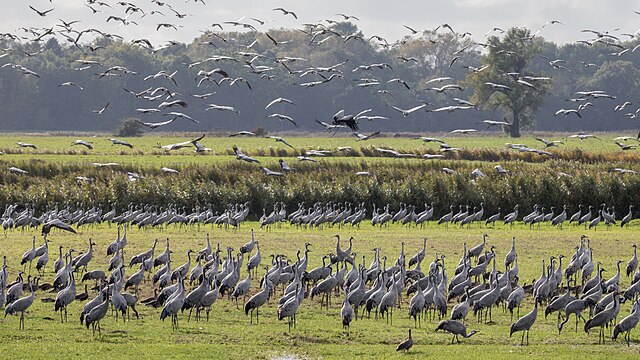
In winter, the common crane migrates southward,Credit: Wikipedia/Andreas Weith
Another way they cope is by moving to a higher latitude. For example, species at the Equator may move to more temperate climates. Marine species like fish and plankton are moving toward the poles in response to warming ocean waters.
Birds in mountain regions have one more option. They can also move higher up in elevation. The higher you go, the cooler it gets. Higher elevations might be similar to the previous climate. However, birds which reside at the highest elevations have nowhere to go, and now have more competition.
How are ants and birds competing?
We know that climate is vital in shaping bird distribution. It’s no surprise that patterns of bird diversity in mountains vary a lot based on what local climates look like. Much like grizzly bears affect black bears, an unexpected species is affecting bird distributions.
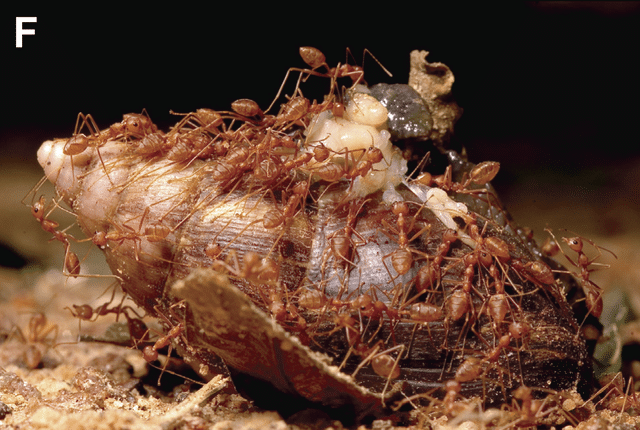
Weaver ants (Oecophylla sp.) are some of the most aggressive ants out there. These small, red insects are found everywhere, from Africa, to Asia, to Australia. Weaver ants eat invertebrates, competing with insect-eating birds in foothills and mountains.
weaver ants feasting on a dead snail, Credit: Wikimedia/ Fallows C, Gallagher AJ, Hammerschlag N (2013)
Researchers investigated data from 46 mountain ranges around the world. Some of these had weaver ants, and some didn’t. They found that when weaver ants are present, insect-eating birds tend to live higher up. The total number of bird species in these areas peaks around 960 meters (3000 feet) above sea level—about 450 meters (1500 feet) higher than in places without these ants.
Here’s why: Oecophylla ants are most common at lower elevations. They reduce the availability of insects there, making it harder for birds to find food. Birds then move upslope, shifting biodiversity patterns. This effect is strongest in insect-eating birds, but even omnivores are affected. Bird groups that don’t depend on insects, like nectar feeders or scavengers, don’t seem to be impacted as much.
We already know that species are shifting to higher elevations to beat climate change. If ants move up too, this could push birds even higher, squeezing them into smaller and smaller habitats at the top of mountains.
“With climate change, if the ants shift their ranges towards higher elevations, this might impact the bird species at higher elevations as well,” said Dr. Srinivasan (lead author on the study) in an article for The Hindu.
It’s almost impossible to account for every single interaction between species. These interactions also vary a lot from place to place. Although scientists have figured out one of these links, climate change could cause new and unexpected changes.