Many people are divided on the opinions of generative AI. One side of that spectrum is fearful while the other is hopeful. Regardless of that, AI is here to stay and that could be seen as an understatement.
Its use is also universal. From asking it to provide you with ideas for your girlfriend’s birthday present, to debugging a 100 lines of code, there is little these tools struggle with.
However, there is one aspect of our society that has been a victim of out-dated and inefficient practices that also needs AI more than ever – and that is K12 education.
The public school system is struggling. The statistics on graduation and SAT scores claim that, in the U.S. even though there are more high school graduates, the average SATs of a graduate are getting lower and lower.
We will be talking about the inevitable rise of the use of AI, and how we can make the best of it, especially in the area of K12 education.
What are the statistics saying?
According to some surveys, businesses are already heavily implementing AI in their workforce in 2024. Around ~70% of correspondents claimed that they use AI in their business in some shape or form.
Why is that important for K12 education
Because what is the purpose of it if it’s not preparing children to enter the workforce? And how will K12 schools do that if they are not using AI tools on a large scale?
If this trend continues, there may not be a single job available that will not use AI. That alone is the reason enough, but there is way more stuff AI can do.
Not only that, but AI already has a significant influence on education.
There are studies that show how much AI is already present in education, and how much its influence will increase in the future.
How can AI improve the state of K12 Education if implemented?
There are numerous ways. We will be naming a few.
Intelligent Tutoring Systems
AI tutors, being available to students and teachers 24/7 can significantly improve the efficiency of learning among the children.
These systems can help in:
- Providing instant feedback on the quality of student’s work (essays, projects, even math problems);
- Giving simple explanations to complicated topics some students may struggle to understand;
- Helping teachers present a lecture in the most comprehensive yet simplest way possible;
- Automation of creating practice materials – Let’s say you teach maths as a teacher. AI can help create math problems that you can practice with your students. It saves time, especially when you run out of good materials in your textbook.
Automation of Administrative Tasks
Teachers very often spend a lot of their time on administrative work such as grading, attendance tracking ect. That can all be automated by AI, or at least to some extent. This will leave teachers with less work, allowing them to focus on more important things.
It can also help reduce inefficiencies in work done by the administrative staff.
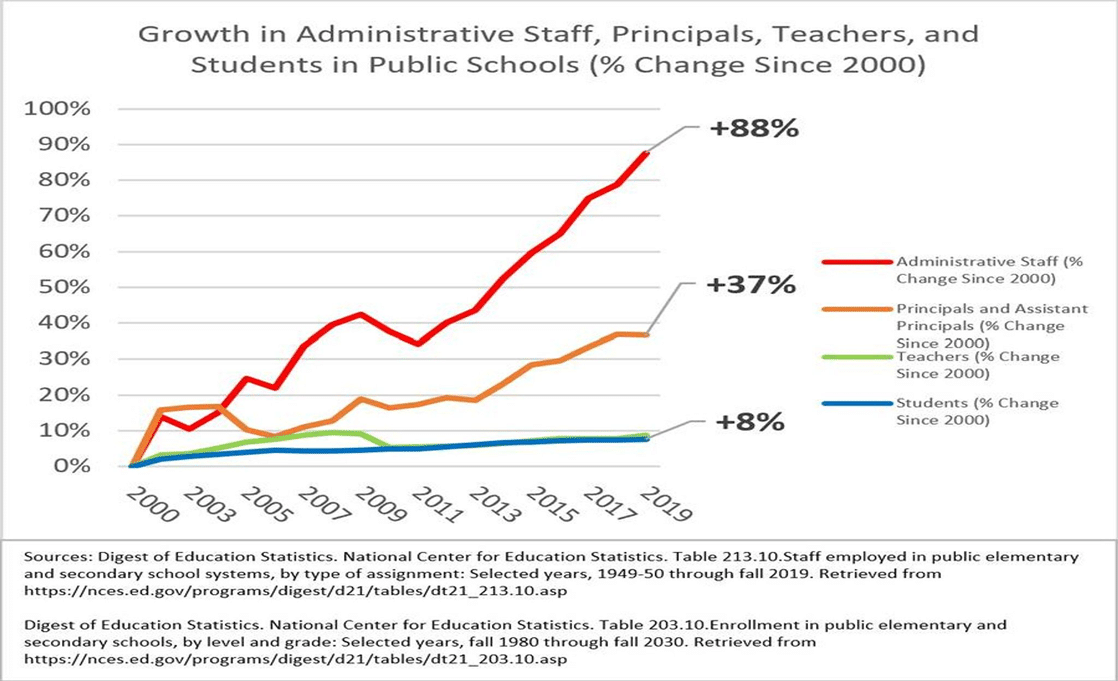
By this chart, we can see that there is a massive increase in the administrative staff over the increase of students and teachers in public schools.
We will not be giving any conclusions to why it happened. However, we cannot disagree with the fact that its increase is disproportional.
Whatever is the cause of that, we believe AI can provide a more efficient solution, the one not additionally burdening the taxpayers.
Finally, this all leads to massive reduction in burnouts from all people employed in K12 education, regardless if it is public or private. That will further increase their productivity as their good mental health would make them less distracted and more focused.
Bridging Educational Inequality
AI can also help students who are met with certain disadvantages. There are many children who have disabilities or simply are immigrants and haven’t learned the language yet.
AI helps in many ways:
- Content translation – Students who do not understand lectures due to not knowing the language yet (such as children from immigrant families) can have AI translate textbooks and lectures to their native language;
- Text-to-speech – Can help foreign or immigrant students practice pronunciation better. It also helps students with restricted sight or dyslexia grasp the lecture without many difficulties;
- Speech-to-text – The opposite of the above. Students with dyslexia, for example, can dictate instead of writing their projects or assignments.
It is important to note that there are tools that already do these things. However, AI implementation and integrating it with existing tools brings its efficiency to a whole new level.
Data-driven decision making
Schools can collect various types of data, including:
- Academic performance (test scores, grades, assignments);
- Attendance records;
- Behavior reports;
- Engagement metrics;
- Demographics (age, language, socioeconomic background);
- Teacher evaluations and feedback.
The data gathered on its own may present too much for humans to learn how to use them. However, with the help of AI, it can be made significantly more effective.
Information gathered, processed by the AI then later reviewed by experts can help in many ways.
For example, improving areas in the system that are falling behind, adjusting curriculums that help students learn more efficiently or evidence-based decision making in policies or funding.
Enhanced Engagement Through Gamification and Interactive Tools
Gamification is already present in some schools without generative AI. However, no technology can remain unimproved after being integrated with it.
Gamification represents a method in which aspects of video games are implemented in certain situations for motivational purposes. In this case, the dopamine releases caused by gaming are used to motivate children to study and learn.
AI can bring this to a whole new level.
The most evident example is VR (Virtual Reality). When playing VR video games, you put on a VR headset that replaces the world around you with a video game world. That way you have a feeling as if you were in that video game yourself.
The VR aspect can be used in classrooms as well. Imagine, in history class, that instead of listening to the teacher talk, you put on a headset and experience walking down the streets of Ancient Egypt yourself. AI can help in generating and tuning the environment which can be done by the teachers to improve the historical accuracy of the generated reality.
AI can also generate videos of processes in natural sciences, such as how photosynthesis works or how electricity is being generated. That would be great for students who are visual learners.
Will AI replace us as teachers?
Many people are fearful that AI is going to make many people obsolete, or even more silly, that it will enslave humanity. However, are their fears justified?
The answer is – not really.
All the aspects we mentioned in which AI would help wouldn’t be possible if no one actually directed it. And that is a skill by itself. Teachers will have to use their knowledge, experience and their skills in AI prompt writing in order for their work to be most optimal.
Apart from that, even if half of the bad things regarding AI are true, our best bet is to learn how to use it in the best way we can. Because the ones who are not using it will definitely be the ones getting replaced.
Copyright @smorescience. All rights reserved. Do not copy, cite, publish, or distribute this content without permission.
SUBSCRIBE TO OUR NEWSLETTER
.......... ..........Subscribe to our mailing list to get updates to your email inbox.
Monthly Newsletter