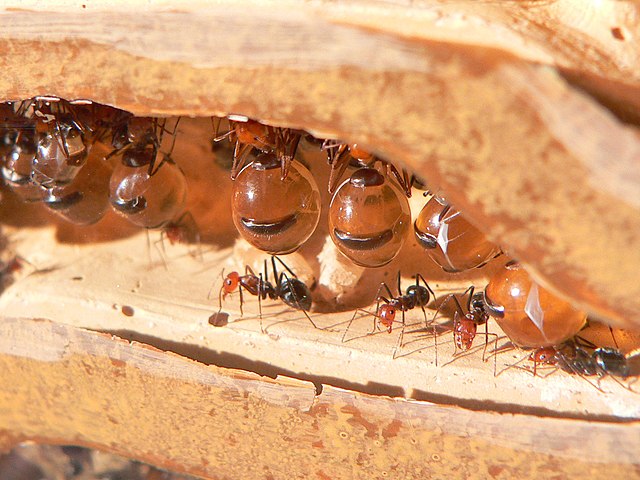
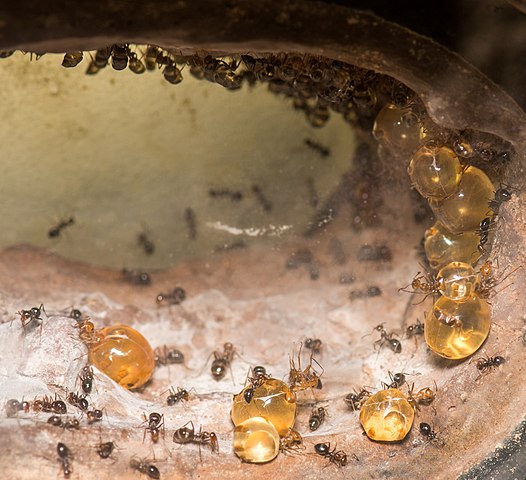
Sharing is caring! Honeypot ants share their sweet stash with other ants in hard times, Credit: Wikimedia/Greg Hume
Is it a grape? Is it a berry? Neither. Camponotus inflatus, commonly known as a honeypot ant, lives in the deserts of Australia. In summer, the worker ants forage sweet nectar from the flowers of the mulga tree. The flowers look like a bottlebrush and are bright and yellow. The ants carry their “nectar stash” to their nest and feed it to certain worker ants called “rotunds” or “repletes.” The worker ants throw up some of the nectar and the repletes slurp it in. The worker ants feed the repletes to the point that the abdomen of the replete has swollen to the size of a grape, and the wall is so thin that you can see the honey stored in its abdomen. This thin abdomen is called the crop, which, simply put, is a cavity. These ants can hardly move with such heavy loads, so their only job is to hang from the roof of the nest and gobble up nectar or honeydew.
Why do honeypot ants store honey?
Australian deserts are dry and barren, and food is hard to find. If on a day the ants cannot forage enough food, they can turn to the repletes. To grab the sweet treat, the hungry worker strokes the replete’s antennae . Soon after, the replete starts to regurgitate “ant honey” it has collected and puts it into the mouth of the hungry ant. This honey is a backup and not the main food source. What do honeypot ants eat at other times?
What do honeypot ants eat?
Honeypot ants eat mites and other insects. They scavenge and feed on dead insects or animals. Some insects, like aphids, eat plant sap and leave behind trails of sugary liquid called honeydew. The worker ants slurp this up too. They either enjoy it themselves or deposit it in the guts of rotunds.
Ant grabbing honeydew left by aphids, Credit: Wikimedia/Dawidi
Can we eat ant honey?
It would have been a shame if no human tried out this dessert of the desert. The indigenous people of Australia, called the Aborigines, have been using honeypot ants as a source of nutrition for generations. They check for nests at the base of mulga trees—this is where the ants keep their living larders. The ants also release formic acid, which tarnishes the color of the soil around their nests. The locals dig a few feet under the soil to access the nest.
In a 1990 documentary by BBC, called the Trials of Life, English biologist David Attenborough popped in a honeypot ant.
Ant honey vs. bee honey
Ant honey looks similar to bee honey but is less dense. Ant honey is less sweet compared to bee honey and has a sour tone to its taste. The composition differs too. The main components in honey are two sugars—fructose and glucose. In ant honey, there is more glucose than fructose, while it is the opposite for bee honey. However, both ant and bee honey are packed with antioxidants.
Where can you find honeypot ants in the United States?
The species of honeypot ants found in USA and Mexico belong to the genus Myrmecocystus. These ants are found in the arid regions of the western part of the USA, particularly Colorado and Utah.
Look how the honeypot ants stay put on the walls of the nests, bubbly with amber-colored honey, Credit: Wikimedia/Derrick Coetzee
Readability: 73.5
Grade: 6.4
Glossary
Nectar: Sweet sap found in flowers
Abdomen: The part of an insect that contains the gut.
Antennae: The long appendages at the end of the head of an insect
Scavenge: The act of feeding on dead flesh
Fructose: Known as fruit sugar, this sugar is found in fruits
Glucose: Simple form of sugar which can be absorbed directly by the body