Whether you use your phone, a DSLR, or even a film camera to take photos, the essential ingredients of photography stay the same. Photography is all about playing with and capturing light and shadows! A camera’s shutter is built to let light in, but just for an instant. Millions of tiny sensors just past the shutter convert light into electrical impulses, which translate into the images we see on our screens.
Film cameras existed before the age of sensors, so how did they work? Instead of sensors which responded to light, cameras used photographic films. Photographic films are coated with silver salts. The shutter opens, and when light hits the silver salt, it becomes darker. Areas which receive less light remain lighter. It’s the inverse of what we see—the bright areas become dark, and dark areas remain light. This is why the initial imprint light makes on film is known as a negative . The film is then developed and fixed through more chemicals. Light passes through the negative onto photographic paper. Darker areas on the negative allow less light to pass through, whereas lighter areas allow more light to pass through. The final negative is turned back into a positive. Since we have the inverse of an inverse image, the final print on photographic paper resembles the initial scene we saw in real life!
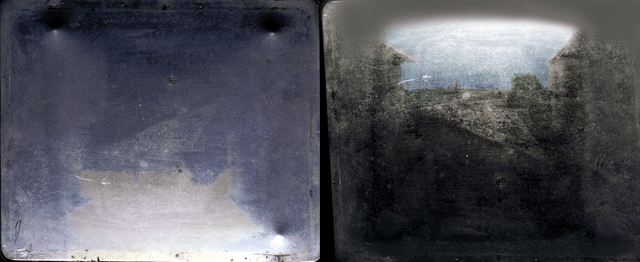
The process of negative–positive photography is not new, and was first invented by Nicéphore Niépce in 1826. He created the oldest surviving photograph, capturing the view from a window in his home, titling it “View from the Window at Le Gras.” Niépce’s process needed two key ingredients: a camera obscura , and a chemical known as bitumen of Judea . Bitumen of Judea hardens when it is exposed to light. This is a simpler process than the darkening of silver salts, but both are similar as they are reactions to light exposure.
The camera obscura projected light onto a pewter plate coated with this special bitumen. The bitumen of Judea on the parts of this plate that received more light hardened faster than on the darker portions of the plate. This was his “negative.” Niépce had to expose the plate for between 8 hours and four days, much longer than modern cameras where the shutter opens for thousandths of a second. The unhardened bitumen was washed off the plate using lavender oil and white petroleum, leaving only the hardened, light-exposed bitumen on the plate. The pewter plate was then coated with inks, and used like a stamp. Since only the hardened areas remained and transferred ink, these turned back into the darker areas from the original scene, rendering the image a positive once more. We now know this to be one of the first photographs, but Niépce termed the process “Heliography,” or “sun writing.”
Left - The original pewter plate, representing the “negative.” Right - A reproduced image, representing the original scene and the positive. It has been colorized, Credit: Wikimedia/Jonnychiwa
Unfortunately, Niépce died in 1833, before the process could gain widespread use. Although his photography skills were largely unrecognized during his lifetime, he also created one of the first versions of the internal combustion engine. Though his first Heliograph was exhibited in France, it remained largely forgotten until 1952 when reproductions were created. His partner, Daguerre, went on to create a new process that found a lot more public use and success.
Flesch Kincaid Grade Level: 8.6
Flesch Kincaid Reading Ease: 57.4
Glossary
Bitumen of Judea: A black sticky petroleum product that hardens when exposed to light
Camera obscura: A simple device that projects light onto a flat surface
Negative: An image, usually on a strip or sheet of transparent plastic film, in which the lightest areas of the photographed subject appear darkest and the darkest areas appear lightest.
Yamini's (he/they) interests lie in environmental education, science communication and trying to build a better world. When not languishing in front of his laptop, they can be found outside, poking at any insect, bird or plant. They love making science accessible, especially to those who aren't encouraged to pursue it. Yamini hopes that the young women who read Smore love learning from their articles and get just a little bit more excited about science!