Introduction
Ever wondered how the strumming of a guitar string brings a melody to your ears or how the gentle hum of a tuning fork seems to fill the room with its pure tone? At the heart of these auditory experiences lies the fascinating interplay between sound waves and music. This intricate dance forms the foundation of musical compositions and offers a window into understanding acoustics in a way that touches our daily lives. Let’s embark on a journey to demystify the science behind sound waves and music, making it accessible and engaging for everyone.
The nature of sound waves:
Imagine throwing a pebble into a calm pond. The ripples that emanate outward are similar to how sound waves travel through air. Sound waves are essentially vibrations that move through mediums—be it air, water, or solid objects—bringing melodies and noises to our ears. These waves are characterized by their frequency, which determines pitch, and amplitude, which affects loudness. It’s the reason a bass drum sounds so distinct from a piccolo; they vibrate at different frequencies, creating a range of sounds that musicians harness to produce music.


How music harnesses sound waves
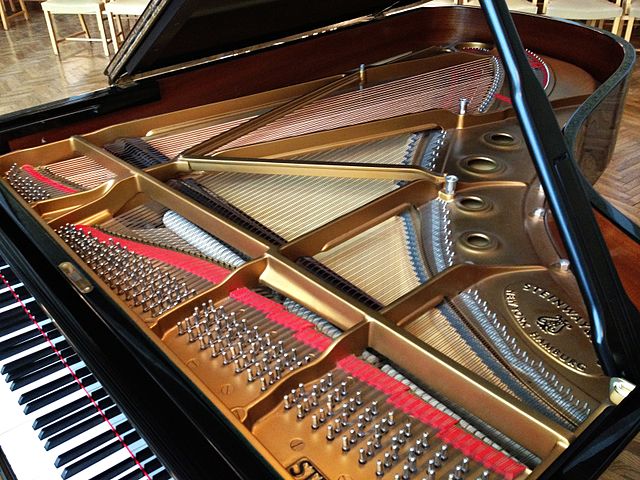
Music is an art form that organizes sounds in time, employing elements like pitch, rhythm, and dynamics. When a musician plucks a string or presses a piano key, they’re setting off a series of sound waves that vary in frequency and amplitude. This variation creates the diverse spectrum of music we enjoy, from the deep, resonant tones of a cello to the bright, sharp notes of a flute. Each instrument has its unique way of producing sound waves, contributing to the rich tapestry of musical expression.
The science of harmony and frequency
Harmony in music is more than a happy accident. It’s deeply rooted in the science of sound waves and their frequencies. When multiple musical notes are played together, sound waves interact to create harmony or dissonance. Studies in acoustics have shown that notes with frequencies that are simple multiples of each other tend to sound harmonious. This principle allows chords to sound pleasing to the ear, demonstrating the beautiful overlap between the physics of sound and the art of music composition.
Rhythm: The pulse of music
Rhythm, the pattern of sounds and silences in time, is another aspect where sound waves play a crucial role. The tempo of a piece of music—the speed at which it’s played—can influence our perception of energy and mood. Researchers have found that our brains are wired to respond to rhythmic patterns, and sound waves carry these patterns. By manipulating the duration and timing of sound waves, musicians create rhythms that can make us want to dance or soothe us into relaxation.
The emotional impact of sound waves
There’s a reason why a particular piece of music can lift our spirits or bring us to tears. The emotional impact of music is a direct result of how sound waves interact with our brains. Studies suggest that certain frequencies and rhythms can trigger emotional responses, tapping into the brain’s limbic system. This connection between sound waves and emotion is important in music therapy and highlights the profound effect that music has on our well-being.
Acoustic properties of musical instruments
Each musical instrument has unique acoustic properties that determine how it produces sound. For instance, the body of a violin acts as a resonator, amplifying the sound waves generated by its strings. Similarly, the shape and size of a drum influence the pitch and volume of the sound it produces. Understanding these acoustic properties allows musicians and instrument makers to manipulate sound waves to produce the desired musical effects.
The role of technology in music and sound
Advancements in technology have vastly expanded our ability to manipulate sound waves and create music. From electronic synthesizers that generate sound waves digitally to software that can modify pitch and timbre, technology has opened new frontiers in musical creativity. It also allows for the analysis of sound waves in ways that were previously impossible, providing insights into the structure and composition of music.
Sound waves in nature and music
Interestingly, the principles governing sound waves and music are not confined to human-made instruments. The natural world is full of examples where sound waves create musical phenomena, from the rhythmic chirping of crickets to the haunting melodies of whale songs. These natural “compositions” follow the same rules of acoustics and demonstrate the universal language of sound waves.
Conclusion
The intersection of sound waves and music is a testament to the intricate ways the physical world intertwines with human creativity. By exploring the science behind sound waves, we gain a deeper appreciation for the music that enriches our lives and insights into the fundamental principles that govern sound. Whether you’re a seasoned musician, a curious listener, or someone fascinated by the science of acoustics, the journey through the world of sound waves and music is a symphony of discovery waiting to be explored.
FAQs:
1. Are sound waves electromagnetic?
Sound waves are longitudinal mechanical waves. They are different from electromagnetic waves as they need a medium to propagate. In contrast, light waves are traverse waves that do not require a medium to propagate and, hence, are electromagnetic.
2. What is the speed of sound in different mediums?
Sound travels at 343 m/s in air, 1,481 m/s in water, and 5,120 m/s in iron. The speed of sound varies according to the temperature and environment.
3. Can you break the speed of sound?
Speed greater than that of sound is called supersonic. Examples: supersonic aircraft, rockets, cars, and supersonic humans. Yes, you heard it right; Felix Baumgartner, a skydiver, achieved faster-than-sound speed during his free fall in 2012.
4. What is the difference between pitch and loudness?
The pitch of a sound is directly proportional to the frequency of a sound wave, while loudness is dependent on the amplitude of the sound wave. The unit of loudness is decibel.
Contributors