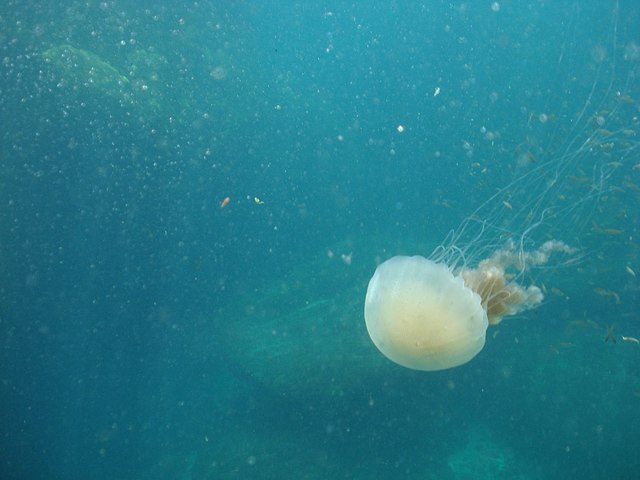
Their gelatinous forms pulse through the ocean with deceiving complexity. Jellyfish decidedly lack the brains we typically associate with advanced behavior, yet these drifting invertebrates still perceive cues, hunt prey, and evade threats with eerie sophistication. How do these spineless drifters exhibit such cues of intelligence without a brain?
This question has long perplexed both scientists and casual observers alike as we witness jellyfish rhythmically propelling themselves through water as if guided by some hidden inner compass. Do they use nerves, ganglia, or other alien means of processing information from the environment?
A jellyfish’s neural network
Unlike humans and many animals, jellyfish don’t have a centralized brain. Instead, they possess something called a “ nerve net .” This nerve net is a simple network of neurons spread throughout their bell-shaped body. It allows jellyfish to respond to environmental stimuli, such as changes in water temperature or the presence of prey or predators. Research has shown that this nerve net enables basic motor functions and reactions, even without a brain as we know it.
Jellyfish have rudimentary sensory structures, called rhopalia , located around the edges of their bell. These structures contain sensory nerves that detect light, gravity, and certain chemicals, helping jellyfish navigate their environment. These senses compensate for the absence of a centralized brain, guiding their movements and feeding behavior.
Feeding is a crucial aspect of jellyfish survival. Jellyfish use their tentacles, lined with stinging cells called nematocysts , to capture prey. Once captured, the prey is transported to the mouth by coordinated movements of the tentacles and body. Researchers have observed that jellyfish can adjust their feeding strategies based on the type of prey and environmental conditions despite their limited neural hardware.
Cnidário, Credit: Wikimedia/Marcelo Bandeira
Reproduction
Jellyfish have a unique lifecycle, involving both sexual and asexual reproduction phases. They can reproduce, relying on environmental cues to trigger spawning events. Temperature and food availability influence their reproductive cycles, demonstrating the jellyfish’s ability to adapt to their surroundings.
Despite their simple nervous system, jellyfish are remarkably resilient creatures. They’ve been around for millions of years, surviving in diverse marine environments. Jellyfish play a vital role in marine ecosystems. They are both predators and prey, influencing food web dynamics. Without a brain, they still manage to effectively find and consume food, keeping populations of smaller organisms in check.
The study of jellyfish, particularly their neurological system, is an evolving field. Scientists are keen to understand how their simple nervous systems can be so effective. Insights gained could have implications for robotics and artificial intelligence. The simplicity of jellyfish neural networks offers a model for creating efficient and adaptable systems.
Glossary
Nerve Net: A simple network of neurons spread throughout an organism, allowing it to respond to environmental stimuli without a centralized brain.
Neurons: Basic nerve cells that transmit information through electrical and chemical signals.
Rhopalia: Sensory structures in jellyfish that contain nerves sensitive to light, gravity, and certain chemicals.
Nematocysts: Specialized cells in jellyfish tentacles that sting and capture prey.