Table of Contents
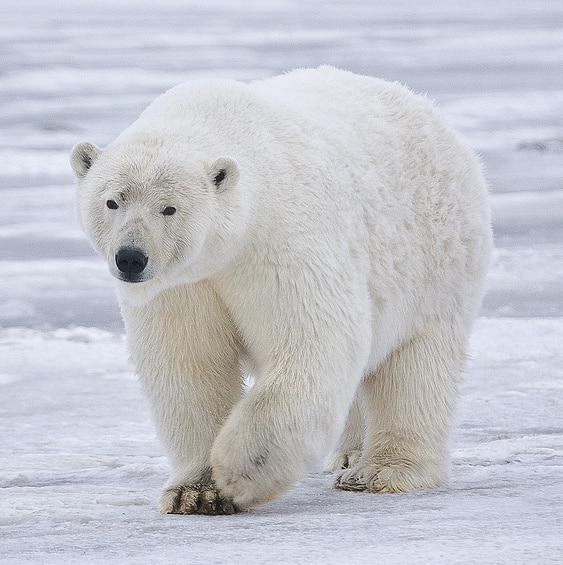
Polar bears are the largest species of bears. In fact, they are the largest carnivorous mammals found on land on our planet. Exactly how big are polar bears? Let’s quickly introduce ourselves to this species before looking at the facts related to their size!
Polar Bears – Distribution
Polar bears are also called white bears, sea bears, ice bears, or the great white northern bears. Most polar bears live in the regions north of the Arctic Circle to the North Pole. A few polar bear populations may be found south of the Arctic Circle in Alaska, Canada, Russia, Greenland, and a few islands belonging to Norway, such as Svalbard.
In these regions, polar bears travel long distances in search of food. Polar bears depend on the drifting sea ice which forms above the open waters. Apart from drifting atop sea ice, polar bears may also swim long distances from shores to sea ice. During periods of ice breakup, polar bears may also swim between floating ice islands.
Usually, polar bears are on the hunt for aquatic mammals known as seals , which are the main source of food for polar bears.
Polar Bears – Adaptations
Polar bears have many adaptations which allow them to retain body heat and deal with the icy habitats of the Arctic regions. The outer layer of fur of polar bears, for example, is hollow and reflects light. The reflection of light gives the fur a white color and helps the bear remain camouflaged in the icy Arctic regions.
Furthermore, polar bears have a thick layer of fat beneath the surface of their skin. This layer of fat acts as insulation to trap body heat in the cold Arctic regions. The large size of polar bears reduces the amount of surface area exposed to the cold environment per unit of their body mass.
Apart from these adaptations, polar bears also have strong legs with flattened, webbed feet. Their wide paws help in distributing their weight evenly on the ice. Additionally, a special “non-slip” surface on their footpads prevents them from slipping on ice. Unlike other bear species, polar bears may be considered “marine mammals” because of their webbed feet.
Another unique feature of polar bears is that, unlike other bears, polar bears do not den in the winter seasons. Since they can hunt for food (seals) all winter long, polar bears do not need to den.
Polar Bears – Exactly How Big?
Scientists measure the length of polar bears from their nose to the tip of their tailbone . An adult male polar bear is between 2.4–3 m (8–10 feet) in length. On the other hand, a female polar bear is slightly smaller at around 1.8–2.4 m (6–8 feet) in length.

When on all fours, polar bears have an average height of 1.3–1.6 m (4 ft 4 in – 5 ft 3 in). When they stand on their hind legs, polar bears may stand up to 3 m (10 feet) tall. An adult male polar bear has a weight between 350–680 kg (775–1500 lbs). An adult female polar bear has a weight between 150–250 kg (330–550 lbs).
Flesch Kincaid Grade Level: 6.3
Flesch Kincaid Reading Ease: 75.6
Glossary
Carnivorous: an animal which feeds on other animals
Seals: a type of large, fish-eating mammals that have thick fur and live in the sea
Adaptations: changes or qualities obtained by a species to survive in its environment
Camouflaged: hidden, disguised or concealed
Insulation: the means of keeping something warm or insulated
Den: to live in a den or a quiet place alone
Tailbone: the bone structure at the base of the spine
References
“How Big Is a Polar Bear? How Much Do They Weigh?” Polar Guidebook, 23 Jan. 2022, https://polarguidebook.com/how-big-is-a-polar-bear/.
“Polar Bear.” Encyclopædia Britannica, Encyclopædia Britannica, Inc., https://www.britannica.com/animal/polar-bear.
“Polar Bear.” National Wildlife Federation, https://www.nwf.org/Educational-Resources/Wildlife-Guide/Mammals/Polar-Bear.
Contributors
Copyright @smorescience. All rights reserved. Do not copy, cite, publish, or distribute this content without permission.
SUBSCRIBE TO OUR NEWSLETTER
.......... ..........Subscribe to our mailing list to get updates to your email inbox.
Monthly Newsletter