Do Jellyfish Have Hearts?

Table of Contents

Jellyfish are fascinating creatures. Their unusual translucence is a fascinating sight. It wouldn’t be surprising to hear that jellyfish differ from us in many ways; one being that they lack a heart.

Heartless Jellyfish

Yes, jellyfish don’t have a heart; at least not in the way we expect hearts to be. Jellyfish do not have true hearts like us humans. But they do have a diffused or spread-out circulatory system . It is a network of vessels that can transport fluids. Dissolved gases and substances like oxygen, wastes, and nutrients can be transported throughout the body. It thus functions similarly to a human heart.


Have you seen a video of a jellyfish moving through the water? You may have noticed the rhythmic movement of its umbrella-shaped organ. This umbrella-shaped organ is called the bell or medusa . The medusa contracts and relaxes periodically. This helps the jellyfish swim or move through the water. The contractions and relaxations also create a flow of water inside that enables the distribution of fluids throughout the body. Jellyfish do not contain any blood cells. Hence, the water flow ensures the delivery of oxygen and nutrients, and is responsible for the exit of waste.


Some jellyfish have pores or openings called ostia on their bodies. These pores enable the entry and exit of water. The entry of water combined with the rhythmic movements of the medusa is essential. It is responsible for many of the functions traditionally carried out by the heart.

Multiple hearts?

Some species of jellyfish are known to have multiple “hearts.” Again, these are not true hearts. These are patches or sections of the jellyfish body that can contract and relax rhythmically, similar to the bell. The rhythmic movements ensure the distribution of fluids. The “hearts” can be located throughout the body.

Not for the weak-hearted

The job of passing fluids around the body may seem boring, but it is necessary for the existence of many interesting phenomena.


Two fascinating phenomena associated with jellyfish are bioluminescence and trans-differentiation . Bioluminescence is the ability to produce light. Jellyfish have cells that produce a compound called luciferin . Luciferin reacts with oxygen. This reaction produces light. The oxygen needed for this reaction is brought in by the circulatory system.


Some species of jellyfish, like Turritopsis dohrnii, can go back to their younger or juvenile state even after they have matured. This process is known as trans-differentiation. It essentially makes the jellyfish immortal. It is a complex process. It needs oxygen, nutrients, and water, and the circulatory system plays a major role in it. 

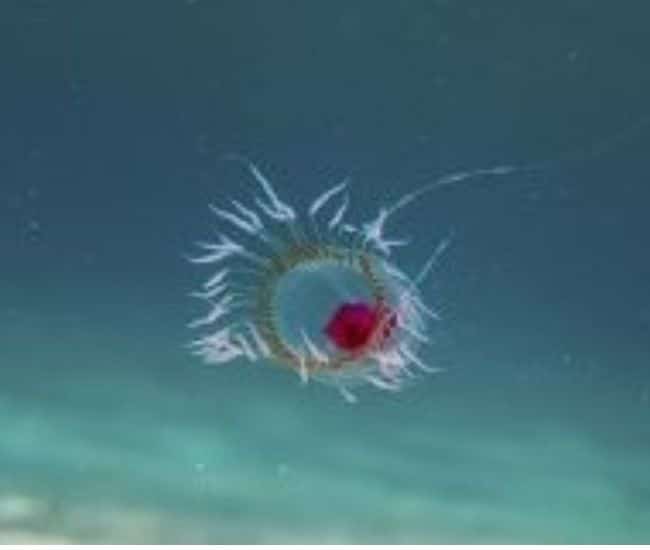
Turritopsis dohrnii
Turritopsis dohrnii, Credit: Wikimedia/Bachware

New and cool jellyfish facts

Scientists have recently discovered some cool things about jellyfish. For example, one kind of jellyfish called the Moon Jellyfish, also known as Aurelia aurita, can stay alive even when there isn’t enough oxygen in the environment. It is still able to keep a steady flow of oxygen through its body. The scientists think this might be because of some changes in the way the jellyfish’s blood moves and in how its body works. The Moon Jellyfish can also live in low- pH water, or acidic water, which might be because of adaptations in its circulatory system and other biological changes.

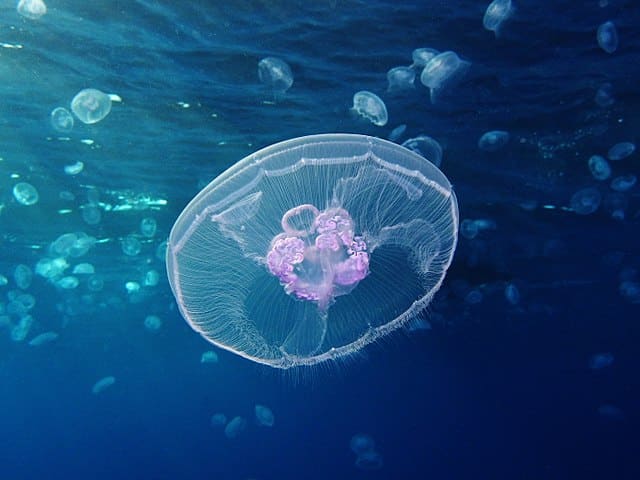
Moon Jellyfish
Moon Jellyfish, Credit: Wikimedia/Alexander Vasenin

Flesch Kincaid Reading Ease: 60.1


Flesch Kincaid Grade Level: 7.6

Glossary

Circulatory system: The system in the body that transports fluids that include oxygen, water, and nutrients


Medusa: The umbrella-shaped organ of jellyfish; also called the bell


Ostia: Openings or pores on the body of jellyfish


Bioluminescence: Ability of a living organism to emit light


Luciferin: an organic compound that can produce light when it reacts with oxygen


Trans-differentiation: A process that enables mature jellyfish to revert to a juvenile state; a developmental process by which mature cells can transform to other types of cells


Ph: A measure of the acidity or basicity of the surroundings

Shoji, J., Kudoh, T., Takatsuji, H., Kawaguchi, O., & Kasai, A. (2010). Distribution of moon jellyfish Aurelia aurita in relation to summer hypoxia in Hiroshima Bay, Seto Inland Sea. Estuarine Coastal and Shelf Science, 86(3), 485–490. https://doi.org/10.1016/j.ecss.2009.03.001


Miller, M. C., & Graham, W. (2012c). Environmental evidence that seasonal hypoxia enhances survival and success of jellyfish polyps in the northern Gulf of Mexico. Journal of Experimental Marine Biology and Ecology, 432–433, 113–120. https://doi.org/10.1016/j.jembe.2012.07.015


Lisenkova, A., Grigorenko, A. P., Vasina, D. V., Andreeva, T. V., Gusev, F., Manakhov, A., Goltsov, A., Piraino, S., Miglietta, M. M., & Rogaev, E. I. (2017). Complete mitochondrial genome and evolutionary analysis of Turritopsis dohrnii, the “immortal” jellyfish with a reversible life-cycle. Molecular Phylogenetics and Evolution, 107, 232–238. https://doi.org/10.1016/j.ympev.2016.11.007


Xia, N., Luo, W., Zhang, J., Xie, X., Yang, H., Li, S., Chen, M., & Ng, M. (2002). Bioluminescence of Aequorea macrodactyla, a Common Jellyfish Species in the East China Sea. Marine Biotechnology, 4(2), 155–162. https://doi.org/10.1007/s10126-001-0081-7
Contributors

Copyright @smorescience. All rights reserved. Do not copy, cite, publish, or distribute this content without permission.


Join 20,000+ parents and educators
To get the FREE science newsletter in your inbox!