Birds peck and don’t chew; there you go, we have the answer to the question. No, they don’t have teeth, as beaks are for pecking and teeth for chewing.
Birds’ extinct ancestors carried teeth, so why don’t they have teeth? Birds branched over 100 million years ago from dinosaurs. We don’t need to watch Jurassic Park to remember their ferocious teeth. Then, what could be the evolutionary advantage for birds to go toothless?
Skipped teeth for a better lifestyle
Adaptation is about blending into one’s food and habitat, which, in birds, are nuts and flying.
When consuming seeds and nuts, a beak full of teeth can become a handicap.
Teeth are required when you want to tear like the dinosaurs or chomp like a crocodile. But when their prey are soft worms and insects, they can skip teeth!
Raptors such as falcons double-toothed kites have tomial teeth and a sharp triangular ridge on the outer edges of the mandible. This structure is not teeth but helps the hunter birds to bite and overpower their prey.
Gizzard grind versus Tooth grind
Reduction in the size of food particles is critical for proper digestion, and there can be different modes of operation – gizzards in birds or teeth in mammals. When birds consume slightly harder food, they just swallow stones, which help to mash the food in the gizzard. For the birds, stones function like teeth, but they have the luxury of dumping them when they become blunt and are not good enough to do the job.
Facts bite into fables behind bird’s tooth story
Paleontologists have put several theories on the loss of teeth in birds, which is arguably unacceptable. The reason for toothlessness in birds could be a combination of all these theories.
A double-toothed kite gazing into the sky. Credits: Needpix/Raw2daBon3
1. Tooth heavy to Fly
For many years, teeth were believed to add weight to birds and slow their flight. So, did they decide to lose their teeth to fly? Archaeopteryx, the avian dinosaur, ancestor to modern birds, had teeth that aided and could fly, thereby crashing this theory. Also, Bats are dentulous and can fly as well.
For many years, teeth were believed to add weight to birds and slow their flight. So, did they decide to lose their teeth to fly? Archaeopteryx, the avian dinosaur, ancestor to modern birds, had teeth that aided and could fly, thereby crashing this theory. Also, Bats are dentulous and can fly as well.
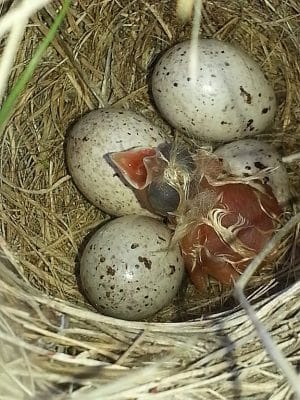
Transformation of eggs into hatchling. Credits: Wikimedia/ Kati Fleming
2. Early hatching for toothless
Extinct dinosaurs took 3 -6 months to hatch. Recent research from the University of Bonn suggests that 60% of the incubation time is used in developing structures for tooth development structures. Faster hatching increases survival, so possibly birds increase the chances of incubating eggs into hatchlings by dispensing their teeth. However, a contradiction to this would be that toothless turtles have incubation periods between 42 and 112 days, falsifying the theory that loss of teeth is for early hatching. But it can claimed that turtles came under different evolutionary pressures to birds.
Conclusion
Birds are compensated with beaks for the loss of teeth. The shape of the beak varies according to their habitat. Darwin’s theory of evolution was based on the beak shapes of the finches, residents of the Galapagos island. We may not understand the evolutionary reason for tooth loss in birds, but they are equipped with other superpowers, such as customized beaks, gizzards, and wings.