Understanding our ancient cousins- the neanderthals
Long ago, two kinds of humans walked the Earth – the stocky and sturdy Neanderthals and the more slender and crafty Homo sapiens. These ancient relatives of ours were similar in many ways but also quite different. Let’s dive into their world and explore how these two species, Neanderthals and Homo sapiens (we modern humans), were alike and different.
Physical differences between neanderthals and homo sapiens
The Neanderthals were admirably adapted to hunting Ice Age megafauna. Barrel-chested and enormously strong, they could take down mammoths, wooly rhinos, and other massive creatures. Their bones were thick and dense to withstand impact from thrashing hooves and horns. Yet they moved with a lumbering gait that left them vulnerable to nimbler predators. Their hefty frames also required vast amounts of calories, forcing them to spend long hours on the hunt.
Where Neanderthals focused their survival strategy on brute strength, Homo sapiens relied more on social bonds, communication, and innovation. Svelte in build, Homo sapiens couldn’t match the Neanderthals in hand-to-hand combat with beasts ten times their size. But they collaborated in large groups, clubs and spears in hand, to surround and confuse their gigantic prey. And while Neanderthals had large nasal cavities to warm frigid air during the Ice Ages, early humans migrated seasonally to milder climes.
Homo Sapiens Lineage, Credit: Wikimedia/ Dbachmann
Brain and intelligence: More than meets the eye
Neanderthals had larger brains than Homo sapiens, but that doesn’t mean they were smarter. Brain structure and how it’s used are more important than size. Neanderthals had brains well-suited for their environment and focused on vision and body control.
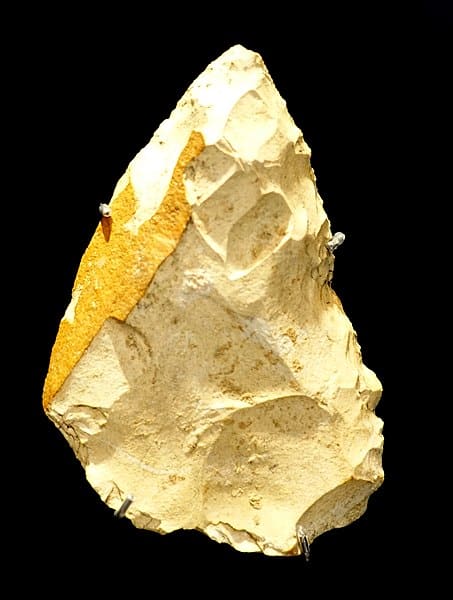
Neanderthals were skilled hunters and made use of various tools. They were known to create weapons and tools from stone and even used fire.
In comparison, Homo sapiens also used tools and fire but took the technology a step further by standardizing production methods and using bone, antler, and ivory as materials. This suggests more abstract thinking abilities that fueled greater creativity. They created art, like cave paintings, and developed language, allowing them to share ideas and stories. It’s evident in other behaviors too, like weaving, body ornamentation, and elaborate burial rituals practiced by early modern humans.
Both species lived in groups, but Homo sapiens had more complex social structures, which played a crucial role in their survival and success. Some differences were less visible, encoded in DNA blueprints. Variations in specific genes point to contrasts in metabolism, immune function, and life expectancy. These distinctions ultimately contributed to the Neanderthals dying out roughly 40,000 years ago while Homo sapiens colonized the planet.
Interestingly, Neanderthals aren’t just a chapter in history books; they are a part of us. Many people today carry a small percentage of Neanderthal DNA. This genetic legacy is a testament to the interactions between Neanderthals and Homo sapiens thousands of years ago.
Understanding the differences and similarities between Neanderthals and Homo sapiens helps us appreciate our own history. It highlights the diverse paths of human evolution and reminds us of our connection to all members of the human race, past and present.
Neanderthal Stone Tool, Credit: Wikimedia/Daderot
Glossary
Cognitive Abilities: Mental skills that include thinking, learning, and memory.
Artifacts: Objects made or used by humans, typically an item of cultural or historical interest.
Evolutionary Lineage: A sequence of species, each of which is considered to have evolved from its predecessor.