Scientists are the ultimate detectives. They observe, hypothesize, experiment and deduce. And sometimes, what they discover changes everything we know about the universe. Scientists found one of those mysteries deep beneath the ocean’s surface: dark oxygen produced by naturally occurring batteries. What is this phenomenon, and how does it change what we know about life on Earth?
What is dark oxygen? How is it produced?
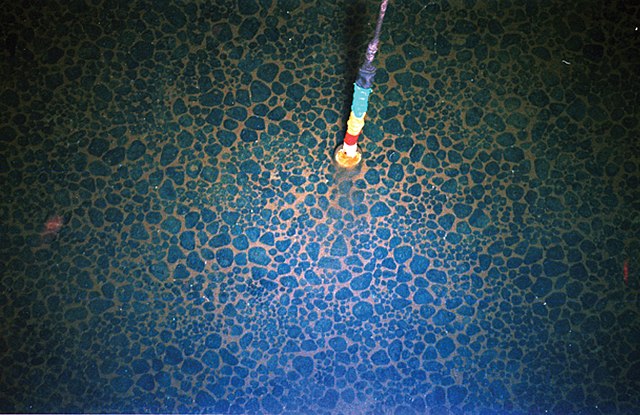
Chemically the same as normal oxygen, dark oxygen is, simply put, oxygen naturally produced in the absence of light or any biological process. How? 5 km deep into the Pacific Ocean, somewhere between Hawaii and Mexico, lumps of metal can be found scattered on the seabed. These lumps, composed of concentric layers of iron and manganese hydroxides, are known as polymetallic nodules. Millions of years in the making, these nodules are found on the ocean floor in an arrangement similar to that of potato fields. A single nodule, on its own, cannot generate a significant amount of electricity. But much like how some toys require multiple batteries to function, scientists now believe that in their current placement, these nodules can collectively generate enough electricity to break down salt water into hydrogen and oxygen.
How was dark oxygen discovered?
It all started when a team of scientists sent landers into the ocean to study how much oxygen deep-sea organisms use up at the bottom of the Pacific Ocean. They chose a spot largely undisturbed by oxygen-carrying currents, which made it a closed system. Scientists expected to observe a decrease in oxygen levels over time due to consumption, but their results revealed the opposite. At the time, this seemed impossible.
These scientists initially thought that their equipment was faulty. However, different equipment did not change the results. After years of disbelief, they had to accept their findings. There was a source of oxygen on the ocean floor. But what?
After ruling out oxygen-producing organisms and other possibilities, there only seemed to be one logical conclusion. The polymetallic nodules on the ocean floor behaved like natural batteries, splitting seawater into hydrogen and oxygen, a process that had not been observed before.

Dark oxygen is a major discovery. Firstly, because scientists had no idea this was even possible. Even though our oceans provide 50% of Earth’s oxygen, it was believed to be through a process called photosynthesis. Microscopic marine algae, or phytoplankton, are the ocean’s equivalent of plants. They use chlorophyll in their structure and sunlight to convert water and carbon dioxide into oxygen and energy in the form of carbohydrates. But now that we know that another process in the ocean is also producing oxygen, the question becomes, how much does this process contribute to Earth’s atmosphere? And since parts of the ocean floor can have much more oxygen than we previously believed, how does this affect the marine life there?
However, the implications of discovering dark oxygen are not just confined to Earth. All known life on Earth, and the only form of life we know, is carbon-based, and carbon-based life needs oxygen to survive. This is why oxygen has been an important parameter in our search for extraterrestrial life. The discovery of dark oxygen provides a new wave of hope for life on planets and moons with oceans.
A discovery like this also forces the people in charge to stop and think before allowing deep-sea mining. Companies interested in deep-sea mining previously reassured us that mining polymetallic nodules was environmentally friendly. But now that we know that these nodules are nature’s batteries and may play a crucial role in oxygen production, we must also realize that even the slightest disturbance can have a drastic effect, not just on marine life, but also on our environment.
But the biggest implication, by far, is the realization that we may have mapped the surfaces of other planets using probes and advanced telescopes, but there are still so many of the universe’s mysteries, right here on Earth, that we have yet to discover. What else is hidden beneath those waves? It may take many more decades to know.
References
Copyright @smorescience. All rights reserved. Do not copy, cite, publish, or distribute this content without permission.
SUBSCRIBE TO OUR NEWSLETTER
.......... ..........Subscribe to our mailing list to get updates to your email inbox.
Monthly Newsletter