Cecilia Payne-Gaposchkin (1900–1979) was a British-American astronomer who discovered what stars are made of. By studying the light from stars, she showed that they are composed mostly of hydrogen and helium, overturning the long-held belief that stars had the same composition as Earth. Her doctoral thesis at Harvard is considered one of the most important in the history of astronomy.
Scientist Quick Facts
Cecilia Payne-Gaposchkin
Born: 1900 — Wendover, England
Field: Astronomy / Astrophysics
Known For: Discovering that stars are made mostly of hydrogen and helium
Legacy: First woman to become a full professor and department chair in astronomy at Harvard.
Early curiosity and a love for science
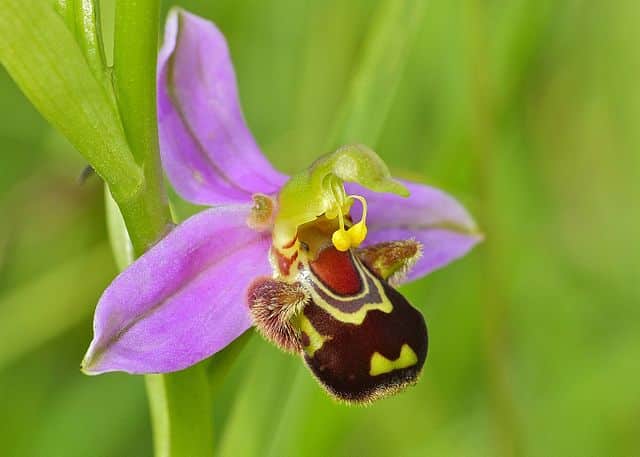
At eight years old, Cecilia Payne made a vow to a bee orchid to dedicate her life to studying science.
She had been inspired by identifying the flower based only on her mother’s description. “I was dazzled by a flash of recognition,” Cecilia said later. “I think my life as a scientist began at that point.”
Aspiring to be a scientist was unconventional for an English girl born in 1900, but Cecilia refused to be limited by conventions.
In school, Cecilia loved the subjects girls were supposed to study: literature, art, music, and languages. She loved the subjects they were not supposed to study even more: math and science. She was expelled from one school for being too curious.
Her single mother couldn’t afford to send Cecilia to college, but she won a scholarship to Cambridge University.
Bee Orchid, Credit: Wikimedia/Bernard DUPONT
Studying physics at Cambridge
At Cambridge, Cecilia chose to study physics even though she was usually the only woman in her classes.
Her first year, she attended a lecture by Arthur Eddington, a famous astronomer. She immediately knew she wanted to be an astronomer, but she wasn’t allowed to change her field.
Instead, she learned everything she could about astronomy from books and lectures. Eventually she convinced Eddington to let her work at the Cambridge observatory.
Cecilia finished her studies, but she did not receive a degree. Cambridge did not award degrees to women until 1946.
A new opportunity at Harvard college observatory
Cecilia knew that she could not work as an astronomer in England. The only job open to her was teaching school.
At the thought of becoming a schoolteacher, she said, “I felt an abyss opening before my feet. My taste for the world of scientists had unfitted me for such a calling.”
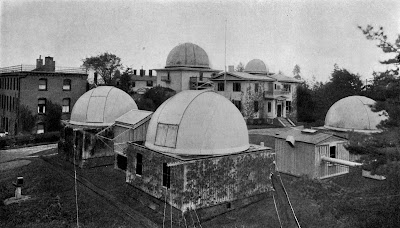
Then she learned that Harvard College Observatory (HCO) in America hired women to do calculations. If the HCO had female employees, maybe it would accept a female graduate student. The HCO’s director agreed.
Harvard College Observatory
Discovering what stars are made of
At the HCO, Cecilia studied the spectra of stars.
Scientists knew that when light passed through a gas, certain energies of light were absorbed by the gas. Those specific energies showed up as black lines on a spectrum. The pattern of lines was unique to each kind of gas.
Cecilia thought a star’s spectrum might reveal what it was made of. Astronomers thought that stars were made of about the same things as the Earth. Until Cecilia, no one had found a way to test that idea.
After a year of “utter bewilderment” and another year of “estimation, plotting, [and] calculation,” Cecilia succeeded.
She showed that stars aren’t like the Earth at all. They are made almost entirely of hydrogen and helium.
Black telescope under blue and blacksky
A groundbreaking thesis and limited recognition
Thirty-seven years later her thesis was called “undoubtedly the most brilliant Ph.D. thesis ever written in astronomy.”
She was the first Harvard student to get a Ph.D. degree in astronomy. But Harvard didn’t award degrees to women in 1925. So her degree officially listed “Radcliffe College,” Harvard’s sister college.
Even after such a brilliant discovery, Cecilia had a hard time making a career in astronomy.
For years she did the work of a professor while being called a “technical assistant.” Her small salary came from the HCO’s equipment budget. She taught many classes, but her name wasn’t included in the course catalogs.
Harvard’s president had declared that a woman would “never get a teaching position at Harvard.” Finally, at age 56, she became the first woman promoted to full professor. She went on to become the first woman to be a department chair at Harvard.
Life beyond the observatory
Cecilia defied conventions in other areas of her life.
At age 30, she bought a car and drove across the country. She later starred in an astronomy-themed musical and conducted an orchestra.
At 33, she helped astronomer Sergei Gaposchkin escape Nazi Germany. They married a few months later. For their honeymoon, they toured America’s observatories.
Cecilia taught classes and lectured at conferences while she was pregnant. Sergei often cared for their three children while she worked. She also frequently brought her children with her to work.
Cecilia Helena Payne Gaposchkin, Credit: Wikipedia/Smithsonian Institution
A lasting legacy in astronomy
When Cecilia died at age 79, her obituary called her “probably the most eminent woman astronomer of all time.”
She might have objected to “woman” being included in the description. As she once wrote, “We were scientists, we were scholars. Neither of these words has a gender.”
Copyright @smorescience. All rights reserved. Do not copy, cite, publish, or distribute this content without permission.
Join 20,000+ parents and educators
To get the FREE science newsletter in your inbox!
SUBSCRIBE TO OUR NEWSLETTER
.......... ..........
Subscribe to our mailing list to get updates to your email inbox.