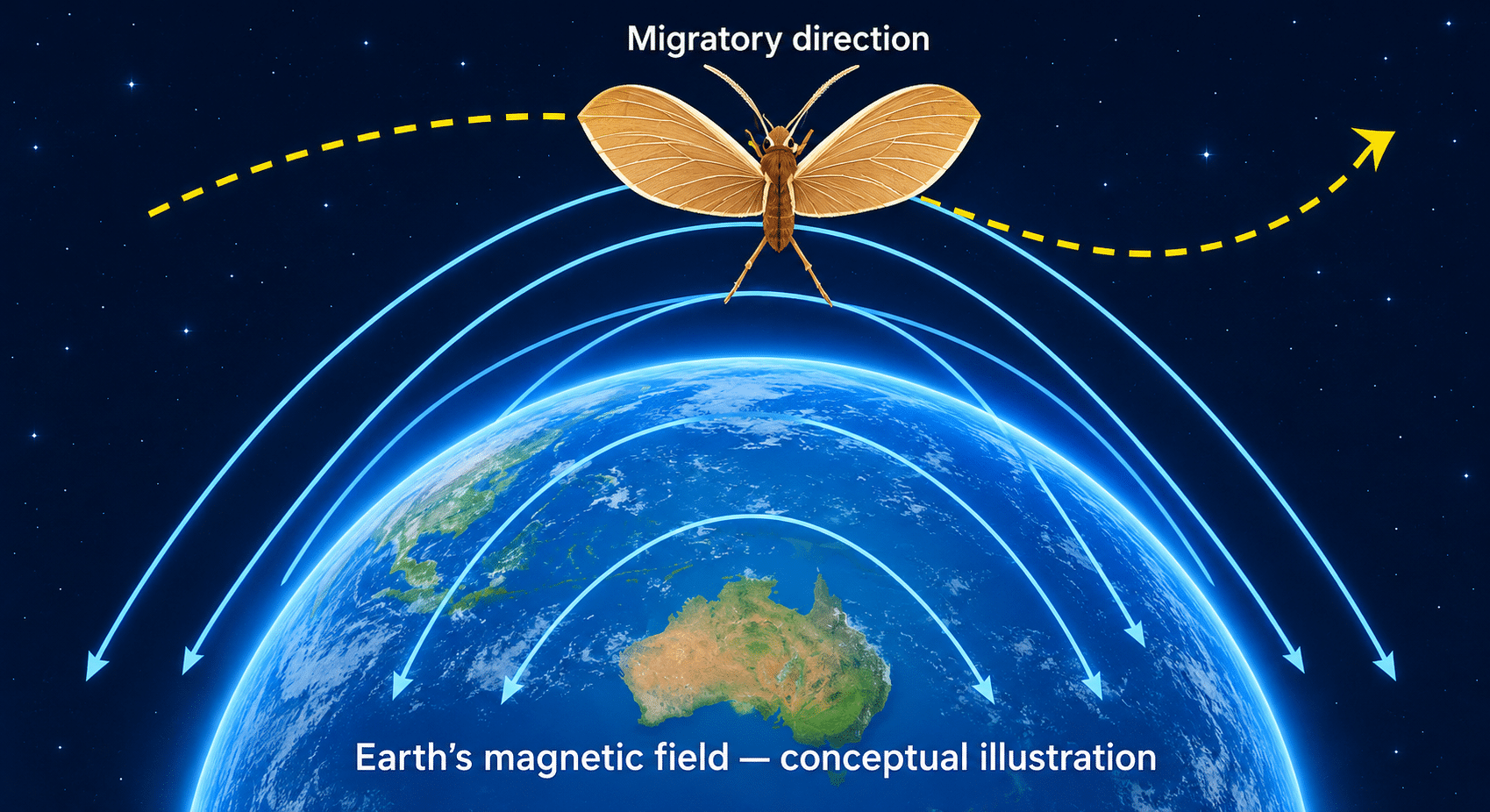
A tiny moth can find its way across hundreds of miles using a force it cannot see: Earth’s magnetic field. Scientists have now shown that Australia’s Bogong moth can use this invisible signal as a compass, even when the stars offer no useful direction.
A long journey to a cool mountain hideaway
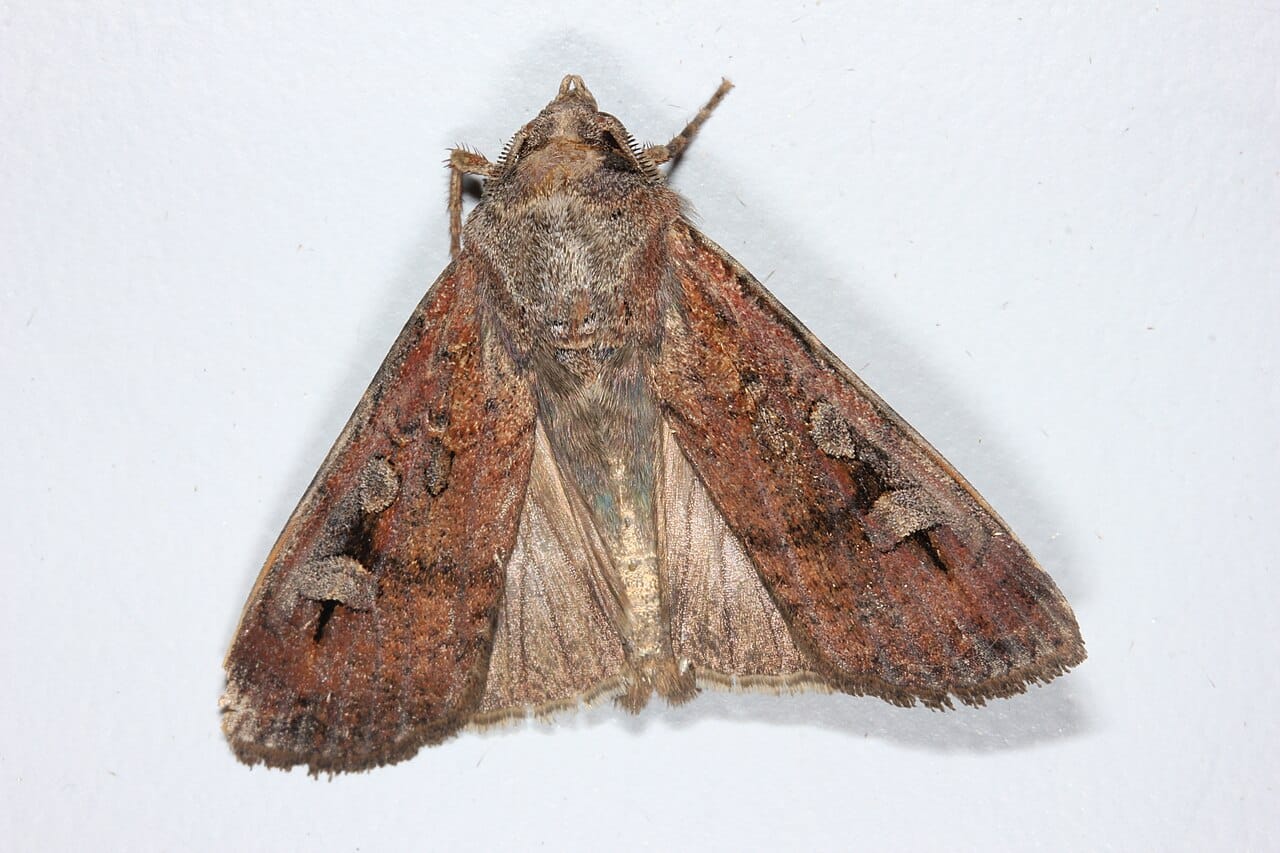
The Bogong moth (Agrotis infusa) is a night-flying insect from southeastern Australia. Each spring, moths travel as far as 1,000 kilometers to cool caves and rocky shelters in the Australian Alps. There, they spend months resting through the hot season. In autumn, they fly back toward their breeding areas.
That is a remarkable trip for an insect only a few centimeters long. The moths do not simply wander until they find the mountains. Their migration follows a seasonal direction, and many of the moths have never visited their destination before.
A compass made from a magnetic field
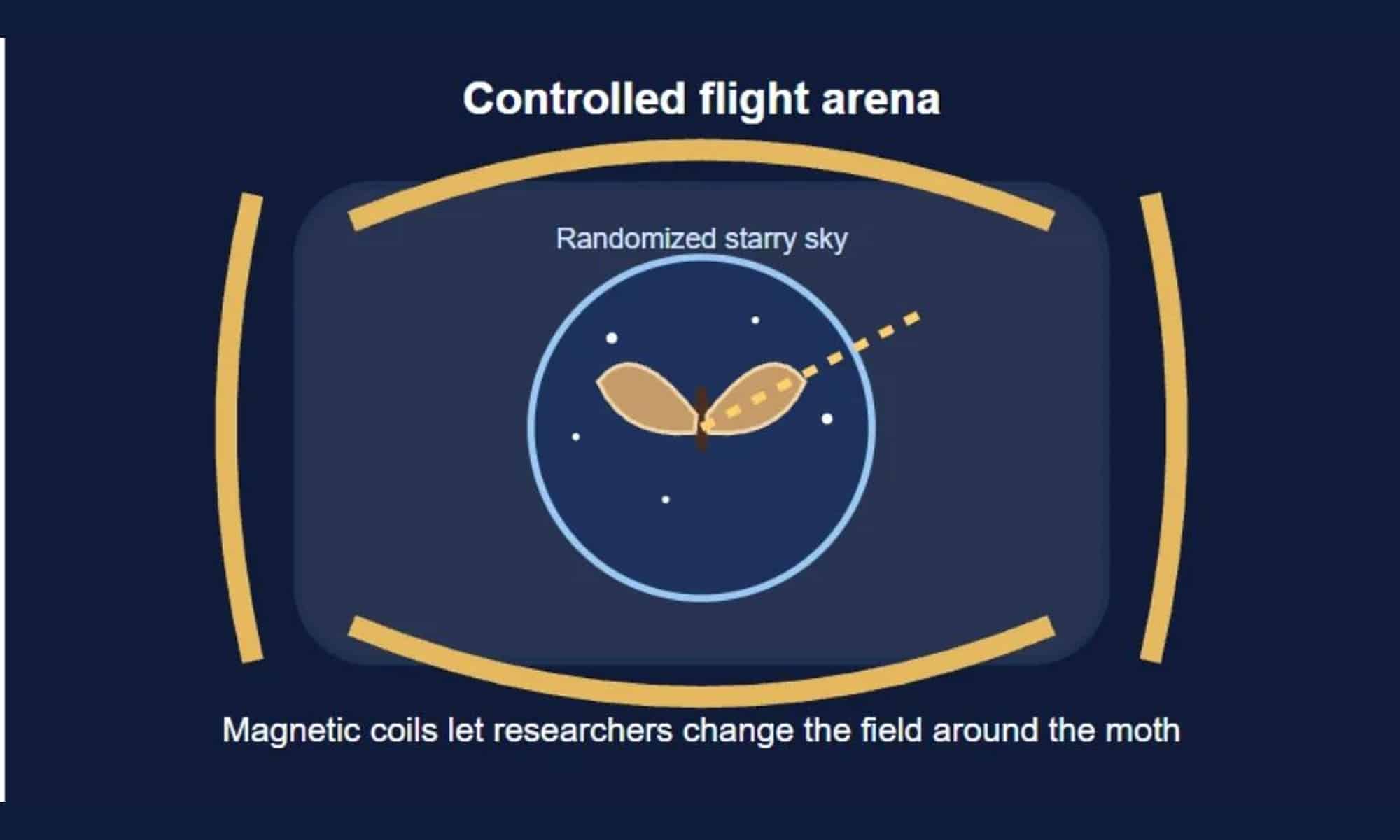
Researchers already knew that Bogong moths can use the night sky to help them navigate. The new study asked whether Earth’s magnetic field could guide them too. To test this, the team placed migrating moths in a special flight arena inside a system of magnetic coils.
The moths were gently attached to a tiny rod so they could turn in any direction while the researchers measured their flight headings. Above them, a screen showed a starry sky with the stars scrambled. It looked like night, but it did not point toward north, south, or the moths’ destination.
The researchers could also change the magnetic field around the arena. With the normal field in place, the moths still pointed in their expected seasonal migration direction. When the team turned the magnetic field around horizontally, the moths turned their flight direction too. When the magnetic field was removed, the moths lost their shared heading.
The moth reads the tilt, not a magnetic north pole
Earth’s magnetic field does more than point from one magnetic pole to the other. Its invisible lines also tilt into or out of the ground. Scientists call this angle the field’s inclination.
The experiments showed that Bogong moths use this tilt as part of their compass. When researchers flipped the field’s tilt, the moths changed direction. But when they reversed magnetic polarity while keeping the field’s axis, the moths kept their original heading.
This is called an inclination compass. It is different from a compass needle, which points toward magnetic north. The moth appears to sense the way the magnetic field leans through the local ground and sky.
Why violet and blue light matter
The team then tested the light around the moths. When violet and blue wavelengths were removed, the moths could no longer use the magnetic compass. The researchers also found that weak radiofrequency noise disrupted magnetic orientation.
These results fit a proposed process called the radical-pair mechanism. In this idea, light-sensitive molecules may form pairs of tiny reactive particles. Earth’s magnetic field can affect how those pairs behave, giving an animal information about direction.
Proteins called cryptochromes are possible parts of this system. But the study did not identify which cryptochrome, if any, acts as the moth’s magnetic sensor. The mechanism is strongly suggested by the tests, not yet fully solved.
Why this discovery matters
Bogong moths use two long-range navigation tools: stars and Earth’s magnetic field. If clouds hide the stars, the magnetic compass can still help. If magnetic cues become unreliable, the stars may provide another guide. Local landmarks and other cues may help too.
The finding also adds to evidence that very different animals can evolve similar ways to sense the planet. Night-migrating birds use a light-dependent magnetic compass too. Moths and birds are separated by a huge stretch of evolutionary history, yet they may rely on related physical principles.
What scientists still don’t know
Scientists still need to find the exact light-sensitive molecule and the cells that read the magnetic signal. They also want to understand how a moth’s brain combines magnetic information with stars and nearby scenery during a real journey.
For now, one thing is clear: this small Australian moth has a remarkable navigation system. It can use the planet itself as a guide.
Why this discovery matters
Bogong moths show how a small animal can use a planet-wide signal to make a long journey. Their magnetic and star compasses may work together to keep migration on course when one source of information is unavailable.