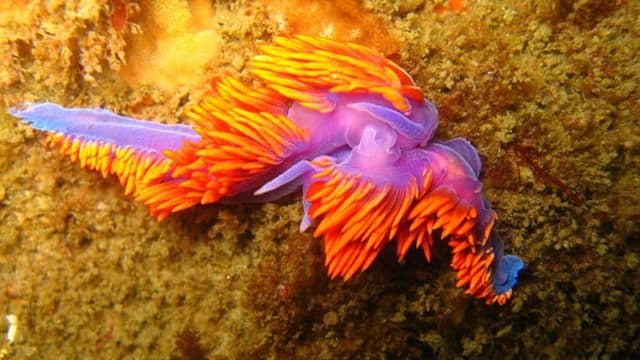
The term sea slug is often used interchangeably to describe many species with the “classic slug shape”—a long, slightly squashed cylinder. True sea slugs, like the blue glaucus, belong to a family known as nudibranchs . Nudibranchs are some of the most fascinating and beautiful marine creatures, with over three thousand species alive today! Sea slugs are technically marine snails. In their young, larval stages the sea slug has a shell. As they grow into adults, they lose this shell. Nudibranchs evolved around 150–100 million years ago,
Chromodoris lochi, Credit: Wikipedia/Alexander R. Jenner
Hypselodoris infucata, Credit: Wikimedia/Kris Mikael Krister
Flabelline iodinea, Credit: Wikipedia/Series8217
Nudibranchs are famous for their spectacular colors. In nature, animals that are poisonous are often very brightly colored. Think of poison dart frogs, or coral snakes. This is a phenomenon known as aposematism. The idea is that this is a signal to predators: “Hey, don’t eat me! I taste gross and I’ll probably make you sick!” When predators eat a visually striking animal and fall sick, they do not need to be taught the same lesson twice. That brightly colored creature, and other things like it, are probably best left alone. Nudibranchs use stinging cells to injure predators when they come close.
What is the blue glaucus?
The genus Glaucus are a particularly spectacular species of sea slug. Unlike other nudibranchs, these slugs do not rest on the seafloor. Glaucus spends its adult life right underneath the surface of the water. Their feathery, tentacle-like structures spread over the narrow interface between ocean and air. Using surface tension alone, these slugs stick to the surface of the water. Rain, shine, tide—they go with the flow!
The blue glaucus, or Glaucus atlanticus, also has some bizarrely morbid adaptations. Glaucus atlanticus feeds almost exclusively on the Portuguese man o’war, notorious for being one of the most dangerous sea creatures. Man o’wars are much bigger than the 3 centimeter (1.2 inch) sea slug. Rather than eat the whole thing, the blue glaucus takes little bites of the tentacles. Nudibranchs are also known for their stinging, and the blue glaucus is no exception. Stinging cells are expensive to produce, so rather than making their own from scratch, the blue glaucus is thought to repurpose the stinging cells of the man o’war as its own. Although not fatal to humans, the blue glaucus’ sting is definitely less than pleasant.
Since the blue glaucus spends its life upside down, it also needs to hide well from predators. Imagine you are a predator in the ocean. When you’re hunting for food, do you look up? Or do you look down?
Most marine predators prowl along ocean floors, looking above for prey. The glaucus employs a clever strategy known as countershading . The underside of the slug blends in with the surface of the water. When viewed from below, it looks like there’s nothing there at all!
This tiny but spectacular snail reminds us that life in miniature can be exciting indeed.
The majestic blue glaucus, Credit: Wikimedia/Sylke Rohrlach
Flesch Kincaid Grade Level: 60.4
Flesch Kincaid Reading Ease: 7.2
Glossary
Aposematism: A signal to predators of poor taste, poison, danger, or venom. It deters predators.
Countershading: A predator avoidance strategy designed for camouflage in marine ecosystems. Organisms employing countershading are invisible from below.
Nudibranchs: True sea slugs of the group gastropoda, with a shell in the larval stage. This group is known for its bright colors.
Yamini's (he/they) interests lie in environmental education, science communication and trying to build a better world. When not languishing in front of his laptop, they can be found outside, poking at any insect, bird or plant. They love making science accessible, especially to those who aren't encouraged to pursue it. Yamini hopes that the young women who read Smore love learning from their articles and get just a little bit more excited about science!