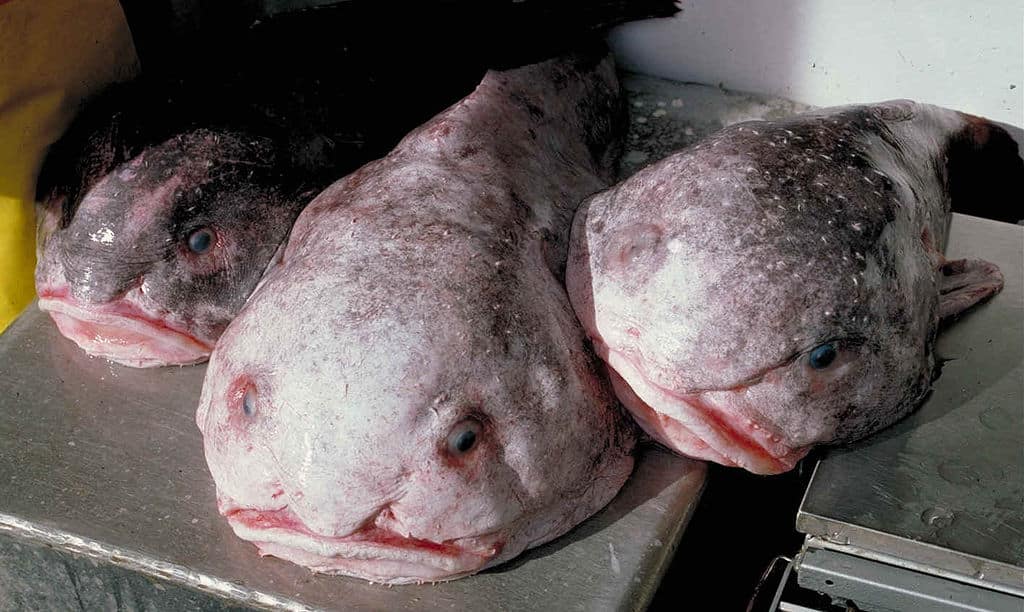
In 2013, the blobfish was crowned the World’s Ugliest Animal, and everyone seemed to agree. The only problem? The blobfish doesn’t look like its pictures at all.
Why is a blobfish so blobby?
Short answer? It isn’t. Blobfish, like other species, have developed according to their environment, and the environment of this alien-looking fish, up to 4,000 feet deep, near the seabeds of the Indian, Pacific and Atlantic oceans, is very different to ours.
Fish closer to the surface have air sacs inside their body that act as floaties. If a fish wants to move closer to the surface, it fills air into these sacs. To move lower, the fish deflates them. But down where the blobfish live, the pressure, caused by all the weight of the water above, is 100 times that of what we feel on the ground. Here, any air-filled spaces, including our lungs, would immediately collapse.
So it is safe to say that for any creature to exist in such a harsh environment, it needs a body a lot different from ours. Instead of air sacs, blobfish have a jelly-like layer in their body that helps them float up to 300 ft below the surface. Rather than red muscles, blobfish have white muscles, which are similar to the ones we have in our eyeballs. These help them move with a sudden striking speed but, at the same time, tire out quickly. They also have weak skeletons with delicate bones, and their soft tissue is saturated with water and fat, which helps them withstand external pressure. In addition, rather than scales, these fish have thin but flabby pinkish-grey skin that helps them move more easily across the sand. Even though they are less than 12 inches in length on average, their skin and all the internal fat and water can make them weigh as much as 9 kg.

All these characteristics are bound to affect a blobfish’s appearance. But even with a head that makes up 40% of its body, a pronounced nose and no teeth, it still does not look all that different from an average fish. It is not until it is brought out of its home into ours that its body begins to break down, giving it the infamous blob-like appearance. Much like how our tissue would expand and rupture in space from zero pressure, the tissue and skin of the blobfish expand too, making it lose its structure and collapse into a distorted shapeless mess.
What eats a blobfish and what does a blobfish eat?
There aren’t many food options at the bottom of the ocean. Light quickly begins to fade out 650 ft below the surface. And at 4,000 ft, none remains. Without any sunlight to warm the ocean’s water, the average temperature remains 4 centigrade, which is barely warmer than the freezing point. And because photosynthesis requires sunlight, there is no greenery to nibble on either. Add this to the fact that blobfish barely have the energy to do more than float around to where the current takes them, there doesn’t seem to be much hope.
But nature almost always finds a way, and a blobfish knows it must make do with whatever unfortunate creature crosses its path. So they lie in wait until a small crustacean, sea snail or other edible matter gets close enough. There are days when it must survive on microscopic bacteria and rocks alone. But when lucky, it may even find a nice juicy octopus in its path. Their white muscles may not help them much in regular movement, but they can provide short bursts of energy, enough to catch prey with its mouth and swallow it whole.
Luckily, there are no known predators of the blobfish. Its droopy flesh helps it slip away from other deep-sea creatures like octopus. And with a slow growth and ageing rate, they can easily live up to 130 years.
But, like most other species, these little escape artists do not have much luck when it comes to destructive man-made activities. Nets used for deep-fishing may injure them or drag them to the surface, where the lack of pressure may kill them almost instantly. Global warming, which could slowly warm up their near-freezing homes, may also make their environment inhabitable for them.
But for now, while mere mortals like us sit in front of screens and make fun of a poor little fish who had no say in being dragged away from its home only to be taken to an inhabitable world, these little marvelous creatures live on, oblivious to our existence, in depths we can barely fathom.
References
https://www.smithsonianmag.com/smart-news/worlds-ugliest-animal-blobfish-6676336/
https://www.sciencefocus.com/nature/the-blobfish-a-bloated-guide-to-the-worlds-ugliest-animal
https://www.nationalgeographic.com/animals/fish/facts/blobfish
https://octopus.org.nz/content/blobfish-facts
Copyright @smorescience. All rights reserved. Do not copy, cite, publish, or distribute this content without permission.
SUBSCRIBE TO OUR NEWSLETTER
.......... ..........Subscribe to our mailing list to get updates to your email inbox.
Monthly Newsletter