Table of Contents
Don’t you think there are many reasons to be envious of birds? They can fly off to different lands, eat juicy berries their entire lives, and sit on trees and sing all day long. But we can do one thing they can’t. We can talk, and they can’t… right? But that’s not entirely true. Some bird species can do that as well!
Conversations with a Bird
One of the most baffling puzzles in science is “why can’t chimpanzees and monkeys talk, but parrots can?” Monkeys are similar to humans in many ways. So, why do they lack vocal abilities? The ability to talk isn’t just a result of the physical capability to do so. Certain cognitive attributes are also needed. Cognitive attributes refer to the brain’s capacities. Monkeys and our other primate relatives have the physical ability to talk but lack the cognitive ability to do so.
Birds’ ability to talk can be attributed to the uniqueness of the avian vocal system . Their vocal system contains a specialized organ called the syrinx . It is present at the base of the trachea and can produce sounds. The syrinx has two sound-producing membranes. They can be controlled independently of one another. That means birds can produce two different sounds at the same time.

There’s a specific part of the brain that controls the ability to learn different languages and words. It’s called the forebrain . In some talking birds, like parrots, this part of the brain is more developed as compared to other birds. Some birds also have a greater number of brain cells called neurons which makes them smarter and gives them the ability to speak.
Not just parroting
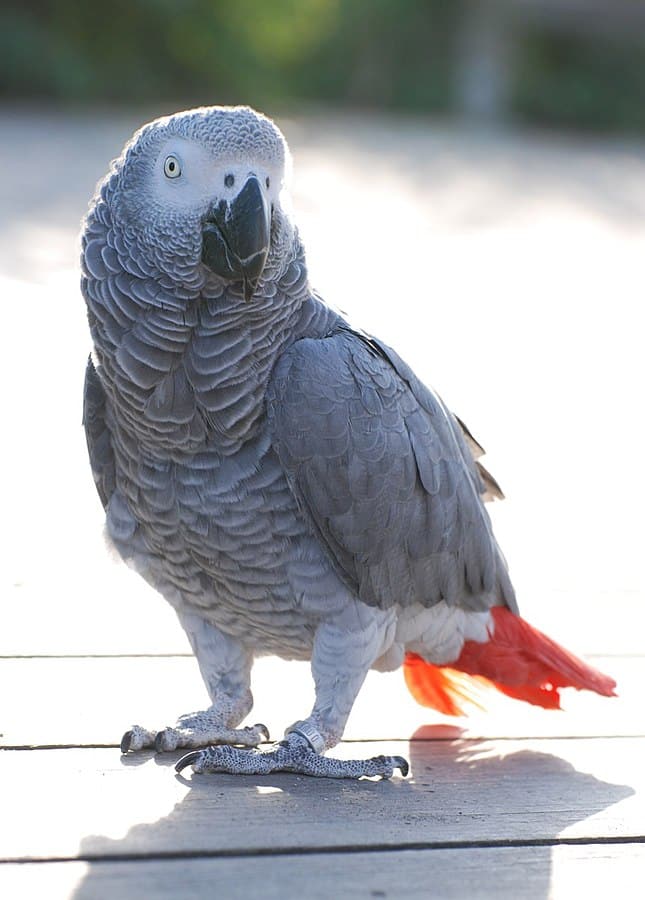
Hearing a bird talk can be an unbelievable experience. But most birds are just repeating and mimicking the sounds they hear. Unlike humans, they can’t understand or interpret the meaning of the words they speak, and unlike dolphins, they aren’t regarded as smart animals. But all that could be changed by the African Grey Parrot.
An animal psychologist, Dr. Irene Pepperberg, conducted many studies and experiments to understand and test the capacities of these birds. The experiments involved a lovely African Grey Parrot called Alex. After an initial training period in which he learned to understand words, he showed impressive abilities. He was able to identify objects that were different from the ones he had been shown and associate them with words he had learned. He was also able to pose his own questions. Alex could also use the words he had learned to request food items. Words like nut, corn, and water were part of his vocabulary.

This research raised important questions about the language and speaking ability of birds. It also made us question the extent of the cognitive abilities of these creatures, who were previously thought to be not-so-smart. Birds that talk are clever, too.
African Grey Parrots are hilarious and often naughty creatures. A mischievous African Grey Parrot named Rocco used Amazon Alexa to shop for food items, like broccoli, watermelon, and raisins, while his owner was away!
The song system
Songbirds, as their name suggests, are great at producing melodious tunes. They do this to attract potential mates and defend their territory. They can produce these sounds due to the presence of a unique song system. The song system consists of two major components:
the vocal learning pathway and the auditory pathway . The vocal learning pathway gives the bird the capacity to learn and produce sounds. It includes regions of the brain like the song nucleus and motor pathway , both of which enable them to produce sound and control their singing. The auditory pathway is responsible for the bird’s ability to analyze the song. This component allows them to recognize and imitate songs and sounds.
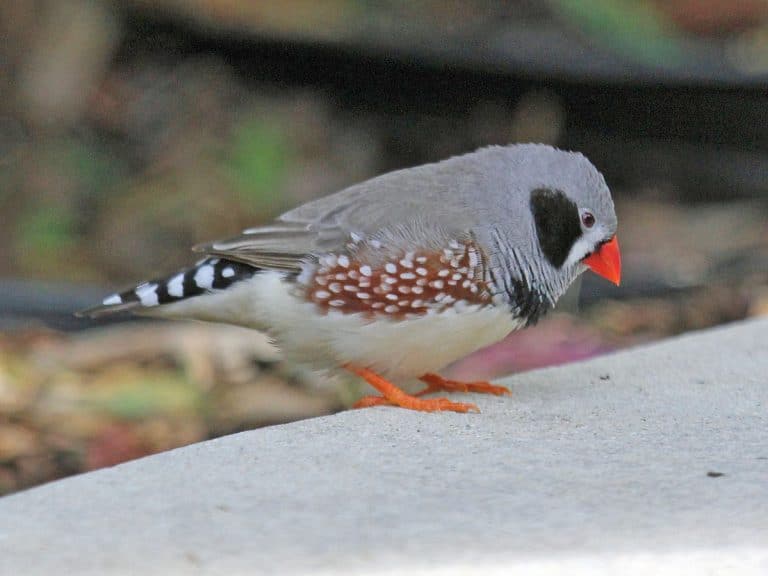
But having the ability to sing doesn’t guarantee the ability to sing. This is where the importance of cognitive and neural capacities comes in. These birds lack the brain and neural pathways that are involved in talking and language and hence can’t talk. This includes birds like songbirds, finches, and thrushes.
Can your pet bird mimic your alarm to wake you up?
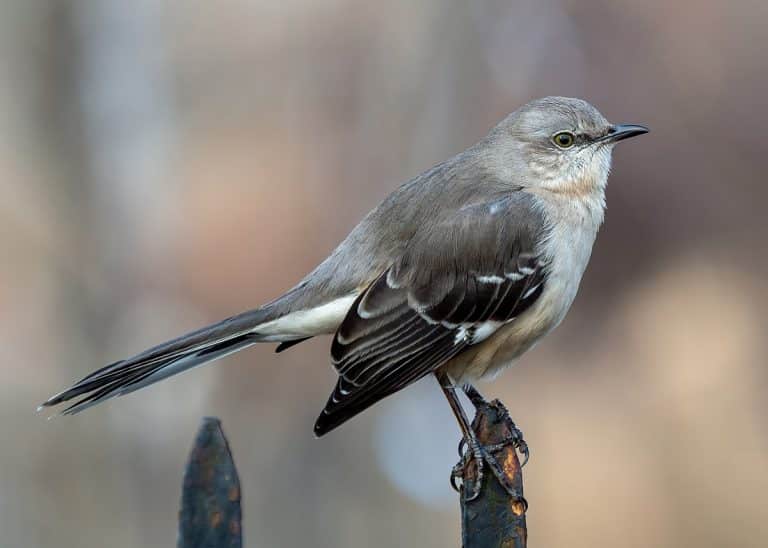
Some birds, like mockingbirds and lyrebirds, can make sounds other than those associated with humans. They can imitate a wide variety of sounds, like car engines, horns, alarms, and chainsaws. Although they can sometimes mimic human sounds, their ability to do so is limited and not as developed as that seen in parrots. There are a few reasons for this. Their vocal system doesn’t include the specialized syrinx. They also don’t have the cognitive capacity to do so, having a smaller brain-to-body ratio than parrots. Environmental circumstances also play a role. Parrots are highly exposed to human sounds. This exposure to human sounds makes them better at mimicking.

Birds that talk can have accents too! A parrot living in London may have a British accent and one living in New York may have an American accent. But the extent to which the accent is noticeable depends on the species of bird and the location they live in.
Babies and Finches
If I told you to plug your ears and pronounce a new word, you would have no way of knowing if you pronounced it right. That’s because in order to refine our sounds or vocalizations , we need to hear what we say. This is called auditory feedback . And it was seen that birds like parrots and zebra finches also rely on auditory feedback to fine-tune the sounds they produce. A series of experiments conducted on zebra finches has shown that auditory feedback is necessary to produce sounds, and it is similarly needed by babies as well. Human language acquisition , a process by which humans gain the ability to understand, analyze and interpret words and sentences, can be studied on birds that can talk and sing

Often, animals like dolphins take the crown for “smart animals.” But it is important to note that birds like parrots and parakeets are clever and intelligent too. Despite having some exceptional human-like abilities, they are often ignored. So, if someone calls you a “bird brain” take it as a compliment!
Flesch Kincaid Reading Ease: 64.9
Flesch Kincaid Grade Level: 7.6
Glossary
Cognitive attributes: The mental skills involved in reasoning and language
Primate: A group of mammals that includes monkeys and apes
Vocal system: An apparatus for producing sound
Syrinx: The specialized vocal organ in birds that talk
Forebrain: Front part of brain involved in language processing
Neurons: The brain’s nerve cells
Vocal learning pathway: A bird’s vocal training process
Auditory pathway: Responsible for a bird’s ability to analyze songs
Song nucleus: Controls a bird’s ability to sing
Motor pathway: A network controlling birds’ vocal movements
Brain and neural pathways: The brain’s communication network
Brain-to-body ratio: Measure of the size of an animal’s brain relative to its body size
Vocalizations: Sound produced for communication
Auditory feedback: Sound information received back
Human language acquisition: Learning to speak, process, and analyze language
References
Thorpe, W. H. (1959). TALKING BIRDS AND THE MODE OF ACTION OF THE VOCAL APPARATUS OF BIRDS. Proceedings of the Zoological Society of London (1944). https://doi.org/10.1111/j.1469-7998.1959.tb05530.x
Benedict, L., Charles, A., Brockington, A., & Dahlin, C. R. (2022). A survey of vocal mimicry in companion parrots. Scientific Reports, 12(1). https://doi.org/10.1038/s41598-022-24335-x
Petkov, C. I., & Jarvis, E. D. (2012). Birds, primates, and spoken language origins: behavioral phenotypes and neurobiological substrates. Frontiers in Evolutionary Neuroscience, 4. https://doi.org/10.3389/fnevo.2012.00012
Fitch, W. T., & Jams, E. D. (2013). Birdsong and Other Animal Models for Human Speech, Song, and Vocal Learning. The MIT Press EBooks, 499–540. https://doi.org/10.7551/mitpress/9780262018104.003.0020
Konishi, M. (1985). Birdsong: From Behavior to Neuron. Annual Review of Neuroscience, 8(1), 125–170. https://doi.org/10.1146/annurev.ne.08.030185.001013
Marler, P. (1970). A comparative approach to vocal learning: Song development in white-crowned sparrows. Journal of Comparative and Physiological Psychology, 71(2, Pt.2), 1–25. https://doi.org/10.1037/h0029144
Kozhevnikov, A. A., & Fee, M. S. (2007). Singing-Related Activity of Identified HVC Neurons in the Zebra Finch. Journal of Neurophysiology, 97(6), 4271–4283. https://doi.org/10.1152/jn.00952.2006
Pepperberg, I. M. (2007). Grey parrots do not always ‘parrot’: the roles of imitation and phonological awareness in the creation of new labels from existing vocalizations. Language Sciences, 29(1), 1–13. https://doi.org/10.1016/j.langsci.2005.12.002
Vates, G. E., Broome, B. M., Mello, C. V., & Nottebohm, F. (1996). Auditory pathways of caudal telencephalon and their relation to the song system of adult male zebra finches (Taenopygia guttata). Journal of Comparative Neurology, 366(4), 613–642. https://doi.org/10.1002/(sici)1096-9861(19960318)366:4
Gentner, T. Q. (2004). Neural Systems for Individual Song Recognition in Adult Birds. Annals of the New York Academy of Sciences, 1016(1), 282–302. https://doi.org/10.1196/annals.1298.008
Nordeen, K. W., & Nordeen, E. J. (1992). Auditory feedback is necessary for the maintenance of stereotyped song in adult zebra finches. Behavioral and Neural Biology, 57(1), 58–66. https://doi.org/10.1016/0163-1047(92)90757-u
Contributors
Copyright @smorescience. All rights reserved. Do not copy, cite, publish, or distribute this content without permission.
SUBSCRIBE TO OUR NEWSLETTER
.......... ..........Subscribe to our mailing list to get updates to your email inbox.
Monthly Newsletter