Sleep is like a superpower for your body and mind! It helps you grow, think, and stay healthy. But what really happens when you sleep, and why is it so important?
Sleep allows the body to heal, and triggers the release of growth hormone. Hormones circulate all around the body, influencing every organ from the brain to the stomach. Right after we fall asleep, the body slowly starts releasing growth hormone. Daily activities and exercise make small, tiny tears to our muscles. If you’ve had a tough day of sports or exercise, sleep helps your muscles recover so you can get back to doing what you love. Growth hormone helps heal and grow the damaged parts of our bodies while we sleep. Sleep also stops harmful hormones, like stress hormones, from being released.
Our immune system also depends a lot on a good night’s sleep. The body makes special proteins that fight infection and swelling throughout the body.
Perhaps more than any other organ, the brain needs sleep.
“When we sleep, the brain totally changes function,” Dr. Maiken Nedergaard, a sleep scientist, told the National Institutes of Health. “It becomes almost like a kidney, removing waste from the system.”
The brain has a lot of plumbing that only gets turned on when we sleep. This is what allows toxins and waste to drain out during the nighttime. If you’ve ever felt foggy or slow after a night with little sleep, you’re not mistaken. The brain takes care of a lot of processes, including memory and learning, during sleep. The brain replays everything you learned during the day. It sorts and stores these memories like a librarian organizing books. That’s why getting enough sleep before a big test is way better than pulling an all-nighter.
Napping isn’t exactly the same as a full night of rest either. Sleep throughout the night happens in about 90-minute cycles. You may have heard of terms like the “REM cycle.” Only recent research has helped reveal how important these cycles are. First, the body enters a light sleep. The body slowly relaxes, and breathing slows down. In deep sleep, hormones are released, the brain cleans up, and the body heals. REM stands for “rapid eye movement.” The eyes move quickly, even while they’re closed. The brain is super active during this stage, leading to vivid dreams and thoughts. REM sleep is vital for creativity and problem solving.
The sleep cycle , Credit: depositphotos.com/VectorMine
Skipping sleep doesn’t just make the body tired; it can have serious effects over time. Poor sleep can lead to problems like heart disease, diabetes, and even mental health issues like anxiety and depression.
Getting enough sleep is like giving your body a reset button every night. When you sleep well, you wake up ready to think, play, and tackle whatever the day brings!
Can lack of sleep cause heart problems?
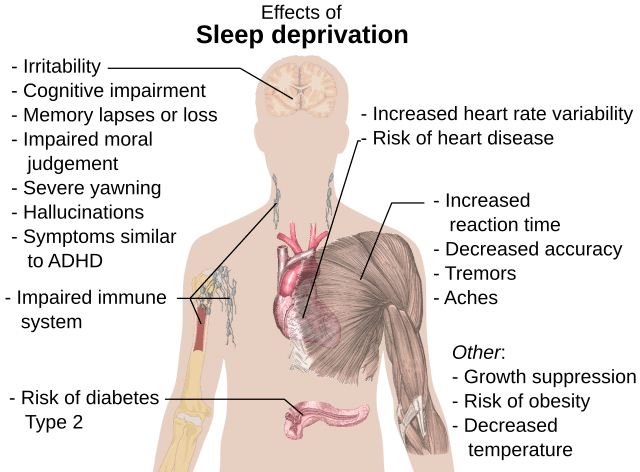
The heart is one of the most important organs in the body. It keeps blood pumping steadily, circulating it around every nook and cranny of our bodies. Heart problems are unfortunately common, and factors like smoking and a poor diet can cause these problems. Researchers are beginning to uncover just how vital sleep is for the heart.
The effects of sleep deprivation, Credit: Wikimedia/Mikael Häggström
When we’re awake and moving around, exercising and doing work, the heart beats faster. Our blood pressure also needs to be higher. In light and deep sleep, the heart slows down. Blood pressure drops. Although the heart can never really stop beating, this slowing is almost like the heart taking a cat nap. It allows the heart to recover a little from the strain of working all day.
Poor sleep can lead to higher blood pressure. It can also lead to a build-up of waste in blood vessels, making them narrower. Scientists found that people who sleep less than seven hours a night are at higher risk of heart failure.
How does compensatory sleep help?
Schedules during the week can be hectic. Whether people are working, going to school, or even pulling night shifts at a hospital, it can be hard to catch a full eight hours with that schedule. On weekends, when there’s less work, most people like to sleep in a bit. Even if they average five or six hours a night during the week, some people can get ten or even twelve a night on the weekends. Scientists call this compensatory sleep.
Most people have time to sleep in on weekends, Credit: depositphotos.com/NewAfrica
Since compensatory sleep is so common among people of very different lifestyles, scientists wanted to look at as many people as possible. To do this, they used the UK Biobank. It’s a long-term data set that has data from over half a million people! They examined people who averaged less than seven hours of sleep a night, but slept in a bit on weekends. Participants even used armband sensors to track sleep accurately.
A recent study found people who had the most catchup sleep had a 20% lower risk of heart disease than people who got very little catchup sleep.
“Sufficient compensatory sleep is linked to a lower risk of heart disease,” said study co-author Mr Yanjun Song in a press release. “The association becomes even more pronounced among individuals who regularly experience inadequate sleep on weekdays.”
The most incredible part of the study is that they tracked participants for over 14 years to build these links. Data over long periods of time tends to be more reliable than over short periods.
Although it’s not as good as a consistent eight hours every night, a weekend lie-in definitely helps. The takeaway? If you can catch up on lost sleep, it’ll always help your body function.