From the eagle’s ability to spot prey from miles away to the chameleon’s ability to see almost every angle of its surroundings, the animal kingdom is full of unique and complex visual perspectives, each adapting their vision to survive in their habitat. Here are our top 10 animals with the best eyesight.

10- Bees (for their ability to see ultraviolet light)
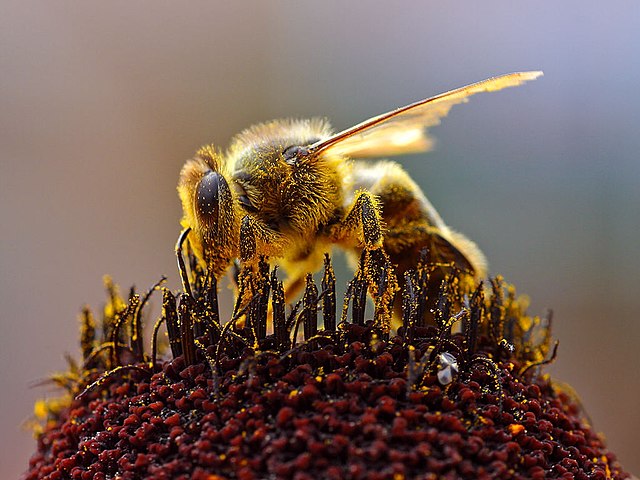
Geographic Location: There are 20,000 bee species worldwide, and they can be found worldwide (except Antartida), especially in areas rich in flowering plants, including gardens, meadows, and forests.
Eyesight Skills: The bee’s vision is surprisingly complex since animals have less than a million neurons in their small brains. Their simple brain structure makes bees a relevant biological model for studying visual perception, learning, and memory. Contrarily to humans, bees have extraordinary vision that allows them to see ultraviolet light. This skill helps bees locate nectar in flowers, as many plants have ultraviolet patterns on their petals that guide bees to their nectar sources. Its color vision is critical for increasing efficiency in reproduction. Moreover, bees use polarized light in the sky to navigate, enabling them to find their way home and food sources.
Scientific Insights: The bee’s compound eyes, consisting of thousands of tiny lenses called ommatidia, are marvels of evolutionary biology. Each ommatidium contributes to a mosaic-like vision, enabling bees to detect movement extremely quickly and see a wide range of colors, including those in the ultraviolet spectrum. This vision is crucial for their role in pollination and ecosystem health.
9- Dogs (certain breeds with exceptional eyesight)

Geographic Location: Dogs are domesticated animals in a wide range of environments globally, from rural to urban areas.
Eyesight Skills: Certain dog breeds are known for their exceptional eyesight. For instance, sight-hound breeds were chosen for their ability to hunt based on sight and speed, while terriers were chosen to hunt ground-living vermin, relying on their keen sense of smell and strong bodies for persistent digging until their prey is found. Dogs contain rod-dominated retinas that allow them to see well in the dark. The tapetum lucidum structure enhances their night vision, reflecting light back through the retina and improving their vision in low light conditions. In addition to this ability, dogs have better motion visibility than humans. However, because their retinas contain only about two types of cones (than in humans), dogs do not see colors as humans do. Therefore, dogs can only distinguish blue from yellow but not red from green. Breeds with exceptional eyesight are frequently used in activities requiring keen vision, such as hunting, herding, and agility competitions.
Scientific Insights: In addition to exceptional vision skills, dogs are also recognized for their intelligence and interaction with humans. These animals have the ability to understand human gestures, facial expressions, and commands, which underscores their deep bond with humans. Dogs show empathy, can learn complex commands, and, in some cases, can predict human emotional states or health issues.
8- Chameleons

Geographic Location: Chameleons are primarily found in Madagascar and Africa, but they also live in southern Europe, the Middle East, and parts of Asia.
Eyesight Skills: Chameleons possess highly distinctive eyes that can rotate independently, allowing them to look in two different directions at the same time. Chameleons’ bulging, swiveling eyes can give them a panoramic vision (around 180 degrees horizontally and 90 degrees vertically), helping to identify potential threats. Each eye has a cone-shaped eyelid fused to the eyeball with a tiny hole in the center for the pupil. This highly specialized structure contributes to their ability to focus and magnify images at varying distances. This adaptation is crucial for their survival, enabling them to spot and accurately target insects from several meters away.
Scientific Insights: Chameleons are almost impossible to see being capable of changing color from subtle shifts in shades of brown to remarkable ensembles of orange, blue, green, and ultraviolet. Some studies demonstrated that this unique ability and exceptional vision help these animals against threats since these lizards are defenseless. They don’t have a dangerous bite, their skin isn’t packed with poison, and they can’t move quickly. Staying hidden is pretty much their only tactic to evade predators.
7- Dragonflies
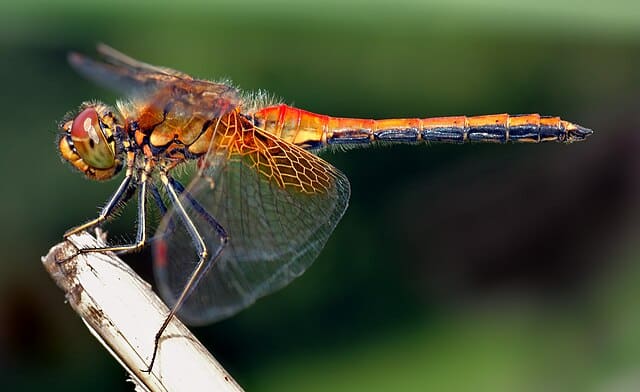
Geographic Location: Dragonflies are ubiquitous and can be found near water bodies such as lakes, ponds, rivers, and wetlands worldwide.
Eyesight Skills: Dragonflies have remarkable vision, with nearly 360-degree sight due to their large, multifaceted eyes. Due to the lack of auditory organs and the reduced size of the antennae, dragonflies possess large compound eyes containing thousands of ommatidia. Dragonflies can detect and catch small insects, wherein brightly colored males attack rival males and mate with dull-colored females. Some studies have shown that the compound eyes of dragonflies contain three to five classes of photoreceptors, with distinct spectral sensitivities covering the UV to red spectral range.
Scientific Insights: Although small dragonflies are essential for the environment. They are crucial as predators (mainly mosquitos) and prey to fish and birds. Interestingly, since dragonflies require stable oxygen levels and clean water, scientists consider them reliable bioindicators of the health of an ecosystem. In fact, one study described that 10% of dragonfly species were under threat of extinction because of the destructi
6- Cats (particularly the big cats)
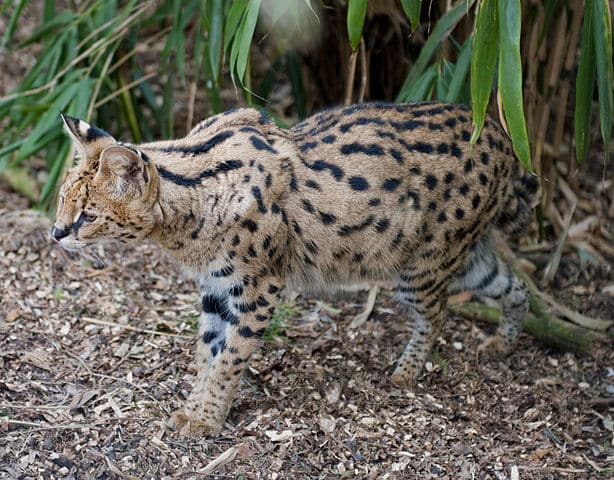
Geographic Location: Big cats, such as lions, tigers, and leopards, are found across Europe, Africa, Asia, and North and South America. They have adapted to various habitats, including savannas, forests, mountains, and grasslands.
Eyesight Skills: Big cats have exceptional night vision, allowing them to hunt effectively in low-light conditions. Their pupils can expand significantly in low light, allowing more light to enter the eye. The eyes of these felines are adapted to detect even the slightest movements, making them formidable predators. The structure of their eyes, including the large lens and cornea, gathers and focuses light efficiently. Big cats have a tapetum lucidum at the back of each retina, which enhances their ability to see in the dark. They also have several nerves running horizontally across the eye’s center, increasing their peripheral vision. Big cats have more rods (responsible for visual acuity for shapes) in their eyes than cones (responsible for color), so it has been described that these animals only see greens, blues, and reds.
Scientific Insights: Worldwide, there are 38 species of cats, most of them relatively small. However, large cats, including lion, tiger, leopard, snow leopard, clouded leopard, jaguar, lynx, and cheetah, can be found in several habitats, and some of them are listed as endangered by the IUCN Red List. For example, tigers have been extensively hunted as trophies and for use in traditional Chinese medicine.
5- Mantis Shrimp

Geographic Location: Mantis shrimp are predominantly found in the warm waters of the Indian and Pacific Oceans.
Eyesight Skills: Mantis shrimp have the most complex eyes in the animal kingdom, and they can perceive the world through 12 channels of color. They can detect ultraviolet and polarised light, which humans can’t access with the naked eye. Their ability to see polarized light, which is light waves oriented in particular directions, is unique and gives them an advantage in detecting prey hidden in the water. Their eyes are mounted on mobile stalks and can move independently, allowing them to scan their surroundings without moving their bodies. This exceptional vision aids in detecting prey, predators, and mates in the complex underwater environment.
Scientific Insights: The visual complexity of mantis shrimp still needs to be fully understood but is thought to play a role in communication and mating, as well as in hunting and navigation. Interestingly, in addition to their incredible vision, these animals are also known for their hunting techniques. Mantis shrimp are small but impressive predators that can kill prey bigger than themselves. Mantis shrimp employ two distinct hunting tactics based on their species: “Spearer” species ambush unsuspecting fish, impaling them with a sharp spike at the end of their arms, while “smashers” like the peacock mantis shrimp utilize their hammer-like claws to deliver powerful blows to hard-shelled prey like crabs and clams. Therefore, these animals have one of the fastest limb movements of any animal.
4- Owls

Geographic Location: Owls are found globally, except in Antarctica, inhabiting various environments, from dense forests to open prairies.
Eyesight Skills: Owls are renowned for their exceptional night vision, among the best in the animal kingdom. Their large eyes are highly adapted to low light conditions, enabling them to spot prey during nocturnal hunting. Their eyes are tubular, providing a larger surface area for light absorption. The retina of an owl’s eye is densely packed with rod cells, which are more sensitive to light than cone cells, enhancing their ability to see in low light. Owls cannot move their eyes within their sockets; instead, they rotate their heads up to 270 degrees to scan their surroundings. Their vision is not just about seeing in the dark; they also have acute depth perception and can judge distances accurately, which is essential for capturing prey.
Scientific Insights: In addition to eyesight skills, owls also have exceptional hearing capacities. These two features are crucial for hunting and survival. Owl hearing is undoubtedly more sensitive than other birds, particularly at frequencies of 5 kHz and above. Their asymmetrically placed ears allow for precise sound localization, enabling them to pinpoint the exact location of their prey without visual cues.
3- Falcons
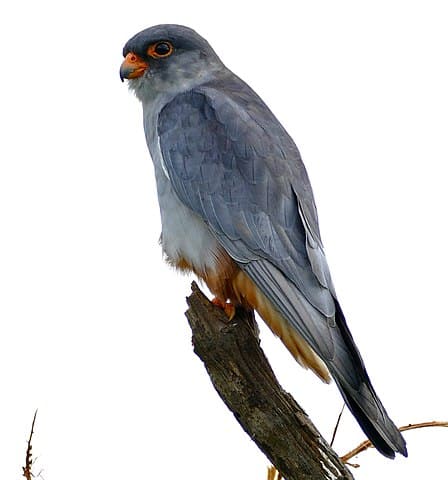
Geographic Location: Falcons are birds of prey found worldwide except Antartida but thrive particularly well in wide-open spaces and mountainous regions.
Eyesight Skills: Falcons possess some of the most acute vision in the animal world, allowing them to spot small prey several kilometers away. This keen eyesight is critical for their hunting strategy, which involves diving at high speeds to catch their prey by surprise. Falcons also have a high degree of foveal concentration, which provides them with sharp central vision, essential for tracking fast-moving targets. Additionally, falcons have a nictitating membrane that cleans and protects the eye at high speeds and acts as a filter to reduce glare from sunlight, enabling them to maintain visual clarity while diving at their prey.
Scientific Insights: Another feature that characterizes these animals is their ability to fly at high speed. For example, the peregrine falcon is the world’s fastest diving bird. The highest speed detected until now was approximately 370 kilometers per hour. Both skills in falcons make them incredible predators and
2- Hawks

Geographic Location: Hawks are found in diverse habitats worldwide, including forests, mountains, grasslands, and tropical rainforests.
Eyesight Skills: Hawks are renowned for their excellent vision, estimated to be several times sharper than a human. This visual acuity lets them detect small rodents and other prey from great distances. Their eyes are forward-facing, providing excellent depth perception for hunting and navigating through dense foliage. The hawk’s visual prowess is due to a combination of factors, including many photoreceptor cells in the retina and a high concentration of cones, particularly in the fovea area. This specialization allows hawks to see in vivid detail and even detect ultraviolet light, helping them track the urine trails of prey.
Scientific Insights: Interestingly, some studies demonstrated that the color of the prey can help hawks detect, pursue, and capture them. For example, it has been described that Harris’s hawk has the best color vision of all animals investigated until now, even better than humans. These results are relevant for the conservation of this species since one reason for the decline in the number of these birds is collisions with structures such as wind turbines and power lines.
1- Eagles

Geographic Location: Eagles are found in various habitats worldwide, from the tundra to tropical rainforests.
Eyesight Skills: Eagles have some of the most powerful eyesight in the animal kingdom, enabling them to spot potential prey from several kilometers away. Their eyes are large in proportion to their heads, and they have a high density of photoreceptor cells even compared with other birds. Eagles use this keen eyesight to hunt and navigate vast distances, spotting fish in water or small mammals on the ground with incredible precision. Some studies have described that eagles have a visual acuity about 8 to 10 times greater than humans. This visual sharpness can be attributed to their eye optics, consisting of a multi-lens construction similar to a telephoto objective lens system. Eagles’ eyes are highly specialized, with a large fovea with dense cones for sharp, detailed vision. This adaptation allows them to see fine details from great distances and even distinguish colors more vividly than humans can. Their ability to perceive UV light helps them to see the urine trails left by prey animals, which are invisible to the human eye, further enhancing their hunting efficiency.
Scientific Insights: As a strategy to hunt, these animals are extremely fast compared to other birds, and the golden eagle is considered one of the fastest birds worldwide.
Copyright @smorescience. All rights reserved. Do not copy, cite, publish, or distribute this content without permission.
SUBSCRIBE TO OUR NEWSLETTER
.......... ..........Subscribe to our mailing list to get updates to your email inbox.
Monthly Newsletter