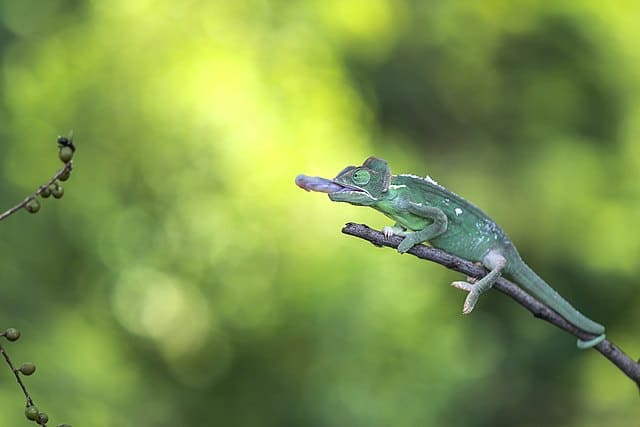
This blog post explores the top 10 animals with the best camouflage abilities, highlighting their geographic locations, special camouflage skills, and interesting facts.
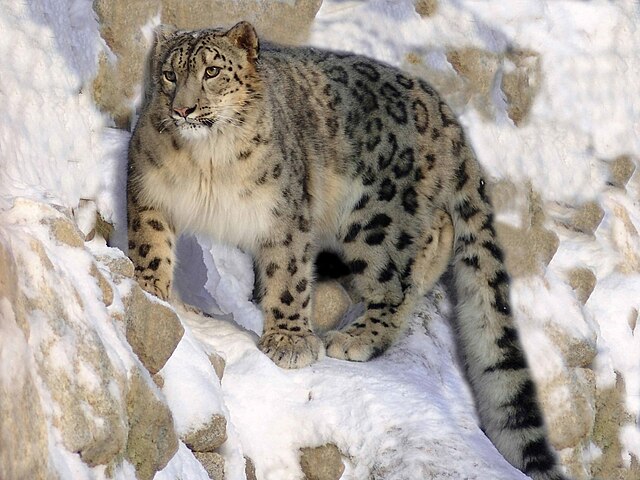
10- Snow Leopard
Snow Leopard, Credit: Wikimedia/Irbis1983
Geographic Location: Snow leopards are found in the mountain ranges of Central and South Asia across 12 countries: Afghanistan, Bhutan, China, India, Kazakhstan, Kyrgyz Republic, Mongolia, Nepal, Pakistan, Russia, Tajikistan, and Uzbekistan.
Camouflage Skills: The snow leopard’s thick, patterned fur blends seamlessly with the rocky, snowy landscapes of its mountainous habitat. This camouflage helps it ambush prey and remain unseen by predators.
Scientific Insights: Snow leopards have evolved to live in some of the harshest conditions on earth. Their large paws act like natural snowshoes, and their long tail aids in balance and are used to cover sensitive body parts from the cold. These animals were classified as vulnerable because their global population is estimated to be between 2500 and 10000 individuals. However, the snow leopards’ exact population is challenging to obtain because 70% of their habitat still needs to be explored by humans. Scientists suggested that compensatory modifications in the oxygen transport have enabled them to thrive at high altitudes where oxygen levels are low.
9- Flounder
Flounder, Credit: Wikimedia/Roban Kramer
Geographic Location: Flounders are found in ocean waters around the world, from the northern Arctic Ocean to the warm waters of the tropics.
Camouflage Skills: Flounders have the remarkable ability to change their skin color and pattern to match the ocean floor. This effective camouflage increases an animal’s success as a predator and its ability to hide from potential predators. Flounders can change color due to the presence of pigment-containing cells called chromatophores, giving them some available patterns to select the most appropriate to the background.
Scientific Insights: Over the years, scientists have been intrigued by the flounder’s asymmetrical physiology. The mechanism that triggers the flat structure has now been identified by comparing the genomes of two related fish species (Japanese flounder and its distant relative, the tongue sole). These animals start their lives fully symmetrical but undergo metamorphosis, where the larva is transformed into an asymmetric juvenile whose eyes end up on one side of the head. Retinoic acid is the main molecule responsible for the changes in skin pigments in flounders, which can interact with a thyroid hormone that causes eye migration.
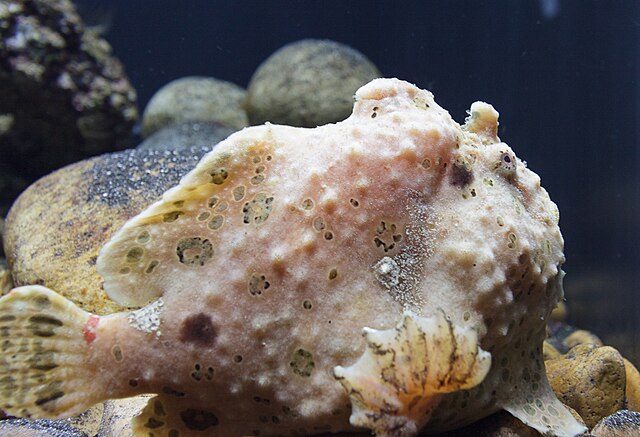
8- Frogfish
Frogfish, Credit; Wikimedia/Julia Sumangil
Geographic Location: Frogfish inhabit the tropical and subtropical waters of the Atlantic and Pacific Oceans, often found around coral reefs.
Scientific Insights: Frogfish possess a unique hunting tool – a lure on their forehead called an esca, which they wiggle to attract prey. Their ability to change color and texture is not as rapid as some cephalopods but can adjust over days or weeks to match their surroundings, a process controlled by hormones.
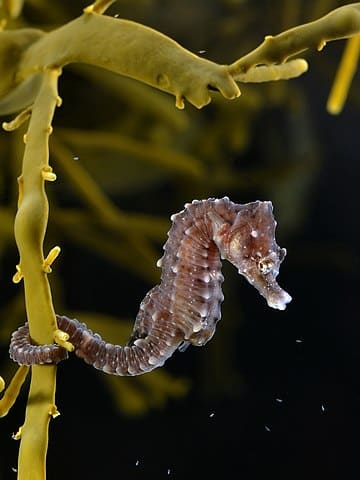
7- Seahorses
Seahorse, Credit: Wikimedia/Hans Hillewaert
Geographic Location: Seahorses are found in shallow tropical and temperate waters worldwide, often in seagrass beds, coral reefs, or mangroves.
Camouflage Skills: Seahorses use their body shape, coloration, and the ability to hold still among plants and corals to blend into their surroundings, making them hard to spot. These animals contain specialized structures in their skin cells called chromatophores, allowing the primarily sessile seahorses to change color to mimic their surroundings.
Scientific Insights: Over the years, scientists have described that seahorse species can vary considerably in appearance and size. For example, the largest reaches 35 centimeters in length, and the smallest can be just two centimeters in the adult phase. Seahorses are unique for their camouflage and reproductive behavior, with males carrying the eggs in a pouch until they hatch. Their prehensile tails, which can grasp onto vegetation, help them stay in one place, aiding in their camouflage strategy.
6- Cuttlefish
Cuttlefish, Credit: Wikimedia/Nhobgood Nick Hobgood
Geographic Location: Cuttlefish are found in oceans worldwide, but they are frequently seen in the Eastern Atlantic Ocean, Mediterranean Sea, North Sea, Baltic Sea, and Northwestern Africa.
Camouflage Skills: Like other relatives, including octopuses and squid, cuttlefish are masters of disguise because of their ability to control the 10 million color cells within their skin. They can quickly change color, pattern, and texture—sometimes completing the illusion by making shapes, like rocks, coral, and sand, with their tentacles to blend into the background better. Since these animals are soft-bodied creatures without protective shells or sharp claws to defend themselves, they developed camouflage skills to avoid predators. Furthermore, some studies have described that the ability to camouflage is not just a reflexive action but can also be shaped by decision-making. For example, these animals can make decisions about when to camouflage based on the presence of threats or to receive a food reward.
Scientific Insights: Cuttlefish contains a large brain-to-body size ratio, considered the largest one in all invertebrates contributing to their intelligence. One recent study described that they can count and remember what, where, and when they last ate, an ability once believed to be restricted to humans. Another interesting study demonstrated that these animals can eat less food earlier if they know that they will be rewarded with shrimp, their favorite treat.
Scientific Insights: Stonefish are known for having one of the most potent venoms of any fish, delivered through spines on their back, which can cause serious harm to humans. The venom is primarily a defensive mechanism, but their hidden appearance is their first line of defense, allowing them to avoid detection by predators and unsuspecting prey. The venom’s composition remains unknown, but this venom has cardiovascular and neuromuscular toxicity.
Camouflage Skills: Octopuses can change their skin’s color and texture to match their surroundings, becoming virtually invisible. They can mimic the appearance of rocks, sand, and even other animals. The octopus’s skin contains millions of chromatophores and structures that can change the texture of their skin to mimic their environment closely. The nervous system controls this ability and is so refined that it can even simulate the shadows of underwater plants or other textures. Furthermore, these animals also developed different strategies to protect themselves from predators. For example, if a predator is coming, octopuses can escape quickly, shooting themselves forward by expelling water from a muscular tube called a siphon. They can also release a cloud of black ink, obscuring them and dulling an encroacher’s sense of smell.
Scientific Insights: Octuposes are also known for their intelligence. Octopuses are reported to be exploratory and attracted by novel objects, opportunistic feeders, and forage large territories. Their solitary nature belies a problem-solving capability that rivals much larger and more social animals. The octopus’s brain and nervous system are subjects of fascination, with two-thirds of its neurons located in its arms, allowing for incredible control and sensory perception. This unique neural architecture provides insights into alternative models of cognition and consciousness in the animal kingdom.
3- Stick Insects
Stick insect, Credit: Wikimedia/ Charles J. Sharp
Geographic Location: Stick insects, also known as phasmids, are found in forests and jungles worldwide, particularly in tropical and subtropical regions.
Scientific Insights: Stick insects are one of the best examples of adaptive radiation, with their bodies evolving to mimic their arboreal habitats closely. A new study demonstrated that these insects pay attention to environmental cues and adjust their behavior accordingly. Stick insects can exhibit exciting behaviors such as swaying, a non-perambulatory movement that involves the lateral rocking of the body, while the legs remain stationary and in contact with the substrate, enhancing their camouflage.
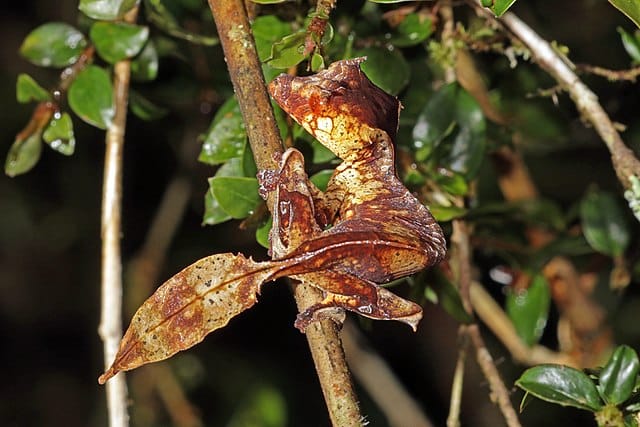
2- Leaf-tailed Geckos
Leaf-tailed Geckos, Credit: Wikimedia/ Charles J. Sharp
Geographic Location: Leaf-tailed geckos are endemic to Madagascar and a few surrounding islands, thriving in tropical rainforests.
Camouflage Skills: These geckos have flattened, leaf-shaped tails and bodies that mimic the appearance of leaves, complete with vein-like patterns. These animals can almost completely camouflage against dry leaves or the bark of trees, hiding from predators. The most characteristic of these animals is their tail, which resembles a rotting leaf with discolored spots and little nicks and tears.
Scientific Insights: Recently, researchers have described a new species of leaf-tailed geckos that may already be threatened by the pet trade. Even with the conservation strategies implemented, these animals are being captured and sold into the illegal pet trade, making it more challenging to maintain conservation strategies to help the long-term survival of these incredible geckos.
1- Chameleons
Chameleon, Credit:Wikimedia/SasanIAF
Geographic Location: Chameleons are primarily found in Madagascar and Africa, but they also live in southern Europe, the Middle East, and India.
Camouflage Skills: Chameleons are famous for their ability to change color, which can be used for camouflage, communication, and temperature regulation. This change is achieved through the expansion and contraction of specialized cells with different pigments.
Scientific Insights: The chameleon’s color change is not just for camouflage but is also a form of communication, with different colors conveying different messages such as aggression, mating readiness, or fear. For example, when male chameleons challenge each other for territory or a female, their coloring becomes brighter and much more intense. Males with brighter stripes, when aggressive, are more likely to approach their opponent, and those with more brilliant head colors are likelier to win fights.
Each of these animals demonstrates the incredible diversity and ingenuity of nature’s solutions to survival. Camouflage is one strategy in the vast arsenal of evolutionary adaptations, showcasing the intricate relationships between predators, prey, and their environments.
Copyright @smorescience. All rights reserved. Do not copy, cite, publish, or distribute this content without permission.
Join 20,000+ parents and educators
To get the FREE science newsletter in your inbox!
SUBSCRIBE TO OUR NEWSLETTER
.......... ..........
Subscribe to our mailing list to get updates to your email inbox.