Echolocation is the biological version of sonar. Animals with this unique auditory ability emit a high-frequency sound pulse that bounces off surrounding surfaces. By listening to reflected sound (echoes), an echolocating animal maps its surroundings and navigates despite having poor vision.
Being able to sense one’s surroundings without relying on vision is a useful skill in the wild, as many animals live in burrows and murky water with low visibility, or are nocturnal (active at night). What animals use echolocation? Let’s find out.
All the tech in Batman’s utility belt will fall short compared to a real bat’s echolocation. Over 90% of bat species rely on echolocation to prey on insects and map out their surroundings. Bats emit sound waves in the form of calls and chirps at ultrasonic frequencies, or simply, sounds at notes so shrill that we don’t hear them. The sound waves bounce off differently depending on the object’s shape, size, and distance. Their ears are built to identify their own calls as they echo back, a feature that scientists believe has been passed down from the bat’s common ancestor, who had eyes too small to hunt successfully at night but developed a brain suited for identifying auditory cues.
Bats have separate searching, feeding, and social calls. Each bat species also has unique call patterns. While a loud concert hits 115-120 decibels, which is usually the limit of human tolerance, bats go beyond that on their evening hunts. Certain species of bulldog bats, found in the tropics of Central and South America, have been recorded at sound pressure levels exceeding 140 decibels at just 10 cm from their mouths, equal to the sound levels of an airplane taking off. It is one of the highest recorded for any airborne animal.
Marine environments are perfect for echolocation, as sound travels around 4 times faster in water than in air. Toothed whales, like sperm whales (Physeter macrocephalus), use a barrage of high-frequency clicks and whistles that bounce off surfaces in the ocean, helping them navigate and find food. Their clicks can reach up to 236 decibels (dB) in air, about 44 times the loudness of a thunderclap. They can hear one another’s clicks from ten kilometers away.
Toothed whales have phonic lips— vibratory organs in their forehead that produce the clicks. The sound waves are focused through a fatty organ called the melon. Their lower jaw acts as a receiver, with oil-filled cavities that conduct sound waves into the ear and then to the brain for processing of the surrounding environment.
There is no record of baleen whales (such as humpbacks and blue whales), which are filter feeders and echolocating. They use baleen plates to filter seawater and catch prey, generally small ones like plankton and krill. They produce and hear sounds with the lowest frequencies among mammals, and scientists believe that early evolutionary forms of the animals, as far back as 34 million years, had the ability, too.
Beluga whales (and other toothed whales) can echolocate.
3. Dolphins
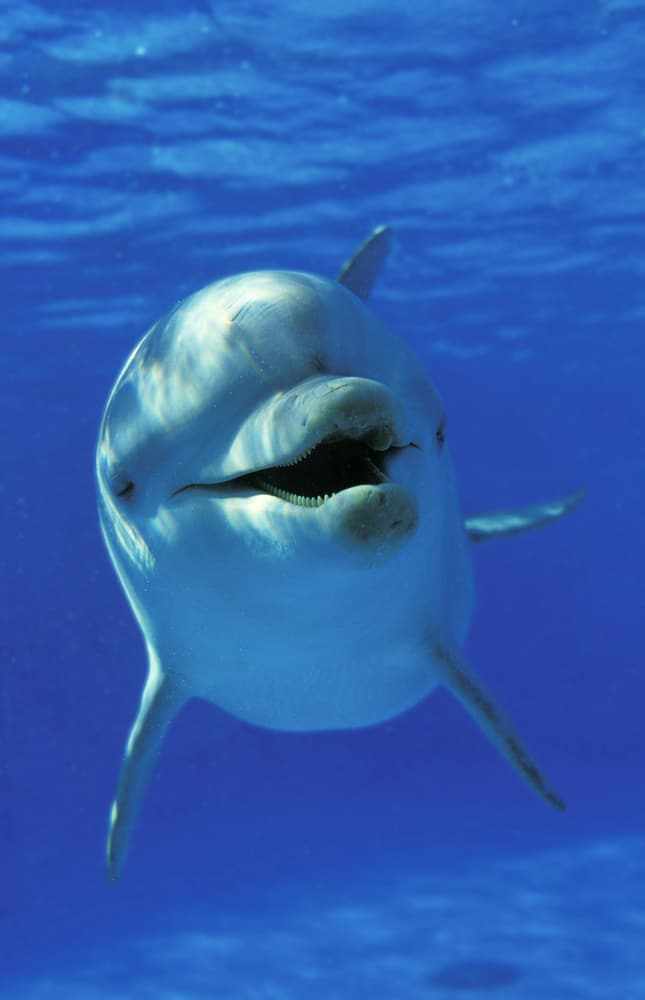
Dolphins use echolocation techniques similar to those of whales, producing short clicks at higher frequencies (100 kHz to 130 kHz) through their phonic lips. They also make low-frequency (40-50 kHz) calls, called ‘whistles’, for social communication between individuals or pods. For comparison, usually a human adult can detect sounds up to 17 kHz.
Dolphins can barely see 150 feet ahead, which makes biological sonar necessary for mapping their environment. Just like in whales, dolphins also possess a melon, which acts as an acoustic lens, directing the sound waves. Using echolocation, dolphins can recognize obstacles or prey from half a mile away. In fact, bottlenose dolphins (Tursiops truncatus) are so adept at echolocation that they can distinguish an object the size of a ping-pong ball from a football field away.
Bottlenose dolphin
4. Porpoises
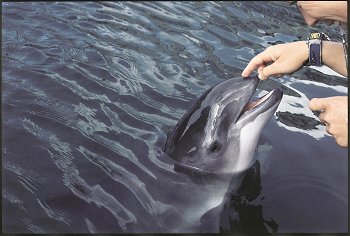
Often confused with dolphins, porpoises emit clicks with peak frequencies of about 130 kHz. Harbor porpoises (Phocoena phocoena) prefer coastal waters to the open ocean, where they hunt for fish and squid using a biosonar signal with a wavelength of around half an inch. This creates a narrow beam of sound, also called narrow-band high-frequency (NBHF) clicks. These clicks are sent in rapid succession, creating a ‘buzz’.
Scientists believe that porpoises evolved their polished echolocation skills to evade their biggest predators: killer whales or orcas. Killer whales have difficulty hearing clicks at frequencies over 100 kHz, helping porpoises avoid detection. In fact, the emergence of killer whales 5-10 million years ago is thought to have pressured these marine mammals to evolve stealthier clicks to avoid being eaten. Their clicks also last only for a millionth of a second.
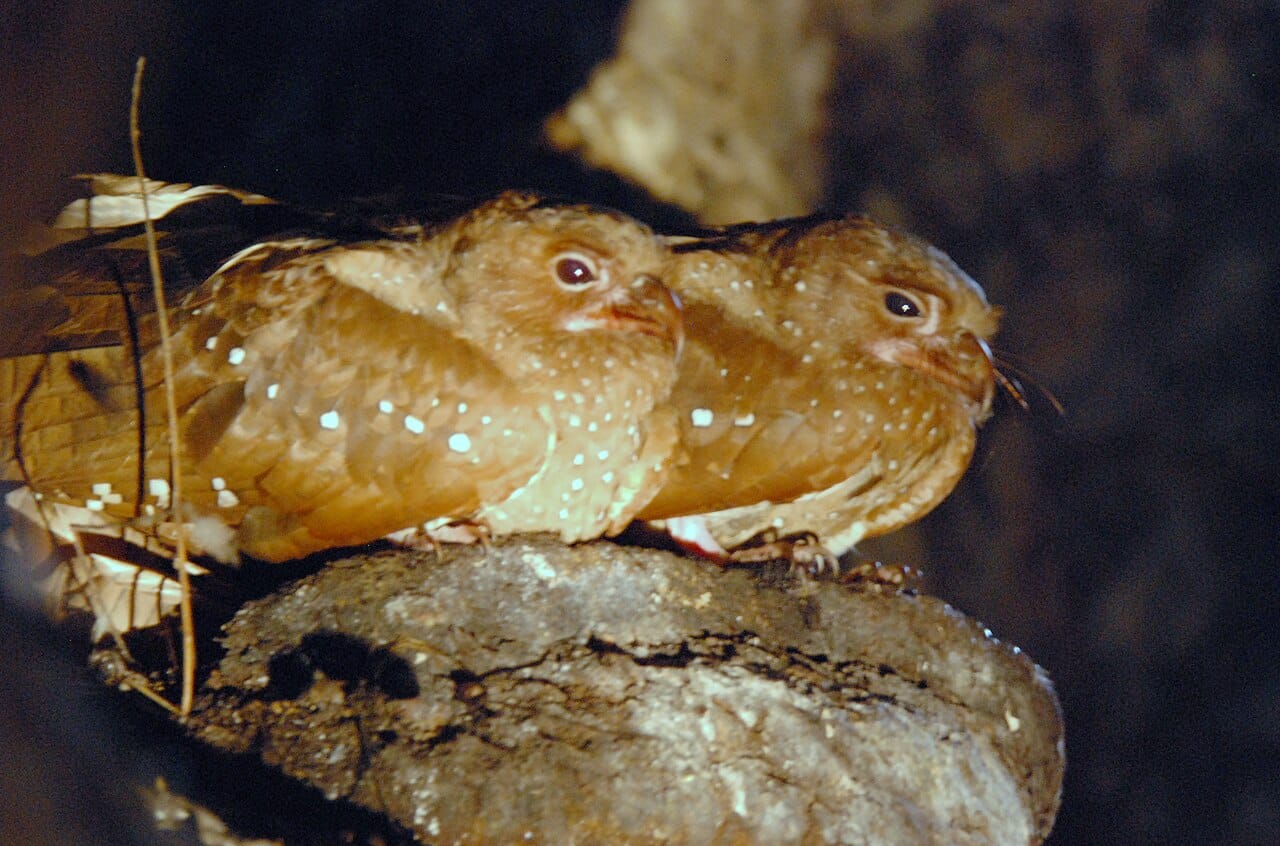
Oilbirds are one of the two avian groups known to use echolocation. The South American oilbird is a nocturnal bird that eats fruit and roosts in dark caves. Their echolocation skills are not in the same league as those of bats or dolphins, and their frequencies are often audible to humans. Unlike bats that can detect small prey like insects, the oilbird’s echolocation is low resolution, working only for objects bigger than 20 cm (7.87 inches) in size. They use their basic echolocation abilities to navigate and avoid collisions with other birds and obstacles.
Oilbirds produce click bursts lasting less than 10 ms, comprising 2-8 clicks at an interval of 2-3 ms using syringeal muscles in their vocal organ. They also reduce the energy and number of clicks in their click bursts during clear, moonlit nights. By detecting the loudness of echoes, oilbirds estimate the size of objects—louder echoes imply larger objects, and smaller echoes signal smaller obstructions.
Oilbirds are one of the two avian groups known to echolocate, Credit: Wikimedia/The Lilac Breasted Roller
6. Swiftlets
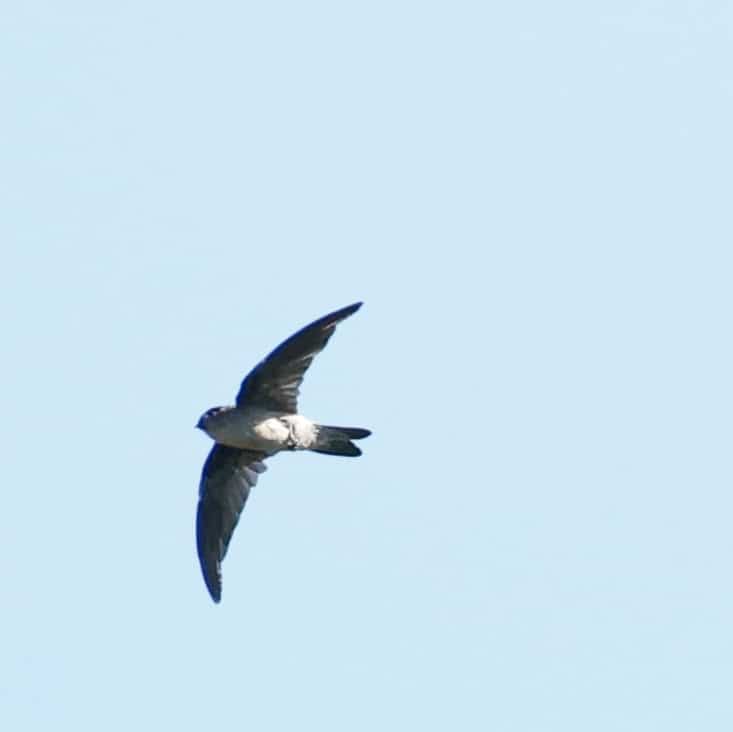
Swiftlets are diurnal (active at both day and night), insectivorous birds found in the Indo-Pacific region. They use specialized vocal organs to produce single and double clicks for echolocation. Scientists believe that at least 16 species of swiftlets can echolocate, and further research can help manage declining populations.
Swiftlet clicks are audible to humans, ranging from 1 to 10 kHz. Most species produce double clicks, separated by 1-3 ms, which are perceived as a single click by the human ear. Double clicks are emitted 75% of the time, mostly when flying in complete darkness. However, when they reach closer to cave entrances, they reduce or stop clicking altogether.
The Vietnamese pygmy dormouse (Typhlomys chapensis) is the only known arboreal (tree-climbing) mammal that uses echolocation. They have a folded retina and a poorly developed optic nerve, leaving them completely blind. But their biological sonar, which can rival that of bats and dolphins, does more than enough to suffice for their eyesight (or the lack thereof).
In 2016, a study in Integrative Zoology suggested that the ancestors of dormice, probably leaf-bed-dwelling, evolved echolocation after losing their sight. Their ultrasonic vocalizations were recorded in the 50 to 100 kHz frequency range and are too faint to be detected using a common bat detector.
“The structure of its calls is surprisingly similar to the frequency-modulated calls of bats,” says Aleksandra Panyutina, a functional morphologist at Severtsov Institute in Moscow and lead author of the paper that described the dormouse’s echolocation. This discovery is also one of the strongest pieces of evidence that bats developed echolocation before flight, although fossil evidence suggests otherwise.
Chinese and Vietnamese pygmy dormice are known to echolocate, Credit: Wikimedia/Alexei V. Abramov
8. Shrews
Shrews are small insect-eating mammals with long, pointed snouts and tiny eyes, and certain species have been found to use high-pitched, broadband twittering vocalizations to echolocate and navigate their surroundings. Shrews don’t vocalize to communicate, according to a study. The shrews in the study didn’t change their calls in response to the presence of other shrews, but increased sounds when their habitat was changed.
Shrews use echolocation to navigate
9. Tenrecs
Tenrecs can be mistaken for a hedgehog, but they are mostly endemic (found only in) to Madagascar. Apart from using scent and touch to communicate, these nocturnal mammals are also known to produce 5-17 kHz clicks with their lips and tongue for primitive echolocation. Their echolocation was first discovered in 1965, but there hasn’t been much research on their echolocation since then.
Lowland streaked tenrecs (Hemicentetes semispinosus) also produce ultrasonic sounds by rubbing their quills together, a process known as stridulation. However, the sound produced in this manner is used for communication, rather than as biosonar.
Tenrecs can echolocate, as well as generate sound by rubbing their quills for communication
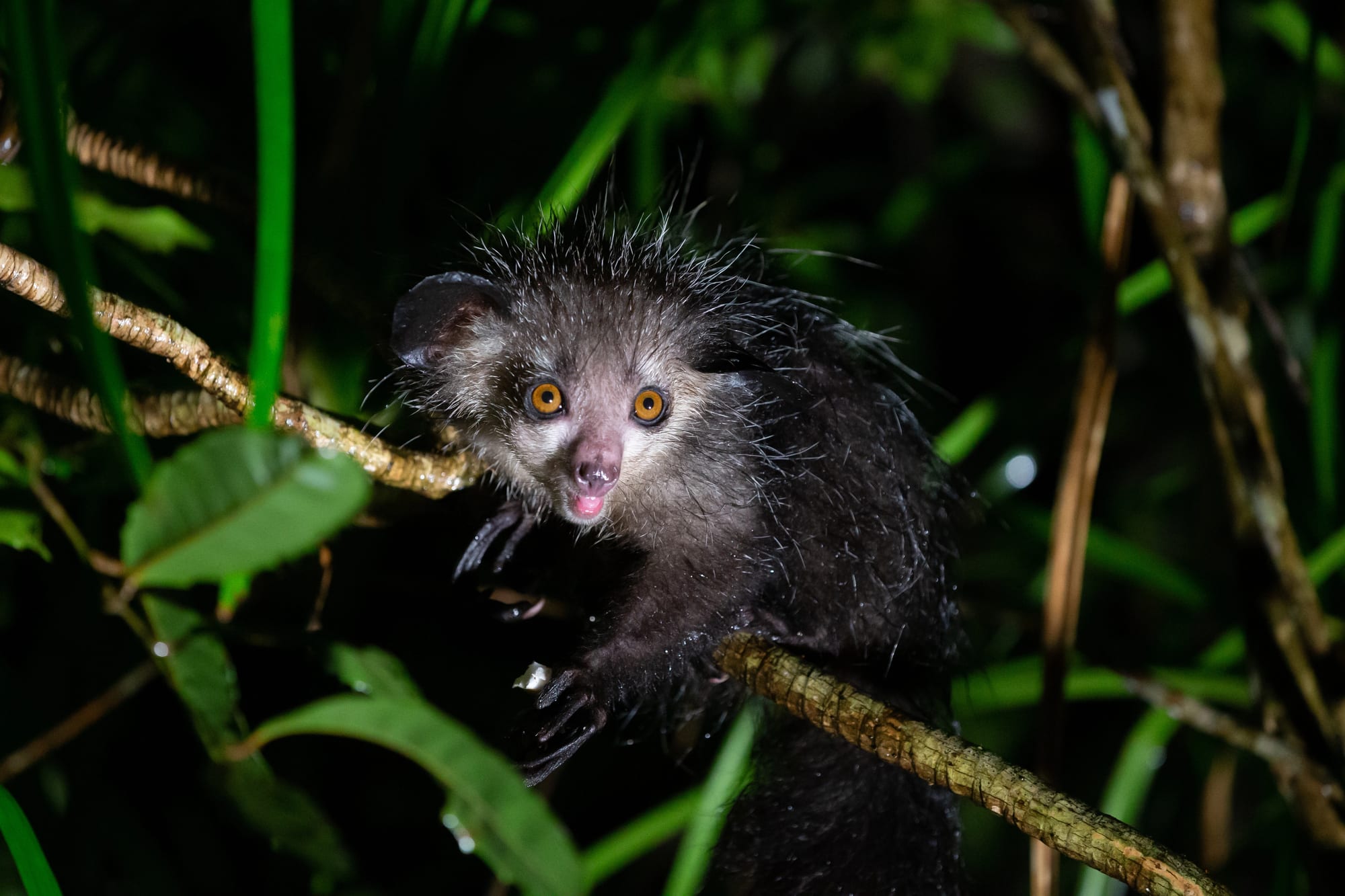
10. Aye-ayes
Aye-ayes (Daubentonia madagascariensis), also endemic to Madagascar, are the only primates known to echolocate. A species of lemur, aye-ayes forage for grubs and insects by tapping on dead trees with their long middle finger, and then listening to the echoes to detect their prey living inside the hollow areas. They also possess large, sensitive bat-like ears to better detect echoes.
Although the process is not exactly like echolocation, and is termed as percussive foraging instead, it sure does mimic echolocation. There are no molecular similarities between aye-ayes and echolocating bats and dolphins, suggesting that they evolved echolocation through different evolutionary processes.
Aye-ayes are the only known primates to use some form of echolocation, but it helps them forage rather than navigate
The Bonus: Daredevil for real
Matt Murdock, better known as Daredevil, is a blind lawyer turned vigilante in the Marvel franchise. Although it seems outrageous, there is more truth than fiction in Daredevil’s story. Meet Daniel Kish— the real-life Batman (or Daredevil), who can use sounds to navigate, like sonar. He can ride a mountain bike and navigate the wilderness, and claims to detect large objects 1,000 feet away.
The process, which Kish calls ‘flash sonar’, works similarly to echolocation in the wild.
He developed his own method of clicks and trained his ears to learn to map his surroundings from the returning echoes. The President of World Access for the Blind, Kish, teaches echolocation in small groups or one-on-one field sessions.
“You could fill libraries with what we know about the human visual system,” says Kish. “But what we know about human echolocation could barely fill a bookshelf.”
Meet Daniel Kish— the real-life ‘Batman.’ Credit: Wikimedia/PopTech