Crocodilians are some of the largest and coolest-looking reptiles on planet Earth! The massive American alligator can range to fourteen feet (4.3 meters) long, and the saltwater crocodile can be up to 20 feet (6 meters) long. Crocodiles and alligators (along with gharials, false gharials, and caimans) are all part of a group known as crocodilians. This group is thought to have originated around 235 million years ago, during the age of the dinosaurs. Crocodilians also included many interesting organisms which went extinct.
The armadillodiles, named for its resemblance to an armadillo. This crocodilian is thought to have been omnivorous, unlike the fully carnivorous crocodilians of today! (human for scale), Credit: Wikimedia/Nobu Tamura
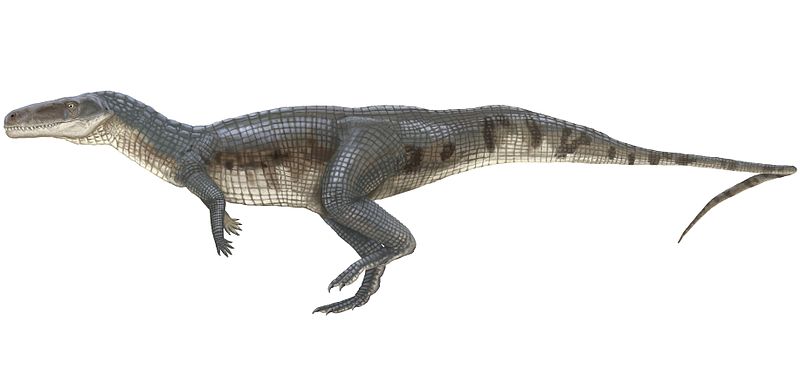
The bipedal crocodile, Poposaurus. Although it looks like a T-Rex, the Poposauraus and T-rex are not closely related, Credit: Wikimedia/Smokeybjb
Although crocodiles are said to look like “living fossils,” this simple description obscures their weird and wacky evolutionary history. There was even a hoofed crocodile, Boverisuchus, which chased and hunted terrestrial animals. The similar-looking alligators, crocodiles, caimans and gharials are just a small remnant of Crocodilians.
Crocodilians are part of the group Reptilia. Reptilia has three main groups: Archosauria, Squamata (lizards, snakes, and tuataras), and Testudines (turtles). Archosauria means “ruling reptiles,” named for the charismatic and dominant dinosaurs which used to roam the Earth. Archosauria is mostly extinct today except for two groups, crocodilians and… birds? Yes, you read that right! Although they are fluffy, colorful, and usually tiny, birds are nothing but feathered dinosaurs! It’s hard to imagine, but rather than being oversized lizards, crocodilians are more closely related to birds than any other extant reptile.
Around 87 million years ago, crocodilians split into the two broad groups we see today: alligators and crocodiles. Caimans are more closely related to alligators, while gharials are more closely related to crocodiles.
A simplified cladogram, showing the evolutionary relationships between different groups. Alligators and crocodiles split, forming two subgroups each.
Fun fact: Crocodiles have the strongest bite of the animal kingdom!
Where are alligators and crocodiles found?
There are only two species of “true” alligators, and these are found in the United States (the American alligator) and Southeast Asia (the Chinese alligator). It is thought that American alligators originated in North America. The species gradually traversed southward, evolving slowly all the while to become the caimans of South America. Chinese and American alligators likely had a common ancestor farther back in time.
There are many more species of crocodiles than alligators, and these are much more widespread, too! They are found in Africa, Asia, America, and Australia. The gharial is found only in India, and the false gharial in Malaysia.
The Everglades of Florida are the only place in the whole world where alligators and crocodiles coexist! Because they are both ambush predators and consume similar prey, they are thought to compete for food. They use the water to camouflage themselves from prey, looking like a rock or debris from a distance. When an unfortunate animal creeps close enough, the crocodile or alligator leaps out of the water to snap it up.
How are alligators and crocodiles different?
Crocodiles and alligators are both scaly and large, with a long snout and tail. Crocodilians are also the only reptiles with an external ear.
The external ear is the small slit visible behind the eye. This is the saltwater crocodile, Credit: Wikimedia/Sheba
Alligators and crocodiles differ in their snout shape and teeth. The alligator has a much rounder snout, where the crocodile’s is more pointed. Alligators also have a bit of an overbite! The top jaw protrudes over the lower jaw. When its mouth is closed, the bottom teeth are not visible at all. When a crocodile closes its mouth, the teeth interlock, like a zipper.
A preserved alligator head viewed from above, Credit: Wikimedia/BrokenSphere
A crocodile submerged in water, showing the pointy snout, Credit: 123rf.com/glavbooh
The visible upper teeth of the American alligator, Credit: 123rf.com/capturingmoments
The interlocking teeth of the Nile crocodile , Credit: 123rf.com/pumbitaurelio
Another key difference is their habitats. Alligators only tolerate freshwater, whereas crocodiles can tolerate any watery habitat from fresh to ocean-salty.
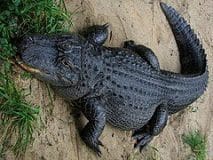
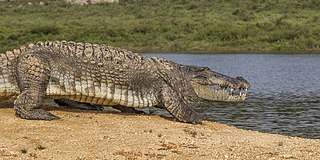
Crocodiles are also lighter than their counterparts. They are usually a pale olive green or brown. Alligators are darker in shade, and closer to a chocolate-brown. This difference is much harder to see, and there is a lot of variation between species of alligators and crocodiles.
Dark-brown American alligator, Credit: Wikimedia/Liftarn
The lighter Mugger crocodile, Credit: wikimedia/Charles J. Sharp
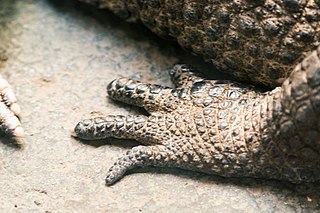
The last key difference in physical features lies in the feet! Alligators have webbed feet to better swim, whereas crocodiles have separated toes.
Webbed foot of the American alligator, Credit: Wikimedia/Rob
Separated toes of a crocodile, Credit: Wikimedia/Eric Kilby
Features: Alligators vs Crocodiles
Fun fact: Gharial hatchlings sometimes climb onto their parents’ heads to defend themselves from predation.
Feature
Alligator
Crocodile
Snout
Rounded, “U”-shaped snout
Pointy, “V”-shaped snout
Teeth
Upper teeth cover lower teeth
Interlocking teeth
Habitat
Freshwater
Range from fresh to saltwater
Color
Dark brown
Lighter green-brown
Toes
Webbed
Separated
As similar as alligators and crocodiles might look, they have a rich and fascinating evolutionary history. Where they are found today can also tell us a lot about how different alligators and crocodiles are related to each other. These living dinosaurs have changed to occupy a wide range of habitats on today’s Earth.
Flesch Kincaid Grade Level: 10.1
Flesch Kincaid Reading Ease: 41.4
Glossary
Cladogram: A simplified flow chart depicting evolutionary relationships between species
Crocodilians: A group of reptiles, most closely related to birds, containing gharials, false gharials, crocodiles, caimans, and alligators
Yamini's (he/they) interests lie in environmental education, science communication and trying to build a better world. When not languishing in front of his laptop, they can be found outside, poking at any insect, bird or plant. They love making science accessible, especially to those who aren't encouraged to pursue it. Yamini hopes that the young women who read Smore love learning from their articles and get just a little bit more excited about science!