Parrots are a diverse group of birds, with almost 400 species known around the world. Many of these parrot species are highly social and vocal, which makes them popular pets. Their vibrant colors and intelligence add to their irresistible charm. In this article, we explore 12 types of parrots, with an overview of their unique features to help you learn more about these fascinating birds.
Difference between Old World Parrots and New World Parrots
The world of birds including parrots is divided. Some fall into the Old World category while others are the New World parrots. Let’s learn the differences between the two.
Old World parrots are native to Africa, Asia, and Europe whereas New World parrots are originally from Central and South America, and the Caribbean, among others.
Old World parrots live in various environments such as rainforests, savannas, arid regions, and scrublands. New World parrots prefer tropical rainforests, savannas, and coastal areas.
A major difference between New World and Old World parrots is their dustiness. Old World parrots produce a lot of fine dust, which can pose health risks to other birds. In contrast, New World parrots, like macaws, produce a more granular powder down.
New World parrots include species like Amazons, caiques, Pionus, quaker parakeets, conures, and macaws. On the other hand, African grey parrots, cockatiels, and lovebirds, are referred to as the Old World parrots.
12 Types of Parrots with Facts and Photos
Here’s a curated list of 12 types of parrots, complete with their scientific names, habitats, diets, risk statuses, sizes, and fun facts about them.
Old World Parrots
Old World parrots are found in Africa, Asia, and Australia. From the impressive mimicry skills of the African Grey Parrot to the creative crest of the Cockatiel, this group of parrots show interesting traits and behaviors.
African Grey Parrot, Credit: Found Animals Foundation/Wikimedia Commons
1. African Grey Parrots
Scientific Name:Psittacus erithacus
Habitat: Rainforests of West and Central Africa
Diet: African grey parrots enjoy a diet of fruits, nuts, seeds, and berries. They also like consuming leafy matter, bark, and occasionally insects.
Risk: The conservation status of the African grey parrot has declined from Vulnerable to Endangered. The reasons behind this are habitat loss due to deforestation and unsustainable trapping for the pet trade.
Size: Around 33 cm (13.2 in.) and 400 g (14 oz.)
One of the most popular pet birds, the African grey parrot is known for its uncanny ability to mimic human speech. Their plumage can be various shades of grey. These medium-sized parrots also have a dramatic crimson tail and a hooked beak that is incredibly strong.
Fun Fact: African grey parrots are highly intelligent birds. Research studies have shown that their cognitive skills are similar to that of a 4-year-old human child.
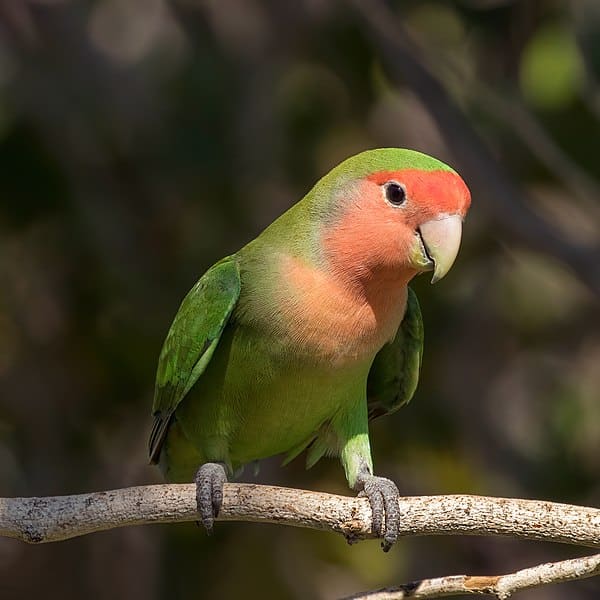
Lovebird in Namibia, Credit: Charles J. Sharp /Wikimedia Commons
2. Lovebirds
Scientific Name:Agapornis
Habitat: Forests and savannas of Africa and Madagascar
Diet: Seeds, fruits, berries, and occasionally leafy vegetation
Risk: Most species of lovebirds are listed as Least Concern by the IUCN. However, some of them, like the black-cheeked lovebird (Agapornis nigrigenis), are considered Vulnerable.
Size: 5 -7 inches in length and 45-60 grams in weight
True to their name, lovebirds are famous for forming strong, affectionate bonds with their mates. As pets, they need a balanced diet of pellets, fresh fruits, vegetables, and seeds to stay healthy. Physically, lovebirds are tiny, typically measuring 13 to 17 cm in length.
Fun Fact: Aggression isn’t rare in lovebirds. These feisty parrots are quite territorial and often do not get along well with birds of other species.
A Cockatiel at a zoo, Credit: Abhinaba Basu/Wikimedia Commons
3. Cockatiel
Scientific Name:Nymphicus hollandicus
Habitat: Native to Australia, cockatiels are found in arid or semi-arid areas, scrublands, bushlands, and wetlands.
Diet: Grass, seeds, fruits and berries
Risk: Least Concern
Size: 12 or 13 inches, weighing between 75 to 125 grams as an adult
Also known as quarrions or weiros, a cockatiel sports a beautiful head crest which they can raise or lower depending on their mood. These birds are a low-maintenance pet that like playing with their owners. Although not as loud as the other parrots, cockatiels can still mimic whistles and speech.
Fun Fact: Cockatiels share parental duties, with males being especially nurturing and protective of their young. For about 12 weeks, both parents work together to care for the young cocktail.
Major Mitchell's Cockatoo, Mt Grenfell, New South Wales, Australia, Credit: JJ Harrison/Wikimedia Commons
4. Cockatoo
Scientific Name: Cacatuidae (family)
Habitat: Cockatoos live in Australia, New Guinea, and nearby islands. They can be found in the rainforest, eucalyptus groves, forests, scrublands, and mangroves.
Diet: Cockatoos eat seeds, nuts, fruits, roots, and insects.
Risk: Varies by species; yellow-crested cockatoos are Critically Endangered
Size: 12 to 27 inches (31 to 70 cm) in length and around 300 to 900 grams (10 to 30 ounces) in weight
The cockatoo flaunts a striking crest and a strong, curved beak. They are popular pets due to their playful personalities and ability to form strong bonds with their owners. However, they require a lot of attention and mental stimulation to stay healthy and happy.
Fun Fact: Cockatoos are often called Velcro birds because they adore their humans and enjoy companionship. They love being close to their owner and dislike being alone.
Australian King Parrot at Port Campbell National Park, Australia, Credit: Ank Kumar/Wikimedia Commons
5. Australian King Parrot
Scientific Name:Alisterus scapularis
Habitat: They are found in Eastern Australia and prefer rainforests, wet sclerophyll forests, and nearby farmlands and gardens.
Diet: Seeds, fruits, berries, nuts, and leaf buds
Risk: Least Concern
Size: 43cm (16.8 in) in length, weighing 195-275g
The Australian King Parrot is a colorful bird native to eastern Australia. These parrots are popular pets due to their bright red and green feathers and calm nature. They are not currently endangered, but habitat loss could be a concern in the future.
Fun Fact: Australian King Parrots are sexually dimorphic, meaning males and females look different. Males are redder, with a red head, neck, chest, and bright orange beak. Females are greener. This makes it easy to tell them apart!
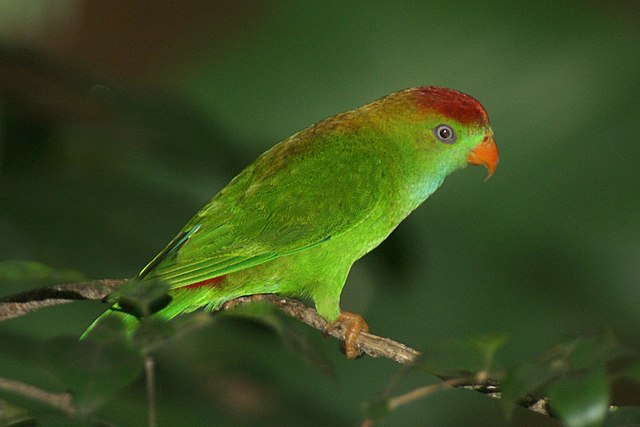
An adult Sri Lanka Hanging Parrot perching on a branch, National Zoological Gardens, Colombo, Sri Lanka. Credit: Hafiz Issadee /Wikimedia Commons
6. Hanging Parrot
Scientific Name:Loriculus
Habitat: Found in tropical southern Asia, hanging parrots live in tropical and subtropical forests, mangroves, and occasionally in plantations and gardens.
Diet: Fruits, nectar, blossoms, and soft seeds
Risk: Varies by species; Wallace’s hanging parrot is Endangered
Size: 13 cm (5 inches) in length and 28 grams in weight
Hanging parrots are small, vibrant birds native to Southeast Asia, including the Philippines, Indonesia, and Malaysia. These parrots have brush-tipped tongues adapted for feeding on nectar. They are popular pets due to their small size, bright plumage, and playful nature.
Fun Fact: Hanging parrots are named for their unique sleeping habit: they hang upside down like bats! This unusual behavior makes them one of the fascinating parrot species.
New World Parrots
New World parrots can be found in Central and South America, as well as the Caribbean. From the large-sized Macaws to the chatty Amazon Parrots, this group of parrots has many intelligent and social birds that are loved by bird owners.
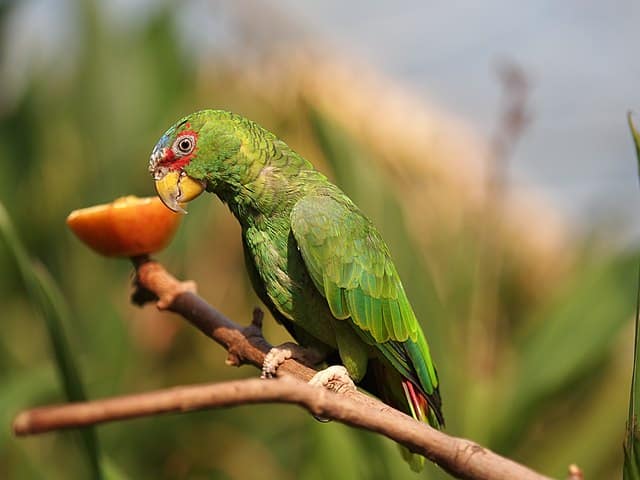
White-fronted amazon (Amazona albifrons), Credit: Christoph Anton Mitterer/Wikimedia Commons
7. Amazon Parrot
Scientific Name: Amazona
Habitat: Amazon parrots are native to Central and South America, including the Caribbean. They prefer to live in tropical rainforests, savannas, mangroves, and sometimes cultivated areas.
Diet: Amazons eat fruits, seeds, nuts, berries, and leafy vegetation.
Risk: Varies by species; Yellow-naped Amazon is Critically Endangered
Size: 12-15 inches (30-38 cm) in length and can weigh between 275-510 grams
Amazons are known for their bright plumage, with various shades of green along with splashes of red, blue, or yellow. They need plenty of mental stimulation. Without enough attention, social interaction, and engaging toys, Amazon parrots can develop behavioral issues.
Fun Fact: Amazon parrots are excellent talkers and are fond of music. When they want attention, they can be noisy, screaming loudly or making repetitive honks. They also make shrill sounds of delight while eating their favorite treats.
Green Wings in Young Sun Conure, Credit: DJvdSteen/Wikimedia Commons
8. Sun Conure
Scientific Name:Aratinga solstitialis
Habitat: Tropical and subtropical forests, savannas, and coastal regions of Northeastern South America
Diet: Fruits, seeds, nuts, berries, blossoms, and insects
Risk: Endangered
Size: 30 cm (12 inches) in length with an average weight of 110 grams
This brilliantly colored parrot can be found in the northeastern regions of South America. They can be quite noisy, especially when excited or seeking attention. Despite their small size, their calls can be heard over long distances in the wild.
Fun Fact: Sun Conures are known to indulge in meat alongside their usual diet of fruits, vegetables, and grains. They enjoy eating small amounts of cooked chicken, turkey, and fish occasionally.
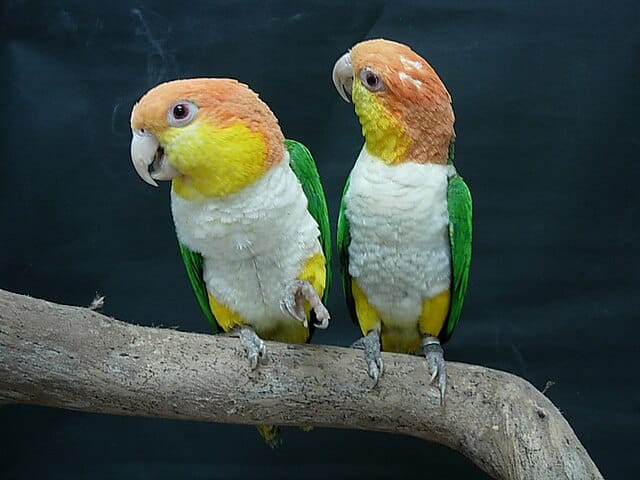
White-bellied Parrot (also known as the White-bellied Caique). Two on a perch. Credit: TJ Lin/Wikimedia Commons
9. Caique
Scientific Name:Pionites
Habitat: Found in the Amazon basin of South America, caiques usually prefer the swamps and tropical lowland forests.
Diet: Fruits, seeds, berries, nuts, and insects
Risk: Varies by species; White-bellied caiques are listed as an endangered species
Size: 23 cm (9 inches) long, with a weight of around 180 grams
There are two primary species of caiques: the White-bellied Caique (Pionites leucogaster) and the Black-headed Caique (Pionites melanocephalus). They sport green, yellow, and white feathers with either a white or black head. They are highly active and playful, and their friendly nature makes them popular pets.
Fun Fact: Caiques are known as the “clowns of the parrot world”, and for good reason, due to their playful and mischievous nature. They love to perform acrobatics, hang upside down, and hop around.
Blue-headed parrot, also known as the Blue-headed Pionus, in a cage. Credit: Yve5/Wikimedia Commons
10. Pionus Parrot
Scientific Name:Pionus
Habitat: Tropical and subtropical regions of Central and South America
Diet: Fruits, berries, seeds, flowers, and corn
Risk: Blue-breasted Parrot (Pionus reichenowi) listed as Vulnerable
Size: 23 to 25 cm (9 to 10 inches) in length and 140 to 170 grams (5 to 6 ounces) in weight
The genus Pionus consists of eight parrot species. Among them, the three most commonly kept as pets are the Blue-headed Parrot (Pionus menstruus), the Scaly-headed Parrot (Pionus maximiliani), and the White-capped Parrot (Pionus senilis). Compared to other parrots, Pionus parrots are generally quieter and more reserved.
Fun Fact: The genus Pionus is thought to derive from the Greek word “pion,” which translates to “fat.” This name is quite apt, as many Pionus parrots are prone to obesity.
A Monk Parakeet (also known as the Quaker Parrot) in Dourados, Mato Grosso do Sul, Brazil. Credit: Geoff Gallice/Wikimedia Commons
11. Monk Parakeet
Scientific Name:Myiopsitta monachus
Habitat: They are native to the temperate and subtropical regions of South America and are often found in woodlands.
Diet: Seeds, fruits, flowers, and leaves
Risk: Least Concern
Size: 28 to 33 cm in length and weighs up to 140 grams
The Monk Parakeet or Quaker Parakeet is a popular pet as they are relatively easy to care for. These parrots sport a range of colors and markings. Quaker Parakeets are unique among parrots for their ability to build large nests that can house multiple breeding pairs.
Fun Fact: Known for their intelligence, these birds can learn to speak English words with enough practice. They can also perform tricks like rolling over or shaking hands.
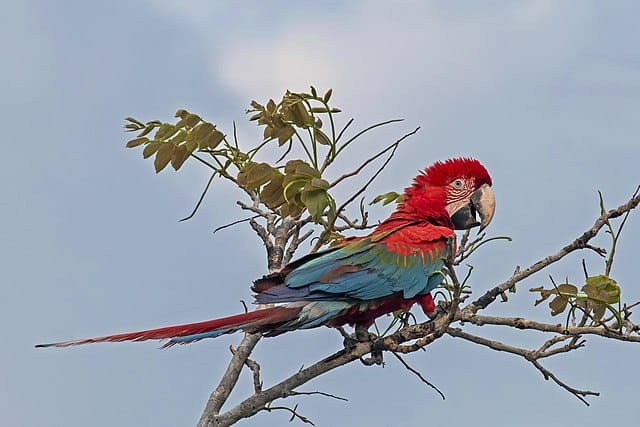
Juvenile of Red-and-green macaw (Ara chloropterus), the Pantanal, Brazil. Credit: Charles J. Sharp/Wikimedia Commons
12. Macaws
Scientific Name:Ara spp.
Habitat: Found in the Central and South America, macaws generally live in tropical rainforests, but some species can also be found in savannas and semi-arid regions.
Diet: Macaws eat fruits, nuts, seeds, and flowers in the wild. They also consume clay, which help them digest their food and neutralize toxins.
Risk: Varies by species; Great Green Macaw is listed as Critically Endangered
Size: Around 3 feet (91.4 cm) long and 4 pounds (1,814 grams) in weight
Macaws are probably the most eye-catching birds in the parrot family. Unlike many parrots, macaws have patches of bare skin on their faces. With proper care, some macaws, like the blue and gold macaws, can live around 60 years, with many reaching up to 80 years or even beyond.
Fun Fact: With over 400 parrot types of parrots in the order Psittaciformes, macaws take the crown as the biggest birds in the bunch! They normally weigh in the range of two to four pounds which is pretty impressive for a bird. The largest of the macaws can be three and a half feet from beak to tail.