Sharks have been swimming in Earth’s oceans for millions of years, yet they are still among the most misunderstood animals on the planet. Movies, scary stories, and sensational headlines have given sharks a reputation as dangerous monsters that hunt humans.
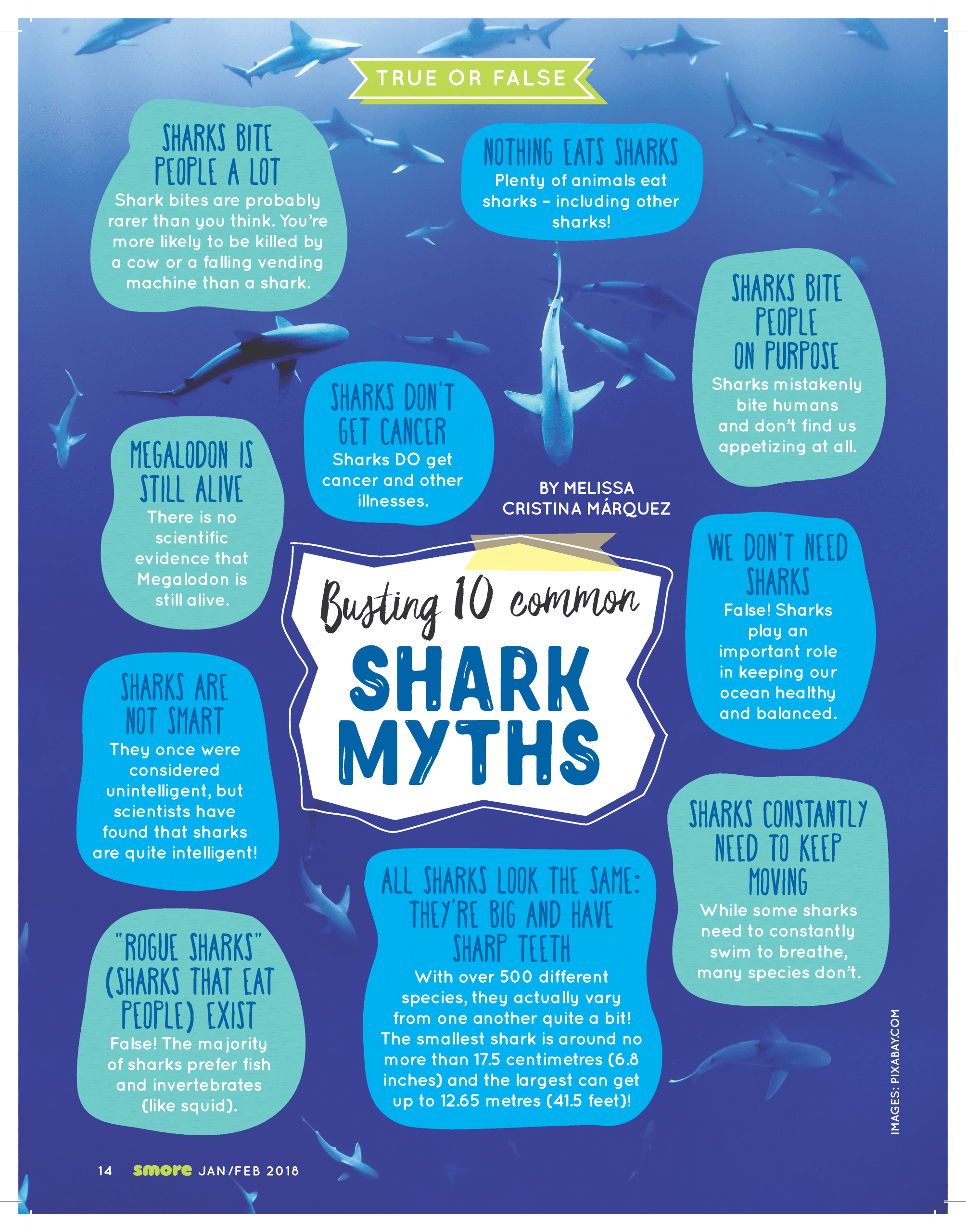
But how much of what we hear about sharks is actually true? Here are 10 common shark myths—and the science behind them.
1. Myth: Sharks bite people a lot
False! Shark bites on humans are extremely rare compared with the number of people who enter the ocean every year. Sharks generally have little interest in humans, and encounters resulting in bites are uncommon. Sharks may be scary in movies, but the real-world risk is much smaller than many people imagine.
2. Myth: Nothing eats sharks
False! Sharks aren’t always at the top of the food chain. Larger sharks sometimes eat smaller sharks, and other marine animals can prey on sharks too. Young sharks are especially vulnerable to predators. Being a powerful ocean predator doesn’t mean a shark is invincible.
3. Myth: Sharks bite people on purpose
Mostly false! Sharks don’t normally hunt humans as food. Some bites may happen when sharks investigate something unfamiliar or mistake a person for something they normally prey upon. Scientists study these interactions, but not every shark bite has a single, clearly understood explanation.
4. Myth: Sharks don’t get cancer
False! Sharks can develop cancer and other diseases. The myth that sharks never get cancer became popular partly because sharks are fascinating animals with unusual biology. But sharks are not immune to cancer, and scientists have documented tumors in sharks.
5. Myth: Megalodon is still alive
False! The enormous prehistoric shark known as Megalodon is believed to have gone extinct millions of years ago. Its fossils provide evidence that it once lived in Earth’s oceans, but scientists have found no credible evidence that it still exists today.
6. Myth: Sharks are not smart
False! Sharks are more intelligent than many people once believed. Research suggests that sharks can learn, remember information, solve problems and show complex behaviors. Different shark species have different abilities, but they are certainly not simple, mindless swimming machines.
7. Myth: “Rogue sharks” that hunt people exist
False! The idea of a shark deliberately hunting humans like a movie villain is largely fiction. Most shark species eat fish, squid, crustaceans and other marine animals. Shark bites involving people are unusual events, not evidence that sharks are targeting humans.
8. Myth: We don’t need sharks
False! Sharks play important roles in ocean ecosystems. Many sharks help regulate populations of other animals and contribute to balanced marine food webs. Protecting sharks helps protect the health of ocean ecosystems, which support countless other species.
9. Myth: Sharks constantly need to keep moving
False! Some sharks need to swim continuously to keep water flowing over their gills so they can breathe. But other sharks can pump water over their gills while resting on the ocean floor. Shark breathing strategies vary depending on the species.
10. Myth: All sharks look the same—they’re big and have sharp teeth
False! There are more than 500 species of sharks, and they come in a remarkable range of shapes and sizes. The smallest sharks are tiny compared with giants such as whale sharks. Some sharks have specialized teeth, while others are filter feeders that consume tiny organisms.
The takeaway: Sharks are diverse, fascinating animals—not movie villains. Understanding the science behind shark myths helps us appreciate their role in the ocean and why protecting them matters.