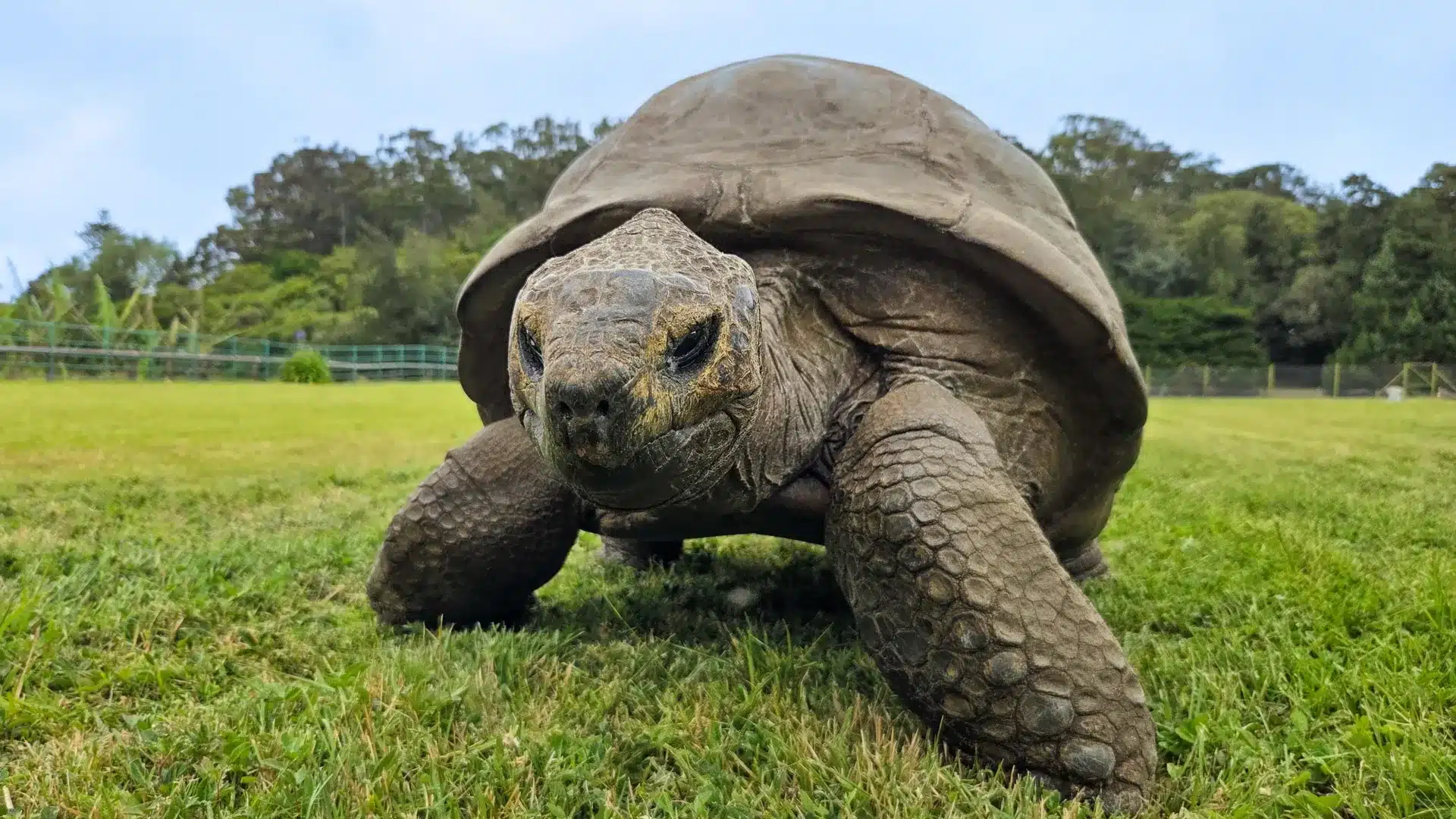
Jonathan, a giant tortoise on the island of St. Helena, may be the oldest known living land animal. Scientists studied his DNA and found unusual patterns in the way some genes are controlled. The results offer clues about long life, but they do not yet explain how to make humans live longer.
A tortoise older than most countries
Jonathan is an Aldabra giant tortoise. His age is estimated at about 194 years, and he is thought to have hatched around 1832. He arrived on St. Helena in the South Atlantic in 1882, already fully grown.
That is an extraordinary age for his species. One study estimated that the upper limit of life expectancy for Aldabra tortoises is about 94 years. Jonathan may be roughly a century older.
The DNA clues
Researchers studied Jonathan’s genome, which is the full set of DNA instructions in his cells. They also examined his epigenome. This is a collection of chemical marks that help control when genes are active or quiet.
Think of DNA as a cookbook. The genes are recipes, while epigenetic marks act like notes that tell a cell which recipes to use. These marks can change as an animal gets older.
The team compared Jonathan with four other Aldabra tortoises. They included a five-year-old juvenile and three older animals. The scientists found that some DNA-control regions in Jonathan were unusually orderly, especially near genes involved in making cell energy and processing RNA.
Cells use tiny structures called mitochondria to release energy from food. RNA helps cells read and use DNA instructions. Keeping these systems working well may help cells stay healthy.
What the scientists found
The study also reported gene variants that may be linked to DNA repair, immune defenses, and other aging-related processes. But the standout result was not one magic gene. It was a pattern: some important gene-control regions showed less random change than expected.
Scientists call this kind of randomness methylation entropy. DNA methylation means adding small chemical tags to DNA. Over time, these patterns can become less organized. In Jonathan, some key gene-control areas stayed unusually stable.
Why this discovery matters
Animals that live for a very long time can help researchers ask how cells avoid damage. Jonathan’s DNA gives scientists a rare chance to study those processes in a real animal that has lived for nearly two centuries.
The work may guide future research into aging. It does not show that people can copy Jonathan’s biology, take a supplement, or use a treatment to extend life. The study is a first set of clues, not a human anti-aging recipe.
What scientists still don’t know
The research team could study DNA from mouth cells, but they could not take a blood sample from Jonathan. That limited some tests, including checks of how genes were being used in cells.
The team also compared Jonathan with only four other Aldabra tortoises. More animals must be studied to learn whether these patterns are common in the species or unusual in Jonathan. Scientists still do not know which traits helped him reach such an extraordinary age.
Quick Science Quiz
Check what you learned about Jonathan and the science of aging.
Copyright @smorescience. All rights reserved. Do not copy, cite, publish, or distribute this content without permission.
SUBSCRIBE TO OUR NEWSLETTER
.......... ..........Subscribe to our mailing list to get updates to your email inbox.
Monthly Newsletter