A Nearby Star System Has Two Dead Stars—and a Mystery
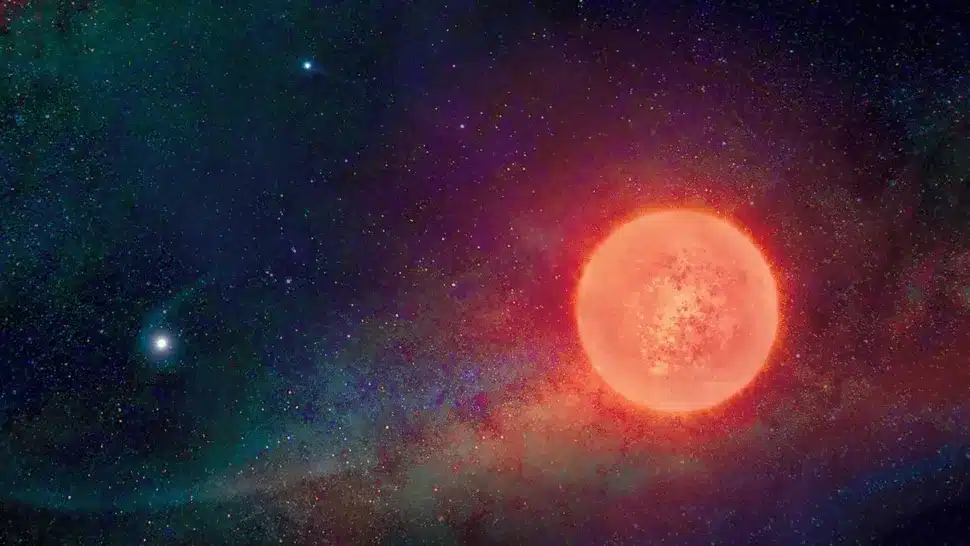
Artist’s impression of Welopō‘ai, a nearby triple-star system containing a red dwarf and two white dwarfs, Credit: Benoît Gougeon / Université de Montréal
Astronomers searching for planets around a small star 28 light-years away found something much stranger: a second white dwarf star. That discovery revealed a rare three-star system called Welopō‘ai, where two stars have reached the end of their lives but a smaller companion is still shining.
The finding, published in Astronomy & Astrophysics on November 19, 2026, gives scientists a nearby place to study how stars change over billions of years. It also raises a puzzle: how did the small star survive the dramatic changes that turned its companions into white dwarfs?
The planet hunt found an unexpected wobble
The team used SPIRou, an instrument on the Canada-France-Hawaii Telescope. It searches for planets by measuring tiny changes in a star’s motion. A planet’s gravity can tug on its star, making the star move slightly toward and away from Earth.
But the red dwarf in Welopō‘ai showed a much larger motion than a planet could explain. Its speed changed by about 16 kilometers per second. Follow-up observations with the Gemini North telescope revealed the hidden object: a white dwarf.
A white dwarf is the hot, dense core left behind after a star like the Sun runs out of fuel. The star first swells into a red giant, sheds its outer layers, and leaves its core behind. That core is about the size of Earth, even though it can contain a large fraction of the Sun’s mass.
Three stars, two very different orbits
Welopō‘ai has a red dwarf and a white dwarf in a close pair. They are separated by about 4.6 times the distance between Earth and the Sun. The newly measured white dwarf has about 62% of the Sun’s mass. The red dwarf has about 42%.
A second white dwarf lies much farther away. It is about 124 times the Earth-Sun distance from the inner pair in the sky projection. The team measured the inner white dwarf’s mass with an uncertainty of only about 0.7%. That makes it one of the most precise mass measurements for a nearby white dwarf.
The system is about 28 light-years away. The researchers describe it as the closest known triple system containing two white dwarfs.
Why did the small star survive?
Here is the mystery. Before it became a white dwarf, one of the stars would have grown into a huge red giant. Its outer layers could have spread far into space. That expansion should have disturbed the red dwarf’s orbit. In some possible histories, the smaller star might even have been swallowed.
Yet the red dwarf remains in a stable orbit with the white dwarf. The researchers do not yet have a clear explanation for how the system reached its present arrangement.
What scientists still don’t know
Astronomers still need to map the distant white dwarf’s orbit and learn how the three stars moved in the past. New observations may show whether the outer star has strongly changed the inner pair’s orbit over time. For now, Welopō‘ai is a nearby stellar family with an unusual history—and a story that is not yet solved.
A red dwarf and a white dwarf form a close pair. A second white dwarf is shown much farther away. The drawing is not to scale. Red dwarf White dwarf Second white dwarf Close pair: about 4.6 AU apart Farther companion SCHEMATIC — NOT TO SCALE
Simple diagram of the three stars in Welopō‘ai. The distances and sizes are not shown to scale.
Test Your Knowledge
Choose the best answer for each question. Then check your score.