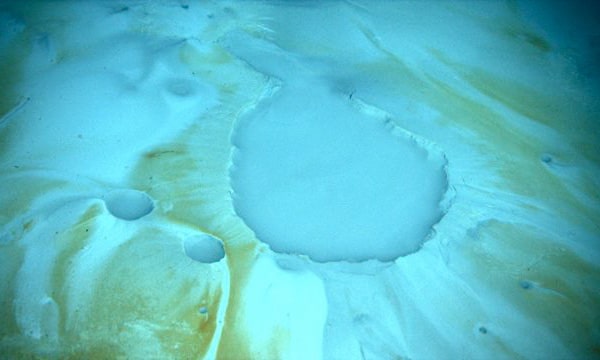
Scientists have found unusual underwater pools in the Gulf of Aqaba, near the northern end of the Red Sea. These pools are filled with water far saltier than the surrounding ocean—and they contain microbial life despite having no oxygen.
The pools, called brine pools, lie about 1,770 meters (nearly 1.1 miles) below the sea surface. Their extreme conditions make them valuable places to study how life can survive and how scientists might search for life beyond Earth.
What are underwater brine pools?
Brine pools are patches of water on the seafloor with extremely high salt levels. They can form when salt-rich materials dissolve into seawater or when geological processes concentrate salty water.
Because the brine is much denser than ordinary seawater, it can settle into a depression on the ocean floor. It may look like a lake with a shoreline—but it is surrounded by ocean water, not air.
The pools described here are in the Gulf of Aqaba, a narrow gulf connected to the Red Sea. Researchers studied them using a remotely operated vehicle, a robot controlled from a ship.
A place where oxygen is missing—but life is present
The pool water is extremely salty and contains no oxygen. These conditions would be difficult for many familiar animals, but microorganisms live in and around the pools.
Some microbes can get energy without using oxygen. At the boundary where normal seawater meets the brine, different chemical conditions create zones where microbes can thrive.
Scientists collect samples and study the organisms and chemicals there. These environments help researchers understand the limits of life on Earth.
The pools may preserve clues from the past
Sediments at the bottom of these pools can preserve layers of material over time. Researchers found evidence that the sediments may record events such as floods, earthquakes and tsunamis in the surrounding region.
Because the pool is close to shore, material washed from land can reach it. The layers may act like a history book written in mud, helping scientists reconstruct past events.
Why this discovery matters
Brine pools offer a chance to study life in harsh conditions. That knowledge could help scientists understand what kinds of environments might support life on other worlds, including places where salty water may exist beneath ice.
The research does not show that extraterrestrial life exists. Instead, it helps scientists ask better questions about where life might be able to survive.
What scientists still don’t know
Scientists still need to learn more about the microbes living in these pools, how they interact, and how the pools formed and changed over time. Further exploration may reveal more about these strange underwater habitats—and the history they preserve.
References