The periodic table of elements is one of the most important tools in science. It helps us figure out how the universe is put together. But have you ever wondered who came up with this incredible system? In this article, we’ll learn about the history of the periodic table and the scientists who helped make it. So, let’s dive in and find out the exciting story behind the science.
How the Periodic Table Came to Be
The periodic table was not made by just one scientist. Instead, it was the result of the work of many smart people over several hundred years. In fact, a French geologist named Alexandre-Emile Béguyer de Chancourtois was the first person to suggest that the elements had a pattern. This was in 1862. He made a cylinder in which the names of the elements were arranged in a spiral based on their atomic weights .
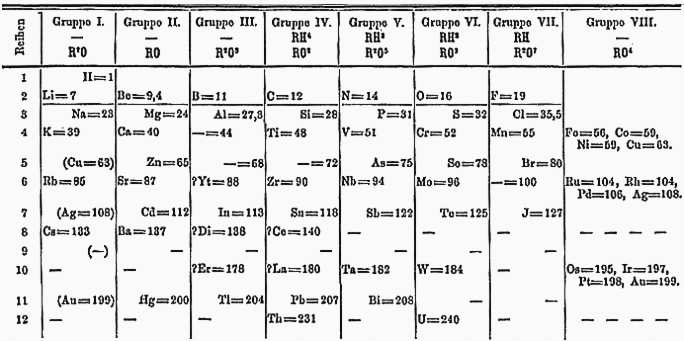
But the Russian chemist Dmitri Mendeleev is the one who came up with the idea of the periodic table. In 1869, Mendeleev made a table that put the elements in order based on their atomic weight and other properties. He saw that some elements had similar properties and put them in rows and columns, leaving spaces for new elements that, based on where they were in the table, he thought would have certain properties.
Mendeleev's periodic table. Credit: Wikimedia/Den fjättrade ankan
The Development of the Periodic Table
Scientists didn’t accept Mendeleev’s periodic table right away because some elements didn’t fit well into his system. But as more elements were found and more was learned about their properties, the periodic table started to come together.
In 1913, the English physicist Henry Moseley found that the properties of an element depend on the number of protons in its nucleus . This was one of the most important discoveries. This led to the modern version of the periodic table, which sorts the elements by their atomic number instead of their atomic weight.
A lot of other scientists have also made important changes to the table. American chemist Glenn T. Seaborg discovered several new elements and proposed a new section of the table for the actinides , which are heavy elements that are highly reactive. He also suggested a new version of the table that put the elements in order of how their electrons were set up.
The Legacy of the Periodic Table
Today, scientists in many fields use the periodic table as a key tool. It is used to figure out how atoms and molecules behave and to predict the properties of new elements and compounds. It is also used to design new materials and drugs.
The periodic table has also had a big effect on how we do things every day. It has helped us create new technologies, like solar cells and electronics, and it has led to the discovery of new elements that have changed medicine and business.
The periodic table is a great example of how smart and creative people can be. It is the result of hundreds of years of scientific research and teamwork. From Chancourtois’s early work to the groundbreaking work of Mendeleev, Moseley, Seaborg, and many others, the periodic table shows how powerful scientific discovery can be and how amazing the natural world is. So, the next time you see this famous chart, think about the exciting story behind the science and the amazing discoveries that are yet to come.