The color and age of a star tell us a lot about what’s going on inside it, and what may determine its size. Stars all go through a life cycle with patterns from birth to death.
First, dust and gas gather into a cloud. As the cloud gets bigger and bigger, it begins to develop its own gravitational field. The field then causes even more dust and gas to gather, pulling it inwards! The constant motion of the gas and dust makes a lot of heat — similar to how your palms heat up when you rub them together. Eventually, there’s enough heat for stars to power nuclear reactions, and stars make bigger molecules out of smaller ones, turning Hydrogen into Helium. Hydrogen is like petrol for stars — they need it for fuel. Stars that formed from big clouds are heavier and burn more brightly. Stars that formed from small clouds are lighter and burn more slowly and faintly.
Depending on how much hydrogen a star has, it can burn for a long time. A star’s adult phase lasts millions of years. It continues to accumulate mass, which increases its gravity, too. Stars exist as stable hydrogen-to-helium machines for millions, billions, or even trillions of years.
There are a couple of factors that decide how big an adult star can be. Larger clouds make larger stars. Some stars also have hotter centers, which causes the stars to balloon outwards. This can even make them shine brighter. It’s also important to note that stars don’t stay the same size throughout their life cycle.
When a star is in its stable state, it remains the same size. However, when it finishes its hydrogen fuel, it can suddenly expand. As they eventually die, they can shrink and become very dense and small.
How a star like our Sun may change over time, Credit: Wikimedia/ESO/M. Kornmesser
What is the biggest star in our galaxy?
How big is our Sun? Think of it like a big orb, kind of like an orange. If you slice it in half, the distance from one edge to another is the diameter. Imagine the entire city of New York. Pretty huge, right? It is roughly 31 miles (50 kilometers) across. Now, stack one New York next to another, 28,000 times. That’s roughly the diameter of our Sun. If you had to walk across the widest part of North America, that’s around 3,000 miles (5,000 kilometers). Walking across the Sun’s diameter would be about 288 times as long. Jupiter is the largest planet in our solar system, and the sun is still bigger! The diameter is about ten times that of Jupiter’s. The Sun’s diameter is about 865,000 miles (1.4 million kilometers).
You might think that the Sun is one of the biggest stars in the universe, but it doesn’t tip the scale in terms of size or mass. There are smaller stars, just one tenth the size of our Sun. There are also massive stars, over 100 times bigger in diameter than our Sun.
The Earth is inside a galaxy known as the Milky Way. One of the biggest stars in our galaxy is Betelgeuse. It has a distinctive reddish color and is observable from the Earth when the sky is clear. Betelgeuse is one of the brightest stars in the night sky. It’s also massive! Its diameter is around 640–750 times that of the Sun — so, 6,400 Jupiters at the least!
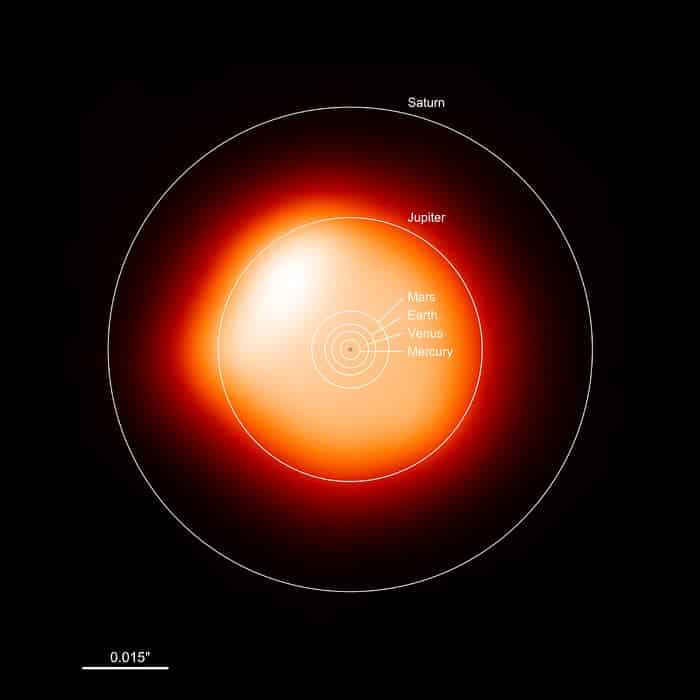
If Betelgeuse were our sun, Credit; ALMA (ESO/NAOJ/NRAO)/E. O’Gorman/P. Kervella
If Betelgeuse were our sun, it would engulf Mars, Earth, Venus, Mercury, and Jupiter! Only distant Saturn would be safe from it. It’s hard to imagine just how massive this is. Despite this, Betelgeuse doesn’t even rank in the top ten of largest stars in our universe!
How big is UY Scuti?
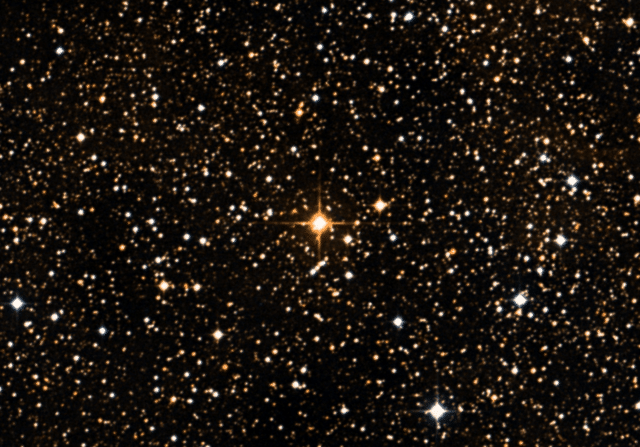
UY Scuti was first discovered in 1860 by German astronomers at the Bonn Observatory. Although we knew of its existence, it took another 150 years for astronomers to measure it. In 2012, researchers were able to identify that it has a radius of about 738 million miles (1.2 billion km). UY Scuti is so big that you could fit 5 billion Suns inside of it. That’s 7 trillion Jupiters, and 40 trillion New York Cities.
UY Scuti, Credit; Wikimedia/ESO/Digitized Sky Survey 2
UY Scuti is also a surprisingly young star. Heavier stars may use fuel more quickly. Scientists estimate it to be between 10–20 million years old, much younger than the Sun. As it runs out of hydrogen, it’s not clear what will happen to UY Scuti. It could explode, or collapse and form a smaller star.
It’s also important to note that size, or diameter, is only one way to measure a star. If you thought of the biggest star as the heaviest, the picture would be quite different. Right now, the reigning heavyweight champ is R136a1. Although the name could be a little more creative, it’s a special star of a rare class of ultra-heavy stars. It weighs between 170 and 230 times the mass of our Sun. It’s twice as heavy as astronomers even thought was physically possible! The size of the star means its lifespan is very short. It’ll probably only exist for about 3 million years. This is the blink of an eye in the scale of the Universe.
Astronomers are working hard to uncover more secrets of the Universe. For a long time, we thought Betelgeuse might be our biggest star. Now, we know it isn’t even in the top 10. We once thought stars couldn’t be as heavy as R136a1. One day, UY Scuti could be among one of the smaller stars we know. That would make our Sun and the Earth teeny-tiny.