Evolution has created life in endless forms, many beautiful and some very bizarre. Among these, some animals stand out for their unique adaptations. These could be special traits that have enabled them to thrive in the most challenging environments, exploit niche resources, or evade predators in clever ways. These adaptations give us a peek into the creativity of natural selection and offer fascinating insights into the delicate relationship between organisms and their environments on our planet.
#10. Giraffe - Long Neck for Feeding on Tall Trees and Unique Cardiovascular Adaptations
Credit Luca Galuzzi - www.galuzzi.it
Geographic Location: Giraffes are native to the African savannas, where they roam among the open plains and woodlands.
Unique Adaptation: The giraffe’s most conspicuous adaptation is its extraordinarily long neck, which allows it to reach leaves and branches higher than any other terrestrial animal. The adaptation allows giraffes to exploit a feeding niche unavailable to other herbivores. Additionally, giraffes have developed a unique cardiovascular system to manage the blood pressure necessary for pumping blood all the way up to their brains, including valves to prevent blood from rushing to their heads when they bend down to drink.
Scientific Insights: Research has shown that the giraffe’s cardiovascular system includes a specialized structure called the rete mirabile, which is a complex network of blood vessels that helps to regulate blood pressure. The giraffe’s heart, weighing 25 pounds and about 2 feet long, can pump blood with enough force to overcome the gravitational pull when moving blood to the brain. Their blood vessels also have elastic walls that absorb pressure surges, demonstrating a remarkable evolutionary solution to their unique physiological challenges.
#9. Fennec Fox - Large Ears for Heat Dissipation
A sleeping fennec fox, Vulpes zerda, at Happy Hollow Park and Zoo.Credit: Grendelkhan
Geographic Location: The Fennec Fox is found in the Sahara Desert of North Africa and some parts of the Arabian Peninsula.
Unique Adaptation: The Fennec Fox’s most distinctive feature is its large ears, which are not just for acute hearing. These oversized ears serve an essential purpose in thermoregulation, helping the fox to dissipate heat and keep cool in the scorching desert environment. Their light-colored fur also reflects the desert’s intense sunlight, further aiding in heat avoidance.
Scientific Insights: Studies have shown that the Fennec Fox’s ears, which are unusually large in relation to their body size, have an extensive network of blood vessels. This network facilitates efficient heat exchange with the environment, allowing the fox to lower its body temperature. This adaptation, coupled with their nocturnal habits, enables the Fennec Fox to thrive in one of the harshest climates on Earth.
#8. Bombardier Beetle - Chemical Defense Mechanism
Brachinus crepitans (Linnæus, 1758). Germany: Niedersachsen, 2 km S of Göttingen, hills north of Gartetal. Credit: Francisco Welter-Schultes
Geographic Location: Bombardier Beetles are found worldwide, particularly in the temperate regions of Africa, Europe, and the Americas. They are not seen in Antarctica.
Unique Adaptation: The Bombardier Beetle has developed a powerful chemical defense mechanism to deter predators. When threatened, it ejects a hot, noxious chemical spray from the tip of its abdomen. This spray is produced by rapidly mixing two chemical substances (hydroquinone and hydrogen peroxide) stored in separate reservoirs in the beetle’s abdomen, which react explosively when combined.
Scientific Insights: The chemical reaction that powers the Bombardier Beetle’s defensive spray reaches temperatures of up to 100°C (212°F). The reaction chamber in the beetle’s abdomen can withstand this high temperature and pressure, an example of natural chemical engineering. Researchers studying this mechanism have gained insights into materials resistant to chemical corrosion and thermal damage, showcasing the potential for biomimicry in developing new materials and technologies.
#7. Arctic Fox - Seasonal Fur Color Change
Arctic fox (Vulpes lagopus) in winter pelage on the snow, Iceland. Credit: Jonathen Pie https://unsplash.com/@r3dmax
Geographic Location: The Arctic Fox is native to the Arctic regions of the Northern Hemisphere, including parts of Canada, Russia, Greenland, Iceland, Norway, Sweden, and Finland.
Unique Adaptation:The Arctic Fox has the remarkable ability to change the color of its fur according to the season. In winter, its coat turns white to blend in with the snow, providing camouflage from predators. During the summer, the fox’s fur changes to a brown or gray color to match the surrounding environment and help the fox stay stealth while hunting.
Scientific Insights: This seasonal change in fur color is triggered by the length of daylight, known as photoperiod, which affects melanin production in the fox’s fur. The adaptation not only serves as a camouflage but also provides insulation against the cold. The double-layered coat of the Arctic Fox, consisting of dense underfur and longer guard hairs, is an excellent example of evolutionary adaptation to extreme temperatures.
#6. Leafcutter Ants - Fungus Farming
Leaf-cutter ants. Credit: (Photograph: Scott Bauer, US Department of Agriculture)
Geographic Location: Leafcutter ants are primarily found in the tropical rainforests of South and Central America, but their range extends from the southern United States to northern Argentina.
Unique Adaptation: Leafcutter ants exhibit a highly specialized form of agriculture. They cut leaves and bring them back to their nests not to eat them, but to use them as a substrate to cultivate fungi, which is their primary food source. This mutualistic relationship between the ants and the fungi is a remarkable example of coevolution, with both parties benefiting from this arrangement.
Scientific Insights: The cultivation process is sophisticated, involving the selection of specific leaf types and meticulous care of the fungal crops to prevent contamination by parasitic fungi. The ants produce antibiotics from glands in their bodies to inhibit the growth of unwanted fungi and bacteria on their crops. This behavior has intrigued scientists, offering insights into natural antibiotic production and the potential for discovering new antimicrobial compounds.
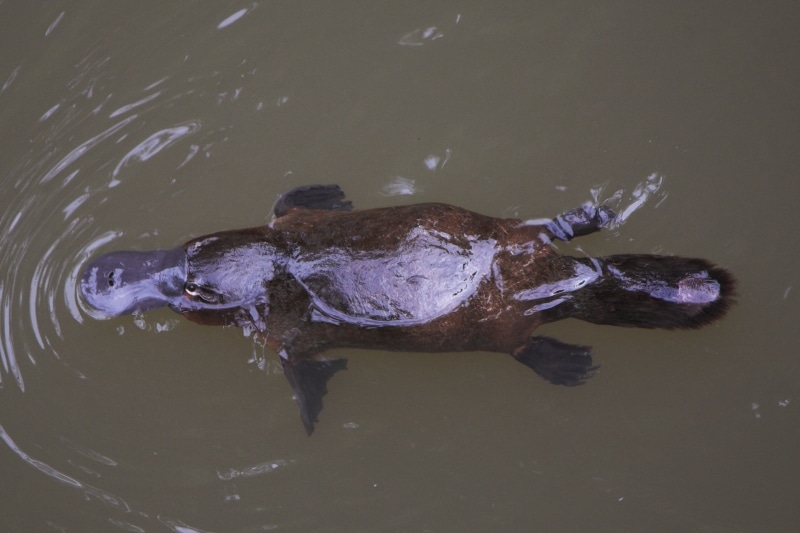
Geographic Location: The Platypus is native to eastern Australia, including Tasmania.
Unique Adaptation: The Platypus is one of the few mammals that can detect electrical signals through electrolocation. This adaptation allows it to locate prey underwater, where visibility is limited. Additionally, male platypuses have a venomous spur on their hind legs, used in combat with other males during the breeding season.
Scientific Insights: The electroreception system of the platypus is located in its bill, which is packed with thousands of specialized receptors. This sensory adaptation is unique among mammals and provides valuable insights into the evolutionary development of sensory systems in vertebrates. The venom of the platypus, though not lethal to humans, contains a variety of compounds that have potential medical applications, including pain relief.
#4. Axolotl - Regeneration of Limbs
This is a picture of Ambystoma mexicanum (Axolotl) Credit: Ruben Undheim from Trondheim, Norway
Geographic Location:Axolotls are native to the lake complex of Xochimilco and lake Chalco near Mexico City, though they are now critically endangered in the wild.
Unique Adaptation: Axolotls have the extraordinary ability to regenerate not just limbs but also other parts of their bodies, including their spinal cord, heart, and parts of their brain. This capability far exceeds that of most other vertebrates, making them a subject of extensive scientific research.
Scientific Insights: The mechanisms behind axolotl regeneration involve the reactivation of cells at the injury site to a more primitive, stem-cell-like state. These cells can then multiply and differentiate into the various cell types needed to rebuild the damaged tissue. Understanding how axolotls achieve this could have profound implications for regenerative medicine, potentially leading to new treatments for human injuries and diseases.
#3. Pangolins - Protective Keratin Scales
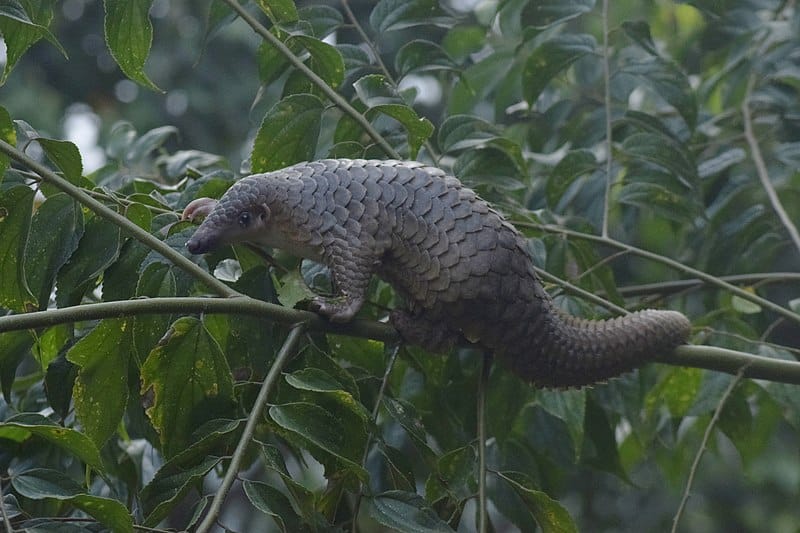
Sunda Pangolin feeding in a branch. Credit: Frendi Apen Irawan
Geographic Location: Pangolins are found in parts of Asia and Africa, with their range extending from India and China to the southern tip of Africa.
Unique Adaptation: Pangolins are the only mammals wholly covered in scales, which are made of keratin, the same material as human hair and nails. These scales act as armor, protecting pangolins from predators. When threatened, a pangolin can roll into a tight ball, with its scales acting as an impenetrable barrier.
Scientific Insights: The structure and composition of pangolin scales have been studied for their incredible durability and potential applications in body armor design. Moreover, the pangolin’s unique method of insect consumption, using a long, sticky tongue to reach into ant and termite nests, offers insights into the evolutionary adaptations for diet specialization.
#2. Mimic Octopus - Ability to Mimic Other Sea Creatures
Thaumoctopus mimicus Credit: Steve Childs
Geographic Location: The Mimic Octopus is found in the shallow waters of the Indo-Pacific, particularly around Indonesia and Malaysia.
Unique Adaptation: The Mimic Octopus possesses the astonishing ability to imitate the physical appearance and behavior of more than 15 different marine species, including sea snakes, lionfish, and flatfish. This form of mimicry is used both to deter predators and to approach prey.
Scientific Insights: The mimic octopus’s ability to change its shape, color, and behavior is a remarkable example of adaptive evolution. This behavior provides insights into the cognitive abilities of cephalopods and the complex interactions between predator and prey in marine ecosystems. Understanding how the mimic octopus controls its muscles and skin to achieve these transformations can inform the development of new materials and technologies in robotics and camouflage.
A microscope image of Tardigrade. Credit: Schokraie E, Warnken U, Hotz-Wagenblatt A, Grohme MA, Hengherr S, et al. (2012)
Geographic Location: Tardigrades are found worldwide, from the deepest oceans to the highest mountains, including extreme environments where few other life forms can survive.
Unique Adaptation: Tardigrades are renowned for their extreme survival abilities. They can withstand temperatures from just above absolute zero to well above the boiling point of water, survive pressures greater than those found in the deepest ocean trenches, radiation levels that would be lethal to most other organisms, and the vacuum of space. Tardigrades enter a state called cryptobiosis, in which their metabolic processes nearly stop, allowing them to survive extreme conditions.
Scientific Insights: The study of tardigrades has provided significant insights into the limits of life on Earth and the potential for life in extraterrestrial environments. Understanding the molecular mechanisms that tardigrades use to withstand extreme conditions could have applications in medicine, such as improving the preservation of cells, tissues, and organs for transplantation.
Dr. Sarita Menon is the founder, and Head of Content at Smore Science. With a PhD in cancer research and over 15 years of experience Dr. Menon has honed her skills as a science communicator focused on making complex and important science engaging and understandable to all. Whether reviewing article ideas, working with writers, or editing pieces herself, Dr. Menon’s guiding vision shapes the informative yet captivating content published across both the website and print magazine.