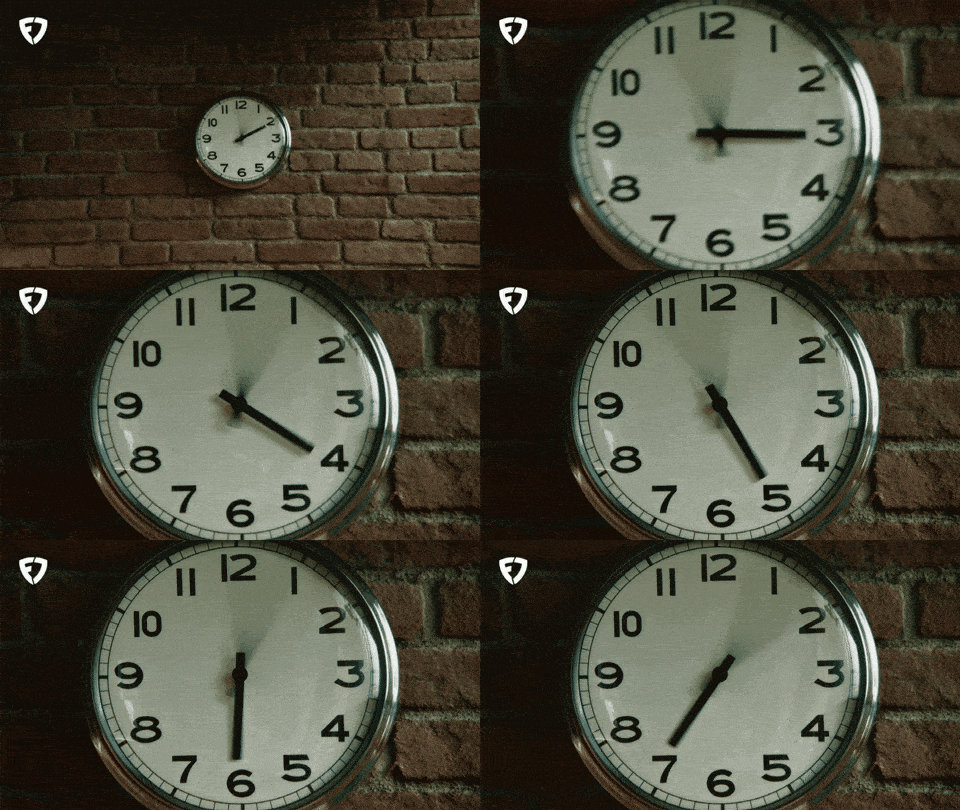
If Einstein’s theory of relativity makes time stretch and compress, Schrödinger’s clock crumples time itself. Just like Schrödinger’s cat, which can be alive and dead simultaneously until observed, his clock can tick faster and slower at the same time. State-of-the-art quantum technology can possibly allow scientists to test this bizarre prediction in the lab for the first time using an immensely precise atomic clock.
The Problem of Time
One of the greatest musings in modern physics is the Theory of Everything— to merge the physics that governs the macro, or general relativity, with the physics that governs the micro, or quantum mechanics. The pivotal discrepancy arises in how the two schools of thought perceive time. In general relativity, time can be warped, or a moment can “seem” to pass faster or slower, but in quantum mechanics, time governs the quantum system. Schrödinger’s clock can point us in the right direction toward unifying these two schools of thought.
Schrödinger’s clock is a hypothetical clock that allows a clock to tick differently at the same time. It is based on the idea of superposition, a “blur” in the certainty. In a very simplistic explanation, it can be thought of as a spinning coin—a normal coin, when tossed, lands either heads or tails. A quantum coin, on the other hand, will remain in a state of heads and tails at the same time, a lot like motion blur, but it is a physical reality rather than a trick of how we see.
However, the moment we try to observe the coin, it must take one form— either heads or tails. In the case of an electron, it’s like a wave that can be everywhere it is physically allowed to be, but when you interact with the electron, it collapses to a defined state.
The Twin Paradox
Let’s come back to Einstein’s theory of relativity and his famous twin paradox. Let’s suppose we have two twins, Scott and Mark. Scott loves a good space adventure, so he darts off to a star on a spaceship traveling nearly at the speed of light, leaving Mark on Earth. After his journey to the star, Scott wastes no time and completes a return trip. However, on returning, he found his twin brother, Mark, had a few extra wrinkles and grey hairs—old age had caught up with him.
Scott thought, “How am I younger?” Well, according to Einstein’s theory of special relativity, time ticks more slowly the faster we travel. The concept is called time dilation, which says that time can stretch or compress, depending on the frame of reference (from which the observer observes a phenomenon).
As for Scott and Mark, it’s not a name I made up in my head. In fact, Scott Kelly, who spent 520 days orbiting Earth on the International Space Station at 17,500 mph relative to his twin, Mark Kelly, who was on Earth, was 5 milliseconds younger than Mark when he came back home.
The Quantum Atomic Clock Twin
We have cruised past the idea of Schrödinger’s clock and Einstein’s twins. Quantum mechanics allows these twins to arise as probabilities of where they could be at a given point in time, not when. Basically, you’re not in two different timelines, but in two different locations that experience time differently. Advanced atomic clocks could reveal quantum effects associated with time, especially when in superposition, using the trapped-ion approach. These ion-based clocks, which are being developed at NIST and Colorado State University, trap single ions such as aluminum or ytterbium and cool them nearly to absolute zero, a temperature at which an ion retains minimal energy and vibrates slightly. Their quantum states can then be manipulated using lasers.
Researchers asked whether a single clock could experience two different ticks of time simultaneously while it exists in a quantum superposition. Quantum theory says yes. Assistant Professor Igor Pikovski of Stevens Institute of Technology proposed the idea more than a decade ago, but the effect was far too subtle to be observed experimentally at the time. Now, he is working with experimental teams led by Christian Sanner at Colorado State University and Dietrich Leibfried at the National Institute of Standards and Technology (NIST) to set up an experiment to test his theory.
Ticking Faster and Slower at Once
When an atomic clock is in two states, it can basically experience time in two different ways. Let’s go back to Scott and make him quantum. What if Scott existed at any point between the International Space Station (ISS) and the Earth, but we weren’t sure where the exact spot is? Einstein’s theory of general relativity says that gravity can warp time; that is, the ticks are slower in higher gravity and vice versa.
Since Scott can be anywhere between these two points (the ISS and the Earth), gravity will make his ticks slower if he is near Earth and faster if he is near the ISS. As quantum Scott is in a state of superposition by virtue, time for him will be an overlap between a faster tick and a slower tick, both existing together.
Elevating the Accuracy
By manipulating the vacuum around the atoms in an ion clock, the researchers aim to create squeezed states, in which position and velocity exhibit unusual correlations. “Atomic clocks are now so sensitive, they can detect tiny differences in time caused by just the thermal vibrations at minuscule temperatures,” says Gabriel Sorci, a PhD candidate at Stevens Institute of Technology and co-author of the paper. “But even at the absolute zero temperature, the ground state, the ticking rate will still be affected by just the quantum fluctuations alone.”
For Pikovski, the possibilities are endless. His previous work focused on detecting single gravitons, hypothetical particles thought to mediate gravity, using quantum tech. And if all of these concepts and thoughts confuse you and are difficult to understand, I think you’re on the right track.
After all, “I think I can safely say that nobody understands quantum mechanics,” is what Richard Feynman said, who was awarded a Nobel Prize for explaining how light and matter interact at subatomic levels— a revolutionary breakthrough in quantum mechanics.
Copyright @smorescience. All rights reserved. Do not copy, cite, publish, or distribute this content without permission.
SUBSCRIBE TO OUR NEWSLETTER
.......... ..........Subscribe to our mailing list to get updates to your email inbox.
Monthly Newsletter