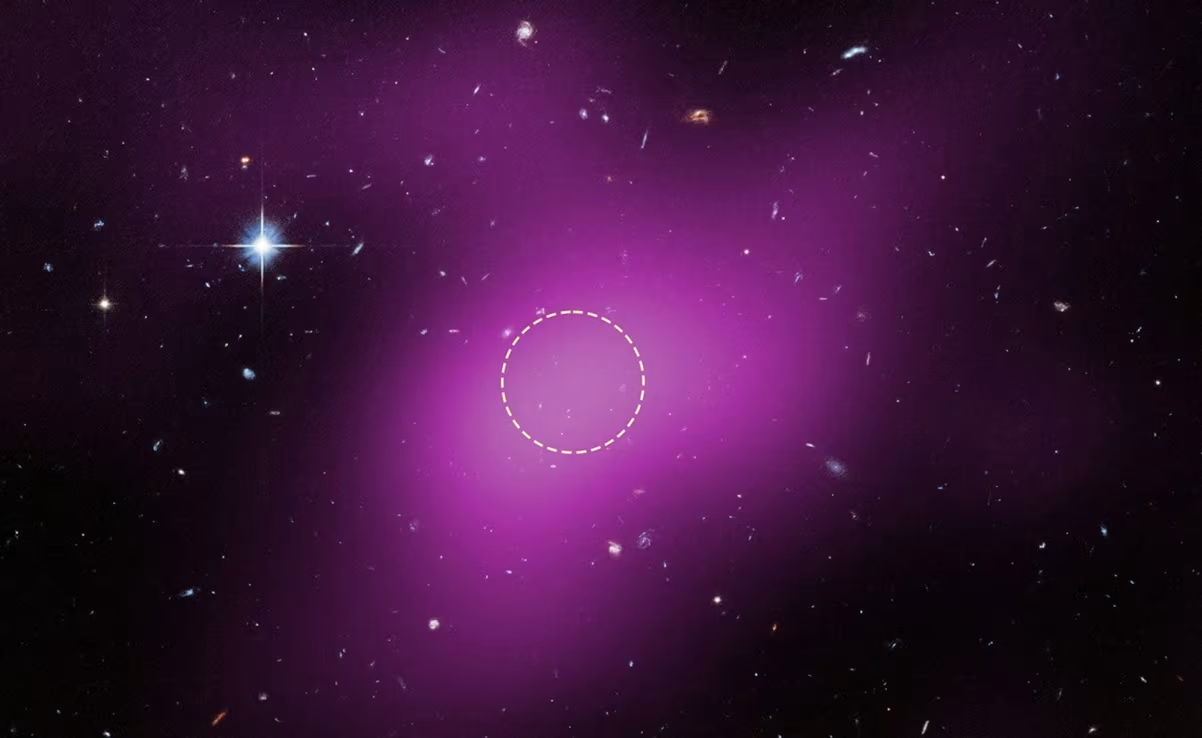
Hundreds of billions of galaxies are scaffolded on a meshwork of dark matter. Yet, as the name suggests, dark matter truly stays in the ‘dark’; it doesn’t interact with light. To date, we have detected only the gravitational effects of dark matter, but this might change with the discovery of a “failed” galaxy by the Hubble Space Telescope—Cloud-9.
Undetected yet omnipresent, dark matter binds the cosmos and provides structure; as much as 85% of the matter in the universe is considered dark matter. According to most theories, dark matter originated from the Big Bang 13.8 billion years ago and forms cosmic clouds that didn’t accumulate sufficient gas to form stars.
According to study coauthor Alejandro Benitez-Llambay, astrophysicist and assistant professor in the physics department at the University of Milano-Bicocca in Milan, Italy, failures often teach more than successes do in science. Cloud-9’s failure to form stars supports the theory, implying that scientists have identified an ancient building block of a galaxy that has yet to form. Future observations of the cloud, along with additional such discoveries, can advance astronomy’s understanding of dark matter, the evolution of galaxies, and the universe in its first moments.
Cloud-9 was mistaken for a faint dwarf galaxy, which is dark and thus difficult to detect. The other hypothesis suggested that this is a small galaxy comprising a few thousand to a few billion stars, compared with the Milky Way, which has hundreds of billions of stars. The Five-hundred-meter Aperture Spherical Telescope, or FAST, in China’s Guizhou province, discovered Cloud-9 three years ago near the Messier 94 galaxy while surveying hydrogen gas near the region. The Green Bank Telescope and the Very Large Array were used for follow-up observations, while findings from the Hubble Space Telescope confirm the absence of stars in Cloud-9.
Galaxies form when the threshold of dark matter required to initiate star formation is exceeded, resulting in star formation from dark clouds. Cloud-9 is an example of an object that is just below this threshold, containing no stars.
This was the ninth gas cloud found in the vicinity of Messier 94. Unlike the usual irregular shape, Cloud-9 is compact and spherical. At its core, neutral hydrogen spans 4,900 light-years, weighing a million times that of the mass of the Sun. Estimates suggest that approximately 5 billion solar masses of dark matter comprise the remainder of the enigmatic cloud.
Study coauthor Dr. Rachel Beaton, an assistant astronomer at the Space Telescope Science Institute, hypothesizes that a massive gravitational field is holding the gas cloud together, with a dark matter halo scaffolding the hydrogen cloud, which alone doesn’t provide enough mass. The cloud just has enough mass to hold onto its gas, but not enough to kickstart star formation. Most halos either lose their gas or go on to form galaxies.
From here, Cloud-9 can get two different outcomes. It can either form a galaxy by accumulating more mass, becoming a late bloomer galaxy, or it might lose mass if it falls closer to the Messier 94 galaxy. The gas will be stripped from the cloud, and it will cease to exist. Future high-resolution observations of the cloud core can reveal the amount of dark matter present at its center.
“We can rule out certain dark matter candidates — a major step to constrain the nature of the dark matter particle itself using astrophysical data,” Beaton said.
Cloud-9 joins a long list of scenarios discussed with respect to ‘dark galaxies’, and although intriguing, the cloud might have ordinary explanations for its oddity. For instance, a hydrogen cloud noted in the study, called FAST J0139+4328, was recently categorized as a very faint galaxy. Dr. Jacco van Loon, an associate professor of astrophysics and director of the Keele Observatory at Keele University in England, contacted the research team to express caution regarding the hypothesis that Cloud-9 is a dark matter cloud.
Cloud-9 is a pivotal discovery in unraveling the mysteries of the universe and, potentially, in detecting difficult-to-detect dark matter. Next, the researchers would further investigate whether Cloud-9 is an anomaly or a pioneering discovery that signals the presence of additional such gas clouds.
Copyright @smorescience. All rights reserved. Do not copy, cite, publish, or distribute this content without permission.
SUBSCRIBE TO OUR NEWSLETTER
.......... ..........Subscribe to our mailing list to get updates to your email inbox.
Monthly Newsletter