A large beehive hanging from a tree is a high-risk, high-reward gift of nature. However, that’s just the tip of the iceberg, as 90% of bee species build their nests in concealed areas such as the interiors of decaying logs and stems and on the ground, and are mostly solitary. And these nests can be rewarding, not because of honey, but because of the diverse knowledge of ecology scientists can gather from them.
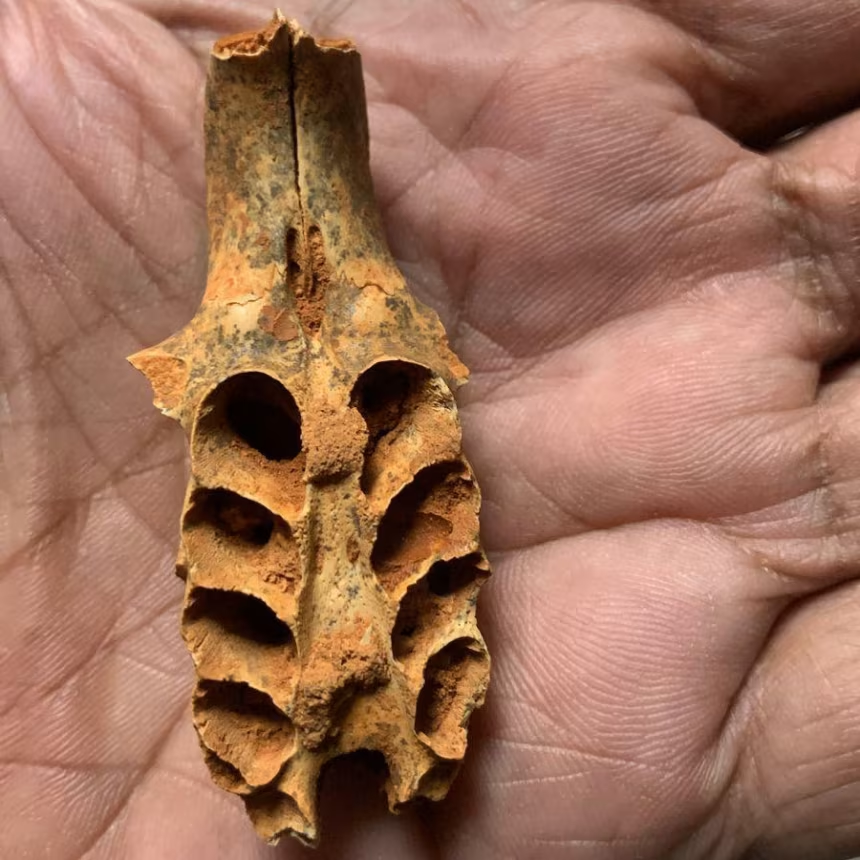
Right now, the buzz is all about ancient bee nests found inside a limestone cave on the Caribbean island of Hispaniola, specifically within fossilized bones of some now-extinct animals— inside empty tooth sockets. This is the first time scientists have recorded bees building nests and laying eggs within them inside bones.
In general, insects and most invertebrates do not dwell in caves, although snails are occasionally found. Most fossils belong to rodents, birds, and other fauna. Finding ancient bee nests in caves marks a very unusual choice of home.
The findings fill a gap in the fossil record, since other bee fossils found in the Caribbean are preserved in amber and are much older, around 20 million years old. These fossils are approximately 1,000 times younger, estimated at 20,000 years old. These fossils can shed light on how the bees adapted to the ancient environment.
“There’s very little known about the ecology of many of the bees on these islands,” lead author Lázaro Viñola-López, a postdoctoral researcher at the Field Museum of Natural History in Chicago, said. “This shows that the diversity of nesting processes of bees is actually really big and sometimes expands past what we think is normal. … It also tells that we have to, when we prepare specimens, look closer for all the things that can get preserved inside these ones, which can show very strange behaviors of species that we think that we understand relatively well.”
Viñola-López was exploring the cave with colleagues in the summer of 2022, in search of specimens to study for his doctoral program at the University of Florida and the Florida Museum of Natural History. The cave itself provides a glimpse into the prehistoric period, rich in fossils of various animals.
The study authors believe that a family of barn owls that lived in these caves coughed up bones of prey that fossilized over time. The cave also has an 8-meter drop at its entrance, which might spell disaster for any unfortunate forager. Species such as tortoises and crocodiles might have fallen into the cave, unable to climb back out and succumbing to starvation.
The fossils Viñola-López discovered had a lining of dirt inside them, particularly within tooth sockets, which reminded him of how a wasp forms its cocoon. Following a series of CT and X-ray scans, the authors produced a detailed 3D image. The nests were more akin to the ones made by bees, mainly made of mud and a waxy substance bees secrete to bind it all. In contrast, wasps use saliva and plant fibers.
Bees generally prefer shady areas for nesting; some are nocturnal; however, caves are not among their natural nesting grounds. Communal nests built by several bee species have also been recorded in a cave.
Although the cave’s conditions preserved the nests, they did not preserve the insect bodies. No data on which bee species built those nests have been found. We also do not know whether these bee species are extinct. The nests have been named after the specimen, Osnidum almontei, in honor of Juan Almonte Milan, the scientist who first discovered the cave, according to the study.
Finding hidden biodiversity is much like finding an untouched treasure trove. Although no insect fossils have been discovered, trace fossils (ichnofossils) are diagnostic of soil bees.
The caves had near-constant humidity, were protected from flooding and rain, and weren’t on the radar of predators, making them a viable environment for the bees. The question remains: Are there such nests in other caves of the Caribbean islands, or was this a one-off discovery?
Modern bees neither nest in caves nor in bones, making this a double discovery. Insects have been evolving for 400 million years, with ground-nesting bees evolving for the past 100 million years.
Boarding bones might be unusual, but evolution buzzes with the bizarre, some even going backwards in the evolutionary timeline. These bees are an example of how nature has evolved ways to balance different ecosystems.
Copyright @smorescience. All rights reserved. Do not copy, cite, publish, or distribute this content without permission.
SUBSCRIBE TO OUR NEWSLETTER
.......... ..........Subscribe to our mailing list to get updates to your email inbox.
Monthly Newsletter