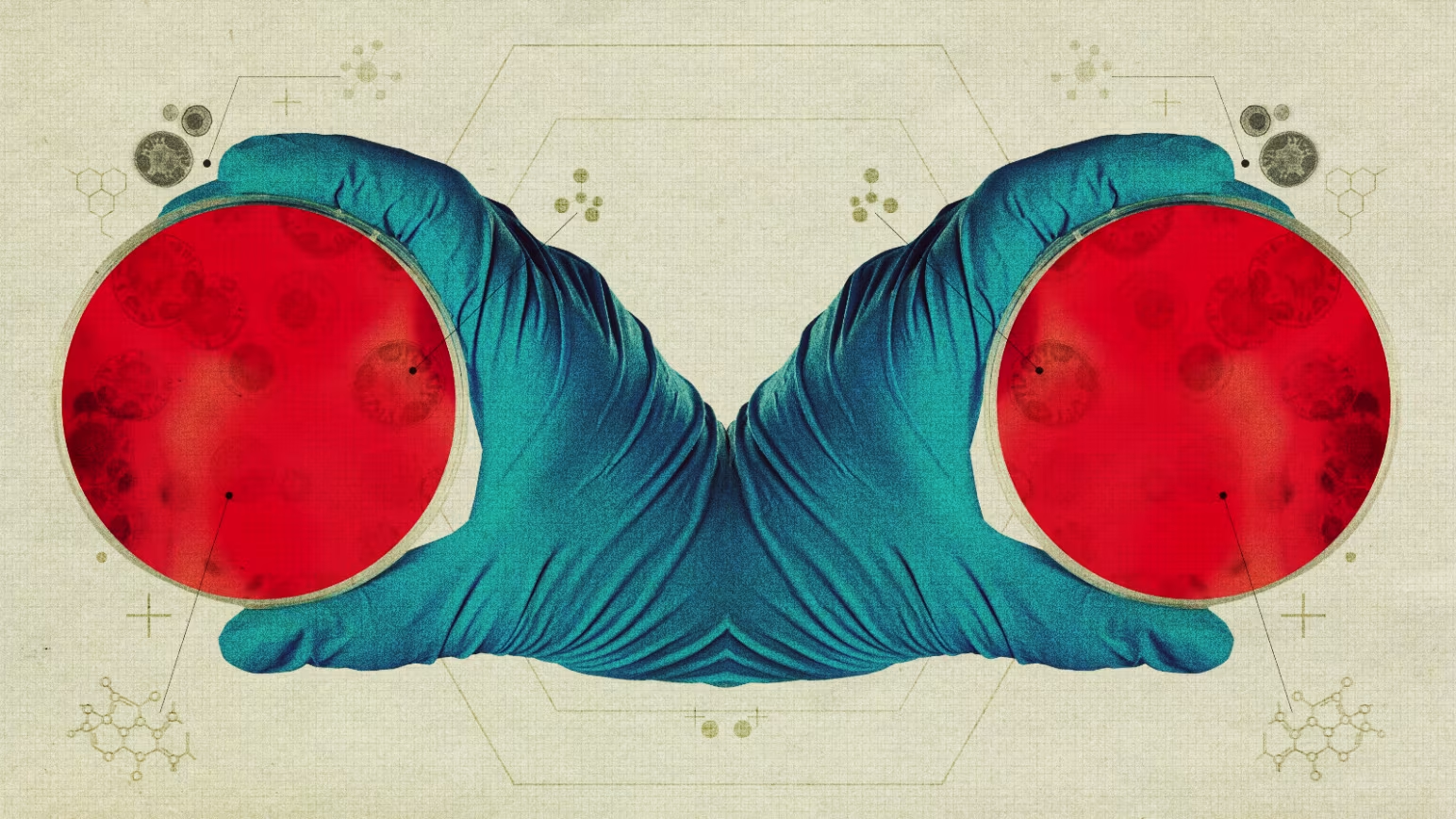
AI getting sentience might be the talk of the town when it comes to bringing an existential crisis, but it has a new contender in the alley. Mirror life, initially seen as a panacea against pathogens, may now become what it sought to fight. Scientist Kate Adamala was one of four scientists who received a $4 million US National Science Foundation Grant in 2019 to explore the possibility of synthesizing a mirror cell, in which the structure of the component biomolecules is the exact opposite of that in normal cells.
Mirror life soon became a double-edged sword. On the one hand, a reverse cell can produce novel, therapeutically active biochemicals and spell doom for infectious diseases and superbugs. However, on the flip side, we could end up with a bacterium that inadvertently spreads through our bodies, leading to dire consequences for the global population.
The biomolecules inside our cells can be aligned in two ways: left-handed or right-handed. For example, the nucleotides (individual units of a DNA or RNA), specifically, the five-carbon sugar in DNA and RNA, are right-handed. The amino acids that make up proteins are left-handed. A left-handed version of a molecule is not superimposable on the right-handed version. This is exactly like a pair of gloves: A right-handed glove won’t fit the left hand, and vice versa. Even in enzymes, the site where the substrate binds has a preference for a specific “handedness”. Interactions between molecules are highly dependent on this “handedness”, or in scientific terms, chirality. Living systems need a consistent pattern of chirality to function correctly.
To synthesize a mirror cell with its constituent molecules having reversed chirality is a feat that’s not going to bear fruit in the near future. Designing a synthetic cell that mimics its natural counterparts, even with natural chirality, has not been possible. However, with emerging technologies, scientists are producing the required biomolecules from non-living precursors, and this might be the key to producing synthetic cells.
Adamala’s research ventures haven’t made significant progress due to COVID-19. Complete mirror cells are out of reach; however, small molecules with reversed chirality have been produced and are regularly used for therapeutic purposes. Then came the informal discussion and conferences, which began to sow alarm.
Adamola was stunned to hear that mirror cells might become undetectable to the human immune system, which relies heavily on recognizing molecules of the correct chirality. Over the course of 2023 and 2024, Adamola and fellow scientists compiled different conversations into a report and subsequently published an abridged article about the same, titled “Confronting Risks of Mirror Life”. The report said that producing mirror cells could become possible within this decade or over the next three. The mirror cells generated can probably become deadly pathogens if they spread into the biosphere.
A non-profit organization called Mirror Life Dialogues Fund sponsored meetings aimed at developing suggestions to avert the risk posed by mirror life. They also aim to set a boundary on how much the scientific community should investigate mirror biology.
“There is the possibility that, with admittedly a great deal of work, we could create something which could grow inexorably, spread across the planet and displace or kill many, many forms of life, including us, the animals around us, the plants around us, and even some of the microbes,” said David Relman, a professor of microbiology and immunology at Stanford University, who attended a meeting on engineering and safeguarding synthetic life, at the University of Manchester’s Institute of Biotechnology.
Since natural life differs starkly in molecular structure from mirror life, the interaction between natural and mirror life will be unpredictable. The first few generations of mirror bacteria will fizzle out, but if they get access to the proper nutrients, they might survive. Because the immune systems of plants and animals alike might fail to recognize them, they will become invasive species that grow unchecked in the absence of natural predators.
If a mirror bacterium enters our body, it will replicate at an astronomical rate, unchecked. Medical countermeasures such as antibiotics will not act on these pathogens because of the different structures of their biomolecules. However, to fight mirror pathogens, mirror antibiotics can be produced; doing so during a crisis is a monumental task. The other option is to implement state-of-the-art biocontainment processes. However, a single moment of loss of focus, a tiny malfunction in any piece of equipment, can become the driver of a ‘lab leak’.
Relman has investigated cases like that of the anthrax letters and Havana syndrome, a disease with known symptoms but inexplicable causes, and according to him, mirror life is the first plausible entry into the list of an existential threat. However, since the technology has not advanced enough to produce a presentable mirror cell, there is a chance to prevent this possible bio-Armageddon from ever taking place.
However, the scientific community, curious as always, doesn’t want to jeopardise the research that can bring mirror life to fruition. Mirror nucleic acids and proteins are not easily degraded and are more stable, making them an excellent tool for therapeutic purposes. The spectrum of activity is a major hiccup, as the mirror cells might starve to death or become the devourers of all resources, challenging life as it is. With such a vast range —from “no big deal” to a downright global catastrophe —mirrors life needs further theoretical study.
The current aim is to develop living components from non-living precursors, which can help trace the evolutionary cascade that led to the development of life as it exists in the real world. Along the way, we might come across novel mirror molecules that can be useful in industry, the medical field, and the environment. Scientists are optimistic about building the first synthetic normal cell in around a year or so, and the same method might be viable for building a mirror cell.
The step where scientists must draw the line before designing mirror ribosomes, which in theory can give rise to mirror proteins. Since proteins are a big part of cell composition, from performing roles in enzymatic systems to signalling pathways, a mirror ribosome can bring a whole new arsenal of unknown proteins. However, this step isn’t enough to construct a mirror cell, but drawing the line when we are assembling the cell, and adding a cell membrane, is basically the ring of a death bell.
There is a silver lining though. Adamola has stopped accepting grants for this research, and has instead focused on discussions surrounding the horrors that might accompany mirror life. Researchers, policymakers, and funders came together to suspend research into mirror life until and unless a future research can prove that such research won’t pose significant threats. Scientific ambitions have grown by leaps and bounds, and, assisted by AI, we have a sense of the information and a catalogue of websites with the required information. This will only make us the victims of our own curiosity. The decision to open this Pandora’s box of biology is solely on us, and the repercussions that life on Earth might face are ours to blame.