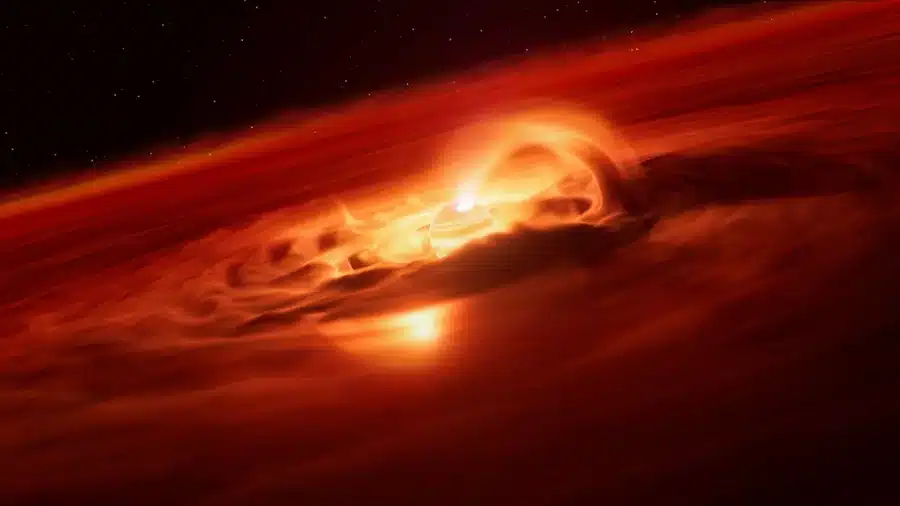
There are planets that just orbit stars; then there is this one, which aspires to become a star. Cha 1107-7626 is a rogue planet (a planet that is not orbiting any star) around 1-2 million years old, and is going through a growth spurt. The planet is still in its infancy (for comparison, most planets in the Solar System are 4.5 billion years old). It is 5-10 times heavier than Jupiter. The planet lies in the Chamaeleon constellation, which is located at a distance of 620 light-years from Earth.
If there were a speed-eating competition hosted in space for different planets, this planet would top the charts. The planet is surrounded by a disk of gas and dust, which constantly sheds debris onto the planet due to the gravitational pull of Cha 1107-7626.
Observations through the European Southern Observatory’s Very Large Telescope in Chile’s Atacama Desert and inputs from the James Webb Telescope have shown that the planet is gobbling up dust and gas at an immense speed of 6.6 billion tons (6 billion metric tons) per second, which has shattered previous records held by other planets. This planet wasn’t always this voracious; rather, it was eight times slower in engulfing dust and gas a few months prior.
Scientists discovered this hungry planet in 2008. Since then, astronomers have kept tabs on the growth and the environmental changes on and around the planet. In 2024, researchers observed Cha 1107-7626 using the James Webb Telescope, gaining a better view of the surrounding gas and dust disk. Following this, the team analyzed the different wavelengths of light, ranging from UV to near-infrared, using the X-shooter spectrograph on the Very Large Telescope. The scientists were left astounded by the burst of growth observed during the period between June and August, which was far higher than the steady accretion rate (the rate at which materials get deposited on a planet) observed before. They were awestruck by the fact that this burst of growth, which scientists had thought to be short-lived, went on a full-blown cascade of growth.
The Webb telescope also recorded notable changes in the chemical composition of the disk. During the growth spurt, it detected the presence of water vapor in this distant, faint celestial object. The chemistry of disks has been observed to change around stars; however, this is the first instance of such changes observed in a planet. The scientists believe that the strong magnetic field of the planet is the driving force behind the constant falling of gas and dust on the planet’s surface. This is usually noticed in stars, but this new study proves that objects with much smaller mass than stars can also possess strong magnetic field that can enhance the growth of a celestial body.
The origin of rogue planets remains a mystery. Scientists speculate that rogue planets might begin as a normal one, before gravitational effects of other celestial bodies send it offcourse. The other hypothesis states that rogue planets arise from the fragmentation of molecular clouds (vast stretches of cold gas spread across light-years), which is the usual process in the formation of stars. Cha 1107-7626 is believed to have followed the latter method.
“We’re struck by quite how much the infancy of free-floating planetary-mass objects resembles that of stars like the Sun,” Jayawardhana said in a statement. “Our new findings underscore that similarity, and imply that some objects comparable to giant planets form the way stars do, from contracting clouds of gas and dust accompanied by disks of their own, and they go through growth episodes just like newborn stars.”
After digging into the archives, the scientists notices that this planet went through a growth spurt in 2016, suggesting that these bursts of growth are intermittent. Scientists are now trying to gather information on the duration of the growth spurts. Seeing this kind of growth in an isolated rogue planet is quite surprising, and the rich chemical disk surrounding the planet has been observed in quite good detail, which makes this research initiative even more productive. According to Dr. Jacco van Loon, an associate professor of astrophysics and director of the Keele Observatory at Keele University in England, the moons surrounding the planet, if any present, can spark curiosity among scientists, since it might be formed from the same planet that this behemothic rogue planet boasts of. He draws the example of Saturn’s moon Titan, which has an atmosphere and weather, which might be suitable for the presence of life.
Rogue planets are hard to detect as they are faint and dim. But new telescopes, like the Vera C. Rubin Observatory, the upcoming Extremely Large Telescope, or ELT, in Chile and the Nancy Grace Roman Space Telescope can become vital in our lookout for planets of this nature. The ELT can become instrumental in detecting neighbors and close companions of rogue planets to decipher how the growth spurts are influenced by these objects. Vera C. Rubin Observatory will scour the skies and detect a whole population of young, planetary-mass objects and track high accretion rates, giving statistical data to the scientists for studying how often these growth outbursts take place.