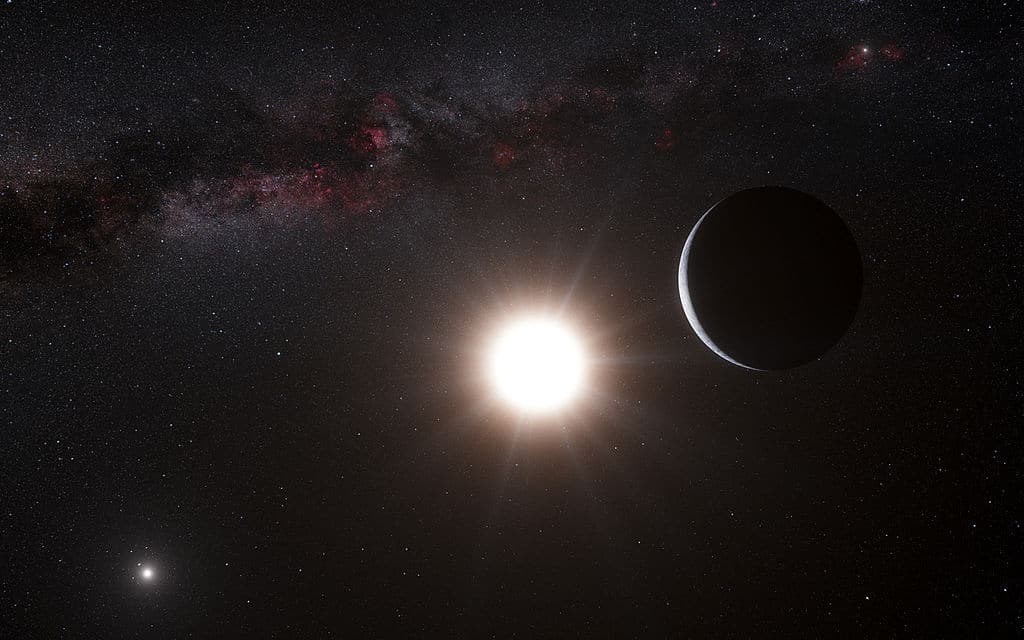
A streak of light observed through the James Webb Space Telescope near the star Alpha Centauri A could be the planet with the orbit of narrowest margin ever to be imaged directly.
Scientists have recorded the presence of a planet in the habitable zone— the ‘just right’ region where life can thrive. Astronomers have been looking at a smudgy planet that has been orbiting in this spot of the star Alpha Centauri A, which is just four light-years away. It is also the brightest star amongst the three strewn together. This planet could be orbiting around its host star at a proximity that breaks records, at least for a planet captured through direct imaging.
Most exoplanets are discovered from indirect clues. For example, astronomers unveiled three other planets in the Alpha Centauri system by observing how one of the stars wobbles due to the gravitational pull of the planet orbiting it. In this case, however, scientists have noted the planet through direct imaging.
Researchers had the first visual clue of a planet revolving around the star in 2021, using a ground-based observatory. Now, Aniket Sanghi, an astronomer at the California Institute of Technology in Pasadena, and his colleagues have used the James Webb Space Telescope’s (JWST) Mid-Infrared Instrument (MIRI) to pinpoint the planet that orbits Alpha Centauri A in a habitable zone.
When a planet revolves close to its host star, it becomes difficult to observe due to the star’s glare. It also makes it challenging to observe planets in habitable zones, an area distant enough from the star to have water in liquid form on a planet’s surface. However, because the Alpha Centauri system is so close to Earth, scientists were able to use JWST to capture high-resolution images just good enough to pick out the planet. The team still had to use MIRI’s ‘coronograph’ mode to filter out some of the glare.
According to Sanghi, he was in complete awe and had to have a moment of silence to appreciate what he was seeing. The team reanalyzed the data again and again over a year to confirm that the faint planet wasn’t just distorted starlight. The blotch of light remained throughout. According to Jason Wang, an astronomer at Northwestern University in Evanston, Illinois, the results need to undergo further scrutiny and be more detailed to confirm that the smudge is actually a planet.
Sanghi says his team wants to double-check the detection by conducting more observations with JWST. If the findings hold true, this would be the first ever planet to be imaged in its star’s habitable zone.
Copyright @smorescience. All rights reserved. Do not copy, cite, publish, or distribute this content without permission.
SUBSCRIBE TO OUR NEWSLETTER
.......... ..........Subscribe to our mailing list to get updates to your email inbox.
Monthly Newsletter