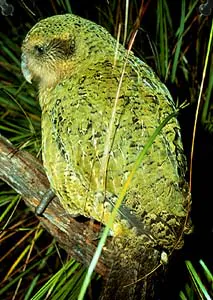
The population of parasites that were once present in the ancient poo of New Zealand’s endangered bird kākāpō has dwindled by 80%. The bird, however, is still hanging on. The researchers noticed a drastic decline in the parasite population after analyzing bird droppings dating back 1,500 years. This uncovered a cascade of co-extinctions that occurred long before recent conservation efforts began. These losses are hidden from our sight, and they suggest that as we fight to save this amazing species, we may be quietly removing whole communities of organisms that play vital, yet misunderstood, ecological roles.
Researchers from the University of Adelaide, New Zealand’s Manaaki Whenua-Landcare Research, and the University of Auckland have discovered that more than 80% of parasites found in kākāpō poo prior to the 1990s are no longer present in modern populations.
Sample feces dating back more than 1500 years have been tested through microscopic techniques and ancient DNA technology. Nine of 16 original parasite taxa went extinct prior to the 1990s. At this time, this endangered parrot came under full-population management and then an additional four were lost since then. According to the University of Adelaide’s Dr Jamie Wood, who contributed to the study published, parasites might seem bad for the ecology. Still, in reality, they are appreciated for their ecological importance. Parasites are one of the most successful and species-rich organisms. Parasites are present in almost all free-living animals. These parasites help in generating an immune response and compete against more harmful parasites.
The dependence of the parasite on only one host has its drawbacks. It makes them susceptible to extinction. Extinction of a parasite occurs in tandem with its host, a process known as co-extinction. The process of co-extinction takes place faster than that of the host animal.
According to Dr. Wood, “As a result, faunal declines may have a lasting impact on parasite communities, even if host populations eventually recover.”
Dependent species like parasites are rarely documented because they are seldom preserved or documented before extinction. This means that there is hardly any data about the co-extinction process. According to this new research, parasite extinctions might be far more numerous than previously documented.
The amount of parasite loss in kākāpō was greater than what the researchers had expected. Very few parasite species were found in both ancient and modern kākāpō populations. Fractions of their original parasite communities might be present in the endangered species of kākāpō everywhere.
According to Dr. Wood, due attention must be given to dependent species such as parasites. As global rates of climate change, ecosystem modification, and biodiversity decline continue to rise, there is a crucial need to gain insights into the downstream impacts on dependent species, such as parasites, mutualists, or predators.
Copyright @smorescience. All rights reserved. Do not copy, cite, publish, or distribute this content without permission.
SUBSCRIBE TO OUR NEWSLETTER
.......... ..........Subscribe to our mailing list to get updates to your email inbox.
Monthly Newsletter