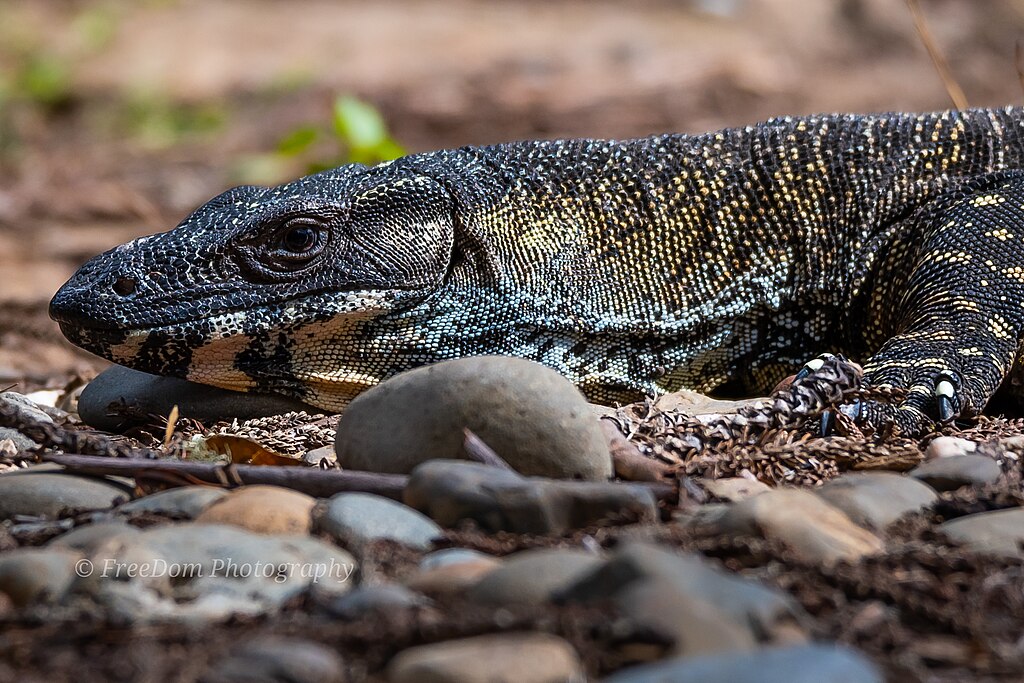
Underneath the scaly skin of Australia’s iconic monitor lizards known as goannas, scientists have discovered a hidden layer of bony skin structure called osteoderm. Scientists have found bony armor beneath the skin of 29 species of goannas, a finding that challenges our understanding of evolution in lizards. Using museum specimens and state-of-the-art scanning techniques, researchers found that this bony armor is far more widespread than previously thought. This suggests that the structure is not only helpful in offering physical protection, but also aids in surviving the harsh environment. This discovery radically alters our understanding of lizard adaptation, ancient evolution, and the untapped potential of museum collections.
The findings, published on July 21 in the prestigious Zoological Journal of the Linnean Society, are the first global large-scale study of osteoderms in lizards and snakes. In this international collaboration, scientists from Australia, Europe, and the United States have employed highly advanced micro-CT scanning techniques to examine nearly 2,000 reptile specimens from museums worldwide.
According to Roy Ebel, lead author and researcher at the Museums Victoria Research Institute and the Australian National University, the discovery of osteoderms in 29 Australo-Papuan monitor lizard species is surprising. There has been a fivefold increase in cases involving goannas.
Osteoderms are most commonly known from crocodiles and armadillos. These were also found in some dinosaurs, such as Stegosaurus. However, the function of osteoderms has remained a mystery. While they probably provide protection, scientists now think that they may also support heat regulation, calcium storage during reproduction, and mobility.
This new research has unveiled that osteoderms are far more prominent in lizards than previously thought. According to this study, osteoderm is present in nearly half of all lizard species worldwide—an 85% increase from earlier estimates.
The discovery is heavily indebted to museum collections. Scientific institutions, such as Museums Victoria Research Institute, play a vital role in preserving biodiversity throughout history, enabling scientists to study species long after their collection. Some of these specimens are decades old, some are even over a century old. Advances in imaging technology helped scientists unravel new insights without physically affecting the fragile specimens. These collections are active tools for scientific study.
“What’s so exciting about this finding is that it reshapes what we thought we knew about reptile evolution,” said Dr Jane Melville, Museums Victoria Research Institute Senior Curator of Terrestrial Vertebrates. “It suggests that these skin bones may have evolved in response to environmental pressures as lizards adapted to Australia’s challenging landscapes.”
As of now, the presence of osteoderms in monitor lizards was thought to be rare and mostly confined to the enormous Komodo dragon. But the discovery of their widespread presence across Australo-Papuan goannas opens new avenues into how these lizards adapted, diversified, and survived across Australasia.
This study is a landmark, as it not only tells a new chapter in the story of Australia’s goannas but also provides an essential and new dataset for exploring how skin, structure, and survival have evolved over millions of years.
Copyright @smorescience. All rights reserved. Do not copy, cite, publish, or distribute this content without permission.
SUBSCRIBE TO OUR NEWSLETTER
.......... ..........Subscribe to our mailing list to get updates to your email inbox.
Monthly Newsletter