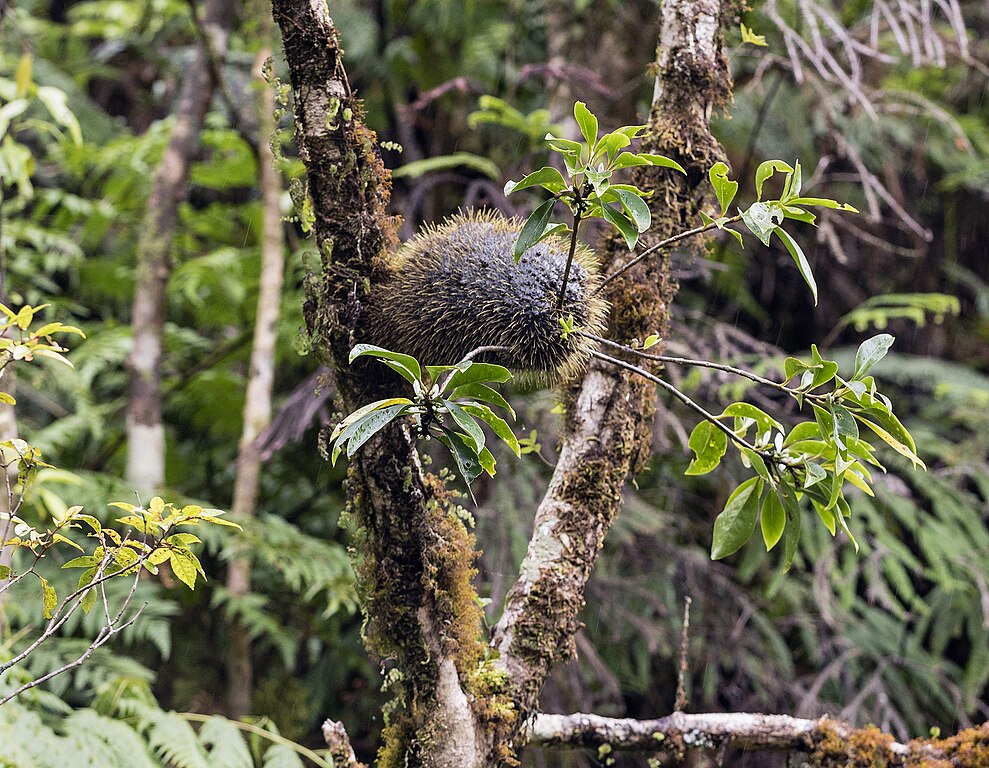
High in Fiji’s rainforest, the ant plant Squamellaria grows swollen tubers containing sealed, single-door compartments. Rival ant species live and nest in these apartments, fertilizing their host with nutrient-rich waste while never coming face-to-face. Once researchers sliced open the walls, fatal battles erupted between the ant colonies. This proves that the compartmentalized chambers prevent wars and help maintain partnerships. CT scans of the tubers revealed intricate, isolated mazes, showing evolution’s clever trick to keep multiple, unrelated houseguests peacefully productive.
Weird plants from a remote Pacific island shed new light on a crucial ecological question: how unrelated partners that initially show animosity can form long-term, mutually beneficial relationships. Scientists studying ant plants in Fiji have discovered a way these plants use to maintain peace among their residents. The plant provides isolated, separate chambers within a gradually enlarging tuber—each chamber has an entry hole from the outside, but no connection to any adjacent chamber. Squamellaria plant prevents wars between the multiple ant species that feed on it and call it home.
According to Guillaume Chomicki, of Durham, the first author of the study, the plant hasn’t evolved in this way for the benefit of the ants, but for its own benefit. With more ants living inside the tuber, there will be more nutrients for the plant. The researchers conclude that compartmentalized chambers are one way of keeping peace.
According to Susane S. Renner, a biologist in Arts & Sciences at WashU, senior author of the study, dried Squamellaria tubers— and many other tubers sitting in herbaria or natural history collections since at least the 1880s— never produced the insights Guillaume was able to gain in the field. One needs two things: Seeing and identifying the ants, and then uncovering that the tubers have entirely separate and isolated compartments with separate entrances to the outside, much like a condo building. The importance of the isolated compartments becomes more prominent when the ant colonies start to fight, when the partitions are removed.
In biology, a symbiotic relationship, also known as symbiosis, is a close and long-term interaction between two different species. Mutually beneficial relationships are called mutualism. Many symbioses involve one host species interacting with several mutualist partners. Yet theory predicts that unrelated partners can come face-to-face in serious conflicts through competition for host resources.
In the case of Squamellaria, researchers had previously reported on how certain ants are specialized in actively farming Squamellaria— by planting its seeds and providing nutrients to the seedlings with their feces— and then nesting in the domatia (hollow chambers) that form on each plant shortly after the unfolding of its cotyledons. Squamellaria begins to germinate only after the ants insert a seed into a crevice in the bark.
The plant’s survival depends on the farming activity, as it is an epiphyte that grows on the branches of rainforest trees and has no other way to gain some ground in the rainforest canopy. During a field excursion high in the treetops of Waisali Rainforest Reserve in 2014, Chomicki pulled down a Squamellaria and unearthed an even more perplexing set of interactions.
“When I dissected this plant (Squamellaria wilkinsonii), which had a domatium that was about 8 inches in diameter, I was very surprised to see two ant colonies living inside it,” he said. “My immediate thought was parabiosis, a specific type of symbiotic association where two species of ants nest together. But the nests were completely separate, which was puzzling.”
That observation gave new insights that led to his new study with Renner. Together, they conducted a series of experiments aimed at examining how the plant enables more than one species of ants to live inside its hollow chambers, starting by recording what happens when the interior walls are broken down. The researchers removed the partition walls with dissecting knives, placing different ant colonies in direct contact. This led to immediate conflict between the ant colonies.
The scientists counted the number of conflicts between ant workers of the relevant ant colonies during a 25-minute window after the removal of the partition walls. They recorded high worker mortality in both ant colonies that were previously living in isolated compartments.
The new research included feeding experiments. Observations revealed that the plants were receiving nutritional benefits from the multiple ant species and colonies inhabiting their compartments. Building 3D models developed from CT scans led to the discovery of which chambers are connected and which are isolated. The results reveal a mechanism that reduces conflicts and allows the hosts to take advantage of multiple, unrelated symbionts.
Copyright @smorescience. All rights reserved. Do not copy, cite, publish, or distribute this content without permission.
SUBSCRIBE TO OUR NEWSLETTER
.......... ..........Subscribe to our mailing list to get updates to your email inbox.
Monthly Newsletter