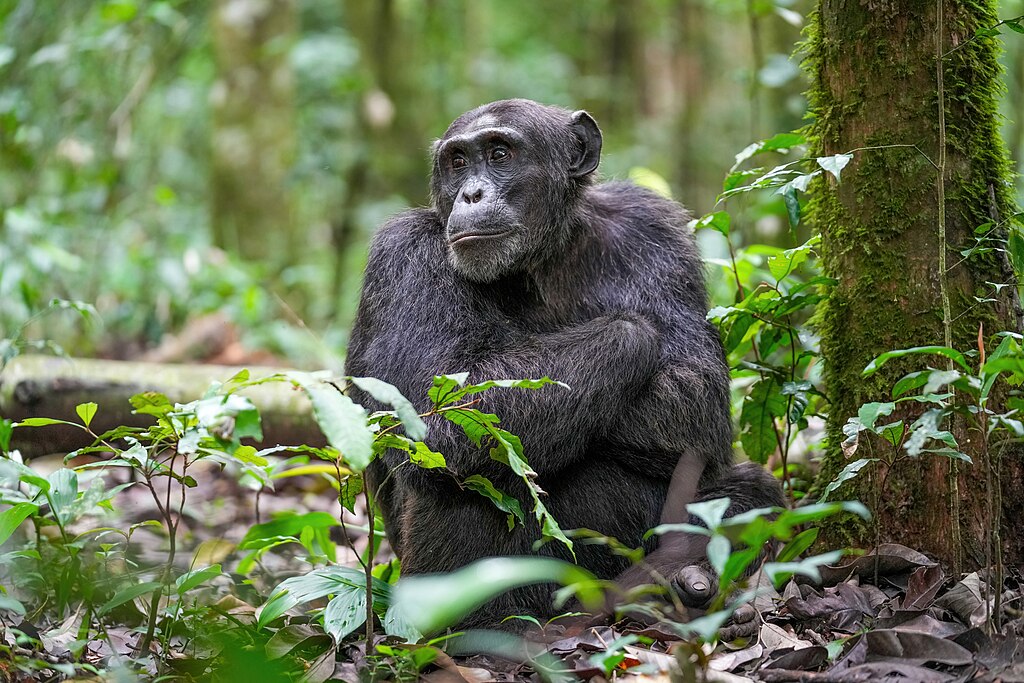
Chimpanzees living in an African sanctuary have developed a “fashion trend” for dangling blades of grass from their ear holes and behind, a new study shows.
In 2010, researchers working at the Chimfunshi Wildlife Orphanage Trust chimpanzee sanctuary in Zambia observed a female chimpanzee beginning to dangle objects from her ear, and other members of her group soon adopted the behavior. There was no evidence of the chimpanzees dealing with pain or itching, as they used blades of grass or sticks, and they remained very relaxed during this activity. The behavior is more of a social trend.
What interests researchers is the fact that chimpanzees in a different group at the sanctuary started showing the same behavior more than a decade later, with some also inserting objects into their rectums. This group lived around nine miles from the first group; they couldn’t have copied it from them. This suggests that the caregivers of these chimpanzees may have influenced them.
As it turns out, the staff in one area of the reserve had developed a habit of cleaning their ears with twigs and matchsticks, while those on the other side didn’t. The behavior was picked up by the chimpanzees from their caregivers before passing on the behavior to other members of their group.
The caregivers then influenced the behavior of the second group, whom they had been looking after years later. This group also developed a habit of inserting blades of grass and sticks into their rectums. This is a trend that went viral through social learning.
Study lead author Ed van Leeuwen, an assistant professor of behavioural biology at Utrecht University in the Netherlands, also cited the example of a group of chimpanzees in a zoo in the Netherlands. In this case, a female chimpanzee started walking as if she were carrying a baby, even though she wasn’t. Soon, all of the females had adopted this walking style. Moreover, when two new females were brought into the group, the chimpanzee that adopted this walking style was integrated swiftly, while the one that refused to walk in the group took longer to be accepted.
According to Van Leeuwen, these behaviors are a part of fitting in and smoothing social relations. The grass behavior was mostly recorded at leisure time, when the chimpanzees gathered to groom and play. The chimpanzees living in the sanctuary don’t have to worry about predators or competition with other groups, indicating that they have more leisure time to hang out than their wild counterparts. Nonetheless, wild chimpanzees may also be capable of developing social trends, but these have not yet been recorded.
Van Leewen’s next plan is to study whether chimpanzees can repeatedly develop new foraging techniques, observing whether they can establish cumulative culture in a manner similar to humans.
According to Elodie Freymann, a postdoctoral affiliate at the University of Oxford’s Primate Models for Behavioural Evolution Lab, these kinds of recordings are crucial to advancing our understanding of the origins and transmission patterns of cultural behaviors in chimpanzees and other non-human animals.
“This study’s finding that there may have been interspecies copying between chimps and their human caretakers is pretty mind blowing,” she said.
“If chimps can copy humans, could they be learning from and copying other non-human species as well? It’s an exciting moment in primatology,” Freymann added.
Copyright @smorescience. All rights reserved. Do not copy, cite, publish, or distribute this content without permission.
SUBSCRIBE TO OUR NEWSLETTER
.......... ..........Subscribe to our mailing list to get updates to your email inbox.
Monthly Newsletter